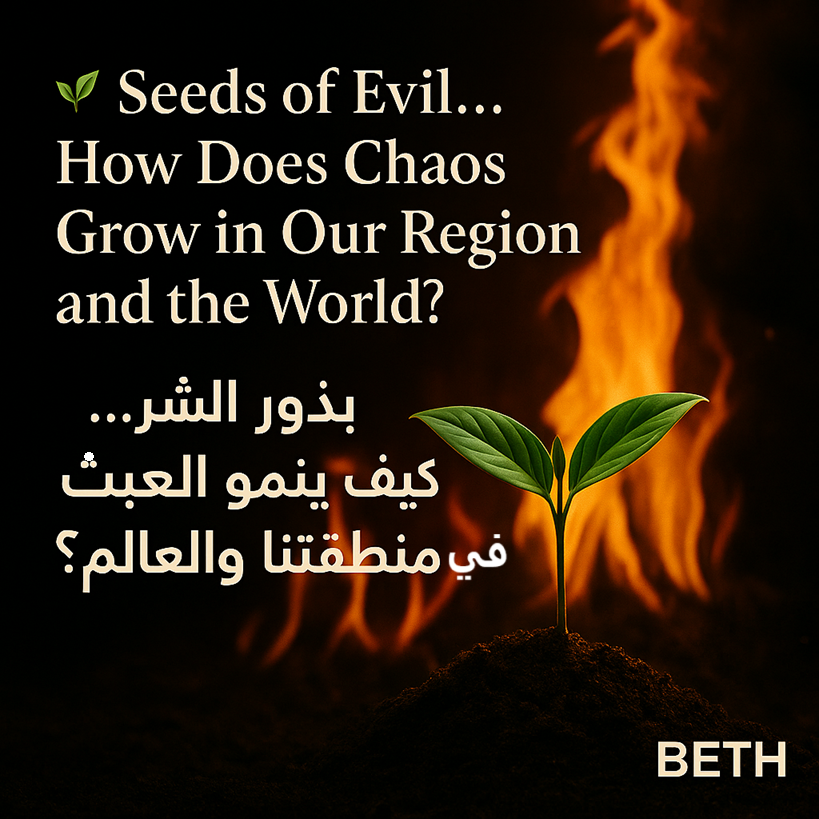
Seeds of Evil… How Does Chaos Grow in Our Region and the World?
International, Jul 29.2025 at Macca 11:44
Prepared and analyzed by: Strategic Media Department – BETH Agency
🌍 Introduction: The Seeds No One Sees
In the Middle East and around the world, disasters never begin overnight. Militias do not fall from the sky, nor do extremist groups explode into existence in a single day. Everything starts with small seeds—initially appearing harmless or even “reformist”—that grow underground until they become a poisonous tree shaking regional and global security.
The question few dare to ask: How is chaos planted? And why does the world ignore the first seed until it grows too large to uproot?
🔹 How Does Chaos Begin? From Seed to Explosion
Disruptive groups often begin under noble slogans: serving religion, social reform, or defending the oppressed. This guise shields them from suspicion at first, making them socially acceptable and sometimes even quietly tolerated by security agencies.
But these groups do not operate in a vacuum. Someone plants them, feeds them with money, ideology, and weapons, until they grow unchecked. By the time the threat is realized, they have already become a force parallel to the state or a transnational entity.
⚠️ Why Are These Seeds Underestimated at First?
A common historical mistake in many countries is to treat emerging groups as short-term tools or bargaining chips.
They are allowed to operate under the cover of “charity” or “community work.”
Authorities assume they can be contained and will not cross red lines.
But over time, this “asset” becomes a fire that consumes everyone.
The Muslim Brotherhood is the classic example:
They began as a religious reform movement.
From their ranks came the ideologies of al-Qaeda, ISIS, and others.
Today, they are the historical incubator for most extremist groups in the region.
🇪🇬 Egypt… A Lesson Still Not Fully Learned
Decades ago, Egypt was a fertile ground where the Brotherhood emerged and expanded. But Egypt is not alone. Any politically and economically strained environment, with a naturally devout society, becomes fertile soil for the first seed.
Some Arab security services—including Egypt’s—initially dealt with the Brotherhood or Hamas as tools of leverage or bargaining chips. But the result was always the same:
The group spun out of control.
The price was paid later by the security of the state and the region.
This is not an indictment as much as it is a warning against repeating the same mistake.
🇮🇷 Iran… Strategic Investment in Chaos
While many states neglected these small seeds, Iran mastered the art of investing in disruptive groups:
It nurtured Hezbollah until it became more powerful than the Lebanese state itself.
It created the Houthis as a lever to threaten Arabian Peninsula security.
It weaponized Hamas and other factions as bargaining chips in every negotiation.
Iran understood that every security vacuum in the region is an opportunity for expansion.
🔍 Are There “New Seeds”?
Today, there are signs of other currents being quietly exploited—such as Sufi-inspired movements or youth-oriented spiritual groups.
They are funded materially and amplified in the media.
Their leaders are presented as “moderate voices.”
But history shows that wolves often begin in sheep’s clothing.
❓ Questions That Must Be Asked
Why are security agencies repeatedly “surprised” when a small group they once tolerated grows into a monster?
Why is the danger underestimated at the early stage when the warning signs are clear?
How long will Arab security strategies remain reactive rather than proactive?
🛑 BETH Conclusion: The Smart Warning
History is unforgiving. Every seed underestimated today can grow into a force that threatens the world tomorrow.
True security is not catching wolves after they start to howl, but recognizing them while they are still in sheep’s clothing.
Arab security services must shift from “investing in groups” to proactively uprooting the seeds early.
If the current complacency and delay continue, the future may bring a new wave of chaos more dangerous than anything seen before.
In the end, the message is clear: Either kill the seed in the hand that planted it, or entire nations will be devoured by its fruit.
❓ Final Questions… and BETH’s Answers
1) How does a “harmless seed” turn into a monster? What is its connection to incubation, shadow operatives, and proxy wars?
The transformation process: It starts as a benign social/religious project → selective recruitment of moldable individuals → engineering a narrative that redefines “purpose” and “enemy” → conditional funding that enforces radical paths → ideological weaponization first (legitimacy), then material weaponization (cells/weapons).
Incubation: Creating a low-cost, high-return safe haven (charities, alternative education, closed discussion groups) that builds loyalty networks beyond the state.
Shadow operatives: Unseen intermediaries (financiers, ideologues, recruiters) “operate” the seed by feeding information, opening smuggling routes, and providing legal/media cover.
Proxy warfare: Once matured, the “seed” is deployed as an external pressure tool—low cost for the sponsor, high impact on adversaries, with plausible deniability.
BETH’s takeaway: The seed does not “mutate” by chance; it is cultivated through a chain of disruption: symbolic legitimization → loyalty networks → conditional funding → operational activation.
2) Who plans from above, and how do they relate to those planting and moving on the ground?
Strategic layer (top): States, agencies, and transnational interest networks that define objectives, maps, and resources.
Operational layer (middle): Civil, partisan, media, and charitable fronts translating objectives into recruitment, funding, and messaging.
Execution layer (ground): Cells, junior leaders, and new recruits turning narrative into action.
The relationship: General orders from above + tactical flexibility below = plausible deniability, with the ability to switch proxies quickly. Weak point: The “intermediary node” where funds and messages flow. Disrupting this node breaks the chain without igniting mass public backlash.
3) How do we expose the strategy of shadow operatives and proxy wars locally and globally?
Early indicators:
Sudden resource inflation in a “non-political” entity (donations, equipment, premises).
Gradual shift in language—from community service to cloaked grievance/nihilistic/takfiri narratives.
Cross-city/border networking unexplained by declared objectives.
Pre-emptive legal/media campaigns defending specific operatives before exposure.
Network analysis: Mapping the “hubs” linking financiers to educational/charitable fronts and digital propaganda clusters.
Deniability test: The more the “sponsor” denies amid measurable resource flows, the higher the likelihood of a proxy war.
Separate the layers: Targeting the intermediary layer (funding and legitimization fronts) reduces political cost compared to direct confrontation with grassroots bases.
BETH’s rule: Don’t fight the ghost in the dark—illuminate money flows, narratives, and movement corridors; you’ll see the operator before the operative.
4) Has the world begun to understand? Or is the puppet master simply too ingenious to detect?
Understanding is advancing… slowly: There is relative awakening after the disasters of the past decade (Europe/region), but it remains fragmented and clouded by electoral calculations and economic alliances.
Why does the “mastermind” seem ingenious? Because it operates by distribution and denial: multiple arms, quick proxy swaps, and narrative recycling (humanitarian/identity/grievance) tailored to the moment.
Where is the blind spot? In the confusion between the genuinely devout and the politically embedded, and between grassroots civic activity and operational fronts.
The trajectory: The world gains clarity when it measures the threat by network and financial data, not slogans. At that point, the mask falls.
BETH’s judgment: Understanding exists but is incomplete; it will only be complete when states shift from reaction to managing the cycle of chaos before it matures.
🛡️ Concise Operational Recommendations (for the final annex)
Prevention, not reaction: Monitor the “legitimization phase” before weaponization.
Choke the intermediaries: Strict oversight on cross-border funding and high-risk charitable/educational fronts.
Narrative engagement: Expose engineered ideological framing early through public discourse targeting the narrative, not individuals.
Security-civil fusion: Joint assessment cells (security/judiciary/education/media) to detect early indicators and close gaps.
Smart accountability: Target the “nodes,” not the grassroots, to avoid expanding support bases.
🧩 BETH’s Final Sentence
“Security is not a fight with the monster after it’s fully grown… but recognizing the moment when water stops being water, and starts nourishing a seed of evil.”
Seeds of Evil… How Does Chaos Grow in Our Region and the World? (BETH Summary)
In the Middle East and around the world, extremist groups do not emerge overnight. It always begins with a small seed that seems harmless or even reformist, yet grows underground into a force that threatens local and global security.
These seeds do not grow on their own. They are planted and nurtured with money, ideology, and symbolic legitimacy until they take root and evolve into cross-border militias. The tragedy is that many states ignore the threat at its early stage, or use these groups as short-term leverage, only to lose control later and bear the consequences.
The examples are many: the Muslim Brotherhood, which gave rise to the ideologies of al-Qaeda and ISIS; movements like Hamas, the Houthis, and Hezbollah that evolved from “resistance” or social groups into regional armed proxies. This pattern is no coincidence—it is part of a deliberate strategy of proxy warfare that weaponizes local groups for global agendas.
The danger today is that new seeds are appearing under different masks: spiritual currents or civic movements that seem moderate but are quietly exploited to build loyalty networks for future use.
The key question: has the world begun to understand? The answer: understanding is improving, but incomplete. Confusion still exists between genuine civic activity and operational fronts, and many security services in the region remain locked in delayed reactions, leaving space for powerful operators to exploit the vacuum.
Conclusion:
Real security starts by identifying the seed before it grows.
Disrupt the “intermediaries” that connect funding to ideology before weapons reach the ground.
Stop using groups as short-term political tools, because the fire you light today may consume you tomorrow.
BETH warns: Unless this equation changes, we will witness new waves of chaos that could be even more dangerous than what came before.
❓ Who is Responsible… and Who Benefits?
Who is behind distorting Islam and the image of Arabs and fueling hatred among nations? Is it the West or the East? Israel or Iran? Or the Arabs themselves? Or other parties pulling the strings from afar?
We might think the answer is obvious, but the truth is far more complex.
🕵️ The security principle in criminology:
When a mysterious organized crime occurs, look for who benefits.
But there is one exception:
That humanity is innately drawn to chaos and evil,
And that there are those who simply enjoy the act of chaos itself… without clear political goals or economic interests.
This possibility… is unlikely, but not impossible. For when humanity allows the seeds of evil to go unchallenged, chaos itself becomes the ultimate goal.