


How Does the IMF Read Economies?
When the IMF Speaks
Why Do Investors Trust the IMF?
Does the IMF See What We Don’t?
Prepared and Analyzed by | Strategic Media Department – BETH Agency | B
When the International Monetary Fund (IMF) releases a report on a country, investors do not treat it as just another economic news story.
Governments do not view it as an academic opinion.
Markets do not regard it as a simple forecast.
Instead, it is widely seen as one of the most influential assessments in the global economic landscape.
That is why the real question is not:
What did the IMF say?
But rather:
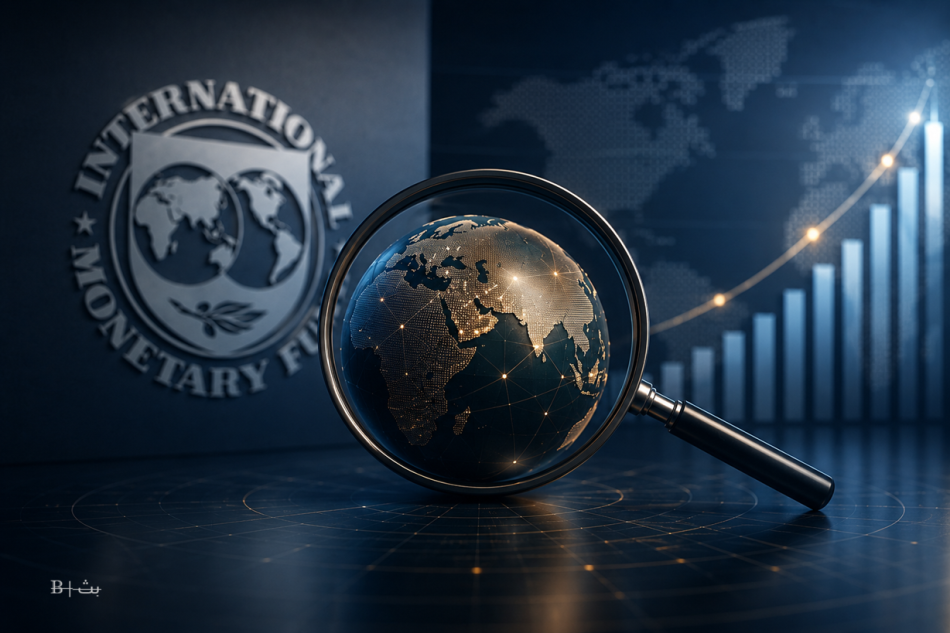
How does the IMF read economies in the first place?
The IMF does not operate like a media organization.
It does not build its assessments on public impressions.
Nor does it rely on daily political statements.
Instead, it depends on specialized teams that continuously monitor economies and review thousands of data points and indicators before issuing any evaluation.
For this reason, IMF reports are not based on a single event, but on a comprehensive economic picture.
What Does the IMF Monitor?
When evaluating a country's economy, the IMF does not look only at GDP growth.
It monitors a broad range of indicators, including:
- Economic growth rates.
- Inflation.
- Government debt.
- Financial reserves.
- Banking sector conditions.
- Labor market performance.
- Current account balances.
- Domestic and foreign investment.
- The effectiveness of fiscal and monetary policies.
- The economy’s ability to withstand shocks.
In other words, the IMF does not ask only:
How fast is the economy growing?
It also asks:
Can that growth be sustained?
Why Do Investors Care?
Because major investors are not searching only for profits.
They are searching for stability.
Investment, by its nature, dislikes surprises.
That is why global investors, banks, and major investment funds closely follow IMF reports. They provide a relatively independent assessment of an economy’s strength and future risks.
A single report may not determine a multi-billion-dollar investment decision.
But it often becomes part of the broader picture on which major decisions are based.
Does the IMF See What We Don’t?
The answer is:
Sometimes yes.
Sometimes no.
The IMF possesses extensive analytical tools, vast databases, and decades of experience monitoring economies around the world.
However, that does not make it infallible.
Economic history contains many examples where the IMF was overly optimistic.
And others where it was overly pessimistic.
Moreover, political, technological, and geopolitical developments can move faster than any institution’s ability to predict them with complete accuracy.
Its reports, therefore, are not prophecies.
They are assessments based on the best information available at the time they are prepared.
Why Was Its Assessment of Saudi Arabia Important?
Because it did not come during a period of global economic calm.
It came amid:
- Regional tensions.
- Disruptions to international shipping routes.
- Pressure on supply chains.
- Uncertainty across several global markets.
Yet the IMF focused on multiple strengths within the Saudi economy, including:
- Economic growth.
- Strong non-oil activity.
- A resilient banking sector.
- Ample reserves.
- The strong financial position of the Public Investment Fund.
- Continued economic reforms.
This matters because the IMF was not speaking only about oil.
It was speaking about an economy’s ability to operate, adapt, and remain resilient in a complex environment.
Modern Economies Are Not Measured by Oil Alone
For many years, some observers viewed the Saudi economy primarily through the lens of oil prices.
Today, international institutions evaluate a much broader picture.
Questions now include:
- How large is the non-oil economy?
- How is the labor market evolving?
- How capable is the private sector of growing?
- How are public finances managed?
- How well can the economy absorb shocks?
These indicators will shape the future of economies far more than oil-price cycles alone.
Beyond the Report
The headline says:
The IMF Praises the Saudi Economy.
(Read the full report on BETH.)
But the more important question is:
Why did it say that now?
Economies are not tested during periods of comfort.
They are tested during periods of pressure.
That is why the significance of the report does not lie in the praise itself.
Rather, it lies in the fact that the praise was issued during a period of regional and international uncertainty, giving it greater weight among markets, investors, and international institutions.
Conclusion
The importance of IMF reports does not stem from their ability to predict the future with perfect accuracy.
Nor from being free of error.
Their value lies in revealing how the world views an economy at a particular moment in time.
That is why the most important question is not:
What did the IMF say?
But:
What did it see in the economy that led it to say it?
In the end, markets do not seek the loudest economies.
They seek the economies most capable of growth, adaptation, and resilience when challenges intensify.
BETH (B Press) – All rights reserved