



New York… Toward a Palestinian State
BETH Coverage & Analysis | From Symbolic Consensus to an Endorsed Document
New York – BETH | July 28–29, 2025
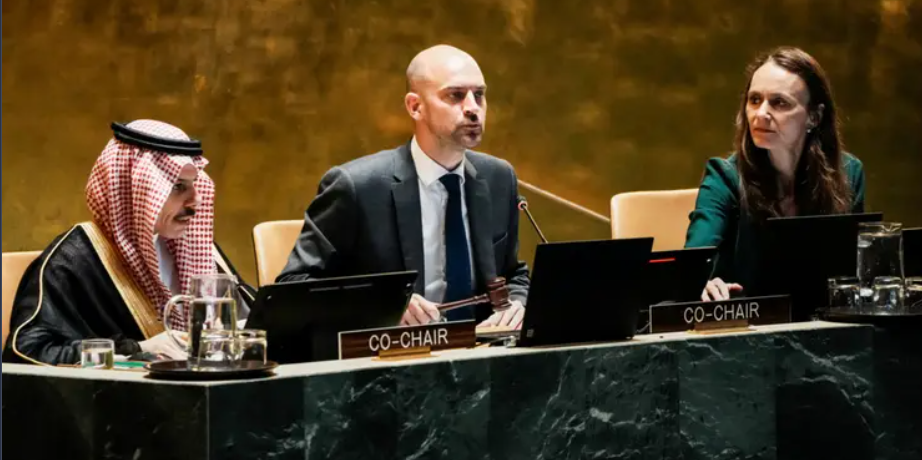
For two days, the United Nations General Assembly Hall witnessed a significant shift in the course of the Palestinian cause through the High-Level International Conference on the Peaceful Settlement of the Palestinian Issue, jointly convened by Saudi Arabia and France. The conference was marked by the absence of the United States and Israel, and the presence of over 55 nations representing diverse international blocs.
🗓️ Day One | July 28, 2025
The Launch: From Vision to Moral Coalition
The conference opened with addresses from Saudi Foreign Minister Prince Faisal bin Farhan, French Foreign Minister Stéphane Séjourné, UN Secretary-General António Guterres, and Palestinian Prime Minister Mohammad Mustafa.
Prince Faisal declared, “The two-state solution is not dead—on the contrary, the world is now reviving it.”
Guterres stressed, “The time for mere condemnations is over; the time for action has come.”
France reiterated its commitment to coordinated international recognition of the Palestinian state and confirmed its intent to take formal action in the UN General Assembly this September.
The Palestinian side presented a comprehensive political and institutional vision for a future state, calling for immediate recognition.
Working groups were formed focusing on five key pillars: Recognition – Security – Governance – Reform – Gaza, and began drafting an implementation framework.
🗓️ Day Two | July 29, 2025
From Negotiations to the New York Document
Day two witnessed marked progress in deliberations, with strong engagement from European, Asian, and African nations.
Saudi Foreign Minister Prince Faisal bin Farhan formally announced the adoption of a concluding document, described as “a unified international consensus,” which called for:
Practical recognition of the Palestinian state based on 1967 borders.
Implementation of the two-state solution along a defined timeline.
A UN-Arab joint mechanism for the reconstruction of Gaza.
Support for Palestinian institutional reform and governance.
Several countries, including Belgium, Luxembourg, Ireland, Canada, and Iceland, declared their intention to move toward formal recognition of Palestine.
The United Kingdom conditioned recognition on a “comprehensive peace plan with security guarantees,” while Germany remained non-committal.
International media hailed the event as “the first major conference to bring Palestine back to the global table in a new diplomatic format—without an American or Israeli veto.”
🔮 BETH Analysis | A Rare Moment to Reshape the Equation
🇸🇦 A Defining Saudi Role
Saudi Arabia's leadership of the conference was not merely logistical—it was political and strategic.
Presenting the final document before the world marked a clear shift from symbolic diplomacy to coordinated international action.
🇮🇱 Israel: Strategic Isolation or Stubborn Denial?
Israel’s absence allowed participants to draft a unified stance without obstruction.
Attempts to impose “facts on the ground” appear increasingly hollow in the face of a collectively endorsed document.
Tel Aviv’s greatest fear may no longer be recognition—but legal international pressure rooted in consensus.
🇺🇸 The United States: The Absence That Will Cost
Washington’s absence from a conference led by Paris and Riyadh creates a notable diplomatic vacuum.
If global recognition of Palestine proceeds, it may mark the first international breakthrough without U.S. authorship or endorsement.
📄 Key Provisions of the New York Document (2025)
Saudi Arabia, through Foreign Minister Prince Faisal bin Farhan, announced the official adoption of the conference’s final declaration. The document outlines an unprecedented international consensus and includes the following core principles:
A firm commitment to the two-state solution, grounded in international law and UN resolutions, as the sole pathway to a just and comprehensive settlement of the Palestinian issue.
An urgent call for immediate and phased recognition of the State of Palestine, based on the June 4, 1967 borders, with East Jerusalem as its capital, and encouragement for countries to begin taking tangible steps toward that end.
The launch of an international plan for the reconstruction of Gaza, supervised by a joint UN–Arab mechanism to ensure transparency, rapid implementation, and humanitarian relief.
Support for Palestinian governance reform, with long-term international cooperation to strengthen institutions in the sectors of security, justice, and financial administration.
A complete halt to Israeli settlement activity and the lifting of the blockade on Gaza, seen as essential prerequisites for a viable political environment.
🧭 BETH Conclusion
This conference was not about who showed up—it was about who showed leadership.
Saudi Arabia and France are no longer just convening parties; they are architects of a new global approach to Palestine.
Palestine today is not simply demanding its rights—it is organizing, initiating, and earning recognition.
The road ahead?
September in the UN General Assembly may be the date that history remembers.