

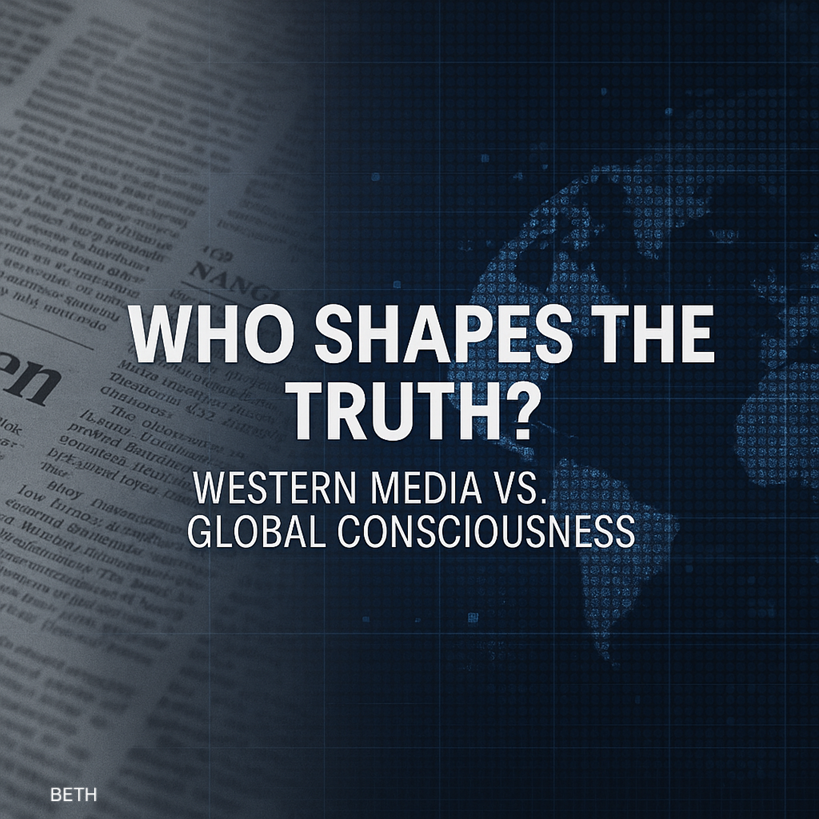
"Who Shapes the Truth? Western Media vs. Global Consciousness"
✍️ BETH Introduction:
In an era overflowing with platforms and fragmented truths, the question is no longer "What is happening?" but rather: "Who is saying what, and why?"
Western media, once seen as the vanguard of global opinion, now stands at the edge of a dual crisis: a crisis of credibility and a crisis of influence.
While institutions like CNN, BBC, and The New York Times were once hailed as "beacons of truth," today’s global audience—East and West alike—has begun turning away from pre-packaged narratives in search of alternative, perhaps more balanced, accounts.
In this report, we explore five interconnected circles:
The decline of persuasive power.
Who draws the map of truth?
The fractured relationship between Washington and reality.
The fall of gravitas before sensationalism.
Europe's tense identity and the media.
We ask: Has media changed, or has the world evolved beyond believing it?
1. Is Western Media Losing Its Power to Convince?
Polls show declining trust year after year. In the U.S., trust in media has hit its lowest since the 1970s.
Why? Not just due to mistakes or biases—but a widespread sense that media no longer serves as a neutral conveyor, but as an arm of authority.
Why is the official narrative no longer applauded? Because audiences now witness what used to be hidden:
Silenced perspectives.
Invisible victims.
Contradictions in the Western narrative—on Palestine, Iraq, Afghanistan.
Has the audience become immune to manipulation? To a large extent, yes. But this immunity sometimes leads not to truth—but to a post-truth chaos.
2. Who Shapes the World’s Truth Map?
For over a century, Western journalism defined global awareness. From the Balkan wars to 9/11, from the Cold War to the Iranian revolution—Western media was the narrator; the rest of the world merely listened.
Today, new maps emerge:
Alternative and independent media.
Social networks beyond censorship.
International outlets outside the Western orbit (e.g., Al Jazeera, CGTN, BETH).
Who controls public opinion today? No clear answer. Multiplicity now reigns. Total control is no longer feasible.
AI: Liberation or Deception? AI has entered the newsroom. It supports investigations… but can also fabricate voices and images. It’s a double-edged tool: In the hands of responsible media—liberating; in the hands of power—dangerous.
3. The Collapse of Trust Between "Washington" and "Reality"
Washington is no longer the truth authority it once was. Its global reporting is now often mocked in many regions:
In Palestine: Massacres are justified as "legitimate responses."
In China: Every internal issue is magnified, every rise demonized.
In Ukraine: Resistance is celebrated—elsewhere, it's criminalized.
Does the U.S. still control the world’s narrative? Partially. But its media power wanes before rising forces:
Diverse news sources.
Growing criticism from American journalists themselves.
An audience increasingly independent in verifying information.
How does Europe react to the U.S. narrative? Publicly: silence or agreement. Privately: unease, recalibration, and fear of being burned by Washington’s impulsive moves.
4. Between Gravitas and Gimmicks: From NYT to TikTok
The media taste has changed. News alone is no longer enough. Images, excitement, impressions—these have become the message.
Yet, the line between reporting and incitement, between analysis and clowning, has worn thin.
Has superficiality triumphed? Temporarily, yes. But it created a vacuum—one that craves a more balanced alternative.
Is a reversal wave coming? Yes, and it has already begun:
Renewed interest in deep analysis.
Rise of independent platforms with quality content.
Audience fatigue from endless noise.
Role of Independent Arab Media? A historic opportunity. To be a voice—not an echo. A mirror—not a megaphone. To speak truth without fear… and without begging for validation.
5. "Tense Europe": Media Between Security and Identity
Issues of immigration, Islamophobia, and the far right are shaking Europe internally.
How does European media handle these topics? With caution… and bias.
Muslims are linked to crime.
Migrants are portrayed as burdens.
Far-right is normalized as mere "reaction."
Does the West address its issues the way it addresses others'? Simply: No. What is labeled extremism in the East is called "free expression" in the West. What is condemned as repression in the South is defended in the North as "preventive measures."
✅ Conclusion:
Western media is no longer the sole light in the darkness. Sometimes… it has become part of the darkness itself.
But the world is no longer without alternatives.
In the midst of this chaos, truth is not only forged in newsrooms— but in alert minds and fearless consciences that say what must be said.
BETH | Special Analytical Report