


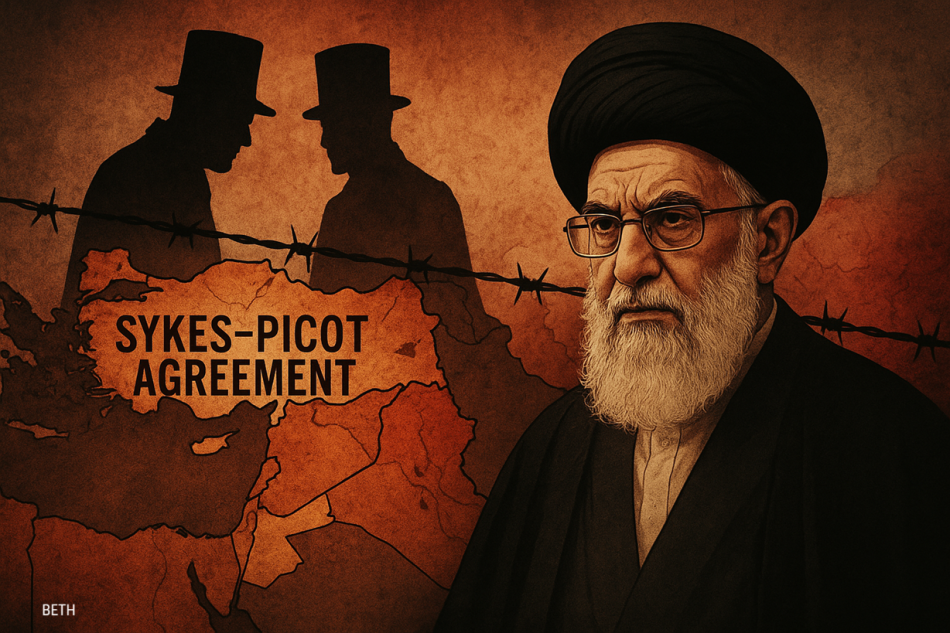
The Mullahs… Sykes-Picot in Religious Robes
🧠 BETH Editorial
In a powerful and unconventional article, Dr. Sami Khater puts his finger on a deep wound in the heart of the Middle East:
The rise of Iran’s clerical regime was not a spontaneous religious awakening nor a purely internal revolution, but rather an extension of old colonial dismantling schemes—revived through new slogans and dressed in piety.
From Sykes-Picot to the U.S. invasion of Iraq, from Paris to Baghdad, from revolutionary rhetoric to “resistance” banners, the article traces the region’s most pivotal turning points—not as grassroots uprisings, but as carefully manipulated transitions shaped by global powers.
This is not merely a critique of Iran’s regime—it is a dissection of the political use of “religious legitimacy” as a tool for dominance, not liberation.
The article deserves to be read not as a direct accusation, but as a deliberate unmasking of a system that infiltrated rather than earned its position, and that rules by slogan, not by justice.
✍️ Here is the full article by Dr. Sami Khater…
Unfiltered, unedited, and unretouched—accompanied by this one reminder:
Awareness is never granted—it must be provoked.
Extension of Sykes-Picot… Iran’s Mullahs as a Project of Subjugation and Chaos in the Middle East
By Dr. Sami Khater | Academic and University Professor
The infamous Sykes-Picot Agreement, which tore the region apart to secure Western interests, is still unfolding—perhaps more brutally than ever. Over the past four decades, the Middle East has entered a new chapter of deep transformation and conflict. This began with the return of Ayatollah Khomeini to Iran, filling the power vacuum left by the Shah and launching a new era under theocratic rule.
That return was far from a domestic affair. It marked the beginning of a sweeping regional project that redrew maps of influence and conflict under the guise of ideology—yet walked hand-in-hand with preordained agendas.
Was the rise of Iran’s clerics spontaneous… or engineered?
The central question now, in the face of growing sectarian chaos and exposed agendas, is:
Will the Mullahs fall at the hands of those who brought them?
Is it possible for those who handed them Iraq, Syria, Lebanon, and Yemen to now undo the machine they built?
Empowerment Was Not a Coincidence
What happened in Iran was not a grassroots Islamic revolution. It began as a genuine national uprising against the Shah's regime—an uprising that threatened Western interests. Faced with this, the U.S. and France had to invent a new framework of control.
Thus, they facilitated the rise of Khomeini and his circle, assuming that Shiite political Islam would be easier to manage—an ideological tool against Soviet influence, and a wedge against rising Arab nationalism.
Then came the 2003 U.S. invasion of Iraq, in which Baghdad was handed to Tehran on a silver platter. Iran’s proxies expanded rapidly—from militias to governments, from sermons to policymaking.
Iran became a silent partner in regional chaos, undermining popular will and derailing major causes—chief among them, the Palestinian issue, which was reduced to a slogan exploited for Tehran’s interests, not the Palestinian people’s rights.
Was Khomeini’s Return Truly Popular?
Khomeini’s return from exile in Paris wasn’t simply a victory for the Iranian people. The Iranian people, with all their factions and voices, had already brought down the Shah.
His return was part of a complex geopolitical arrangement, with France playing a key role, and the U.S. seeking to counter the rise of leftist ideologies. Political Shiism provided an ideal tool to fragment Arab unity and control oil-rich regions under a new, ideologically charged order.
How the West Handed Iraq to Iran
In 2003, the U.S. not only toppled Saddam Hussein—it dismantled the Iraqi state, opening the door to sectarian division. Iran’s agents were ready:
The Iraqi army was dissolved
Officers were purged
State institutions were rebuilt around pro-Iranian figures
A quota-based system made governance chaotic and penetrable
Thus, Iran ruled Iraq by proxy, while the U.S. withdrew, leaving the field open for Tehran’s Revolutionary Guard to govern in disguise.
This wasn’t neglect—it was deliberate.
The Mullahs… Sabotaging the Region’s Greatest Cause
Among the biggest casualties of Iran’s regional project was the Palestinian cause.
Support for groups like Hamas or Islamic Jihad was never part of a liberation agenda—it was a geopolitical card. By embedding the Palestinian cause within Iran’s “resistance” narrative, it lost its pan-Arab essence, became divisive among Palestinians, and was entangled in Iran’s nuclear and regional ambitions.
Who Will Topple the Mullahs?
The most credible answer: the Iranian people themselves.
Iran’s internal crisis is severe—ongoing uprisings, poverty, repression, economic failure, and diplomatic isolation.
Iraqis too are resisting, despite suppression. The Arab public increasingly sees Iran not as a force of resistance—but of imperial ambition wrapped in sanctity.
With masks falling and outrage growing, the regime is internally fractured. It may collapse not by foreign intervention, but by internal implosion.
When the international community recognizes Iran’s legitimate resistance movement—particularly the Ten-Point Plan declared by Maryam Rajavi—and affirms the Iranian people’s right to resist clerical tyranny,
then the fall of the regime will accelerate rapidly.
And the world will see a free, democratic, non-nuclear Iran—one that respects its neighbors, honors human dignity, and abides by international norms.