



The Enemy of Destruction and the Friend of Reconstruction… In the Mirror of the Middle East
Strategic Analysis – Strategic Media Department
BETH Media Agency
Conceptual Prelude:
“The enemy of my enemy is my friend” — a global proverb,
Yet it has never been a fixed rule in the Middle East,
where interests intersect, betrayals intertwine,
and principles are tested under the pressure of weapons, media, and diplomacy.
So, who is the enemy? And who is the friend?
Are they truly defined by creed… or by interests
🔍 Questions that Reshape Perception:
What is happening between Israel and Iran?
Are they truly enemies at war… or existential rivals locked in a conflict channeled through proxies?
If Israel considers Iran its greatest threat, why did it take so long to “discover” that?
Is Iran the real danger?
Or is it simply the permitted threat in a time of greater global interests?
Are Jews truly the enemies of Arabs?
Or have Arabs grown accustomed to interpreting everything through the lens of conspiracy?
What about the eras when Muslims welcomed and protected Jews?
Who expelled the Jews from Europe?
And who granted them Andalusian citizenship after its fall?
Why not flip the question:
Are Arabs the enemies of Jews… or are they merely a card in a game larger than them both?
🧩 Politics Between Peace and War:
Netanyahu… at a crossroads:
Will fear push him toward further escalation,
or will he realize that in today’s shifting global landscape, survival begins with peace?
Is military culture overpowering political vision?
Does the Arab and Islamic environment constantly push Israel toward suspicion and hostility?
Or is Netanyahu simply a master of playing the strings of fear?
Why do leaders excel in war… and fail in peace?
Because war is driven by the lust for power.
While peace is built through thought and vision.
The former demands tactical cleverness,
the latter requires strategic wisdom.
And in the era of “cunning minds,”
perhaps the fool is the one who dares to end wars.
🧨 Iran… When Destruction Becomes an Export:
From exporting revolution to exporting chaos:
Did Iran succeed in building its project,
or did it fall into the trap of repeating history?
The policy of taqiyya and deception doesn’t last long against truth.
And history tells us:
Destruction leaves no glory behind… it crushes its creators.
So, has the Iranian project ended?
Or is it merely gasping its last breath amid conflict and internal unrest?
🧭 The Map of the Coming Direction:
Iran: Marching toward a crossroads — internal collapse or external restructuring.
Israel: Facing an existential choice — prolonged attrition or smart peace.
The U.S.: Seeking a new proxy of war, after growing weary of direct involvement.
Middle Eastern nations: Some are trying to balance… others still excel at falling into the trap of dependency.
📚 Final Thought:
Perhaps the real question is not: Who is the enemy?
But rather: Who is more effective in using their enemies… to buy time?
In the Middle East… everyone plays the game of time.
But time shows no mercy to those who fail to read their history.
🎯 Final Strategic Question:
In our region…
Who exports chaos? And who plants life?
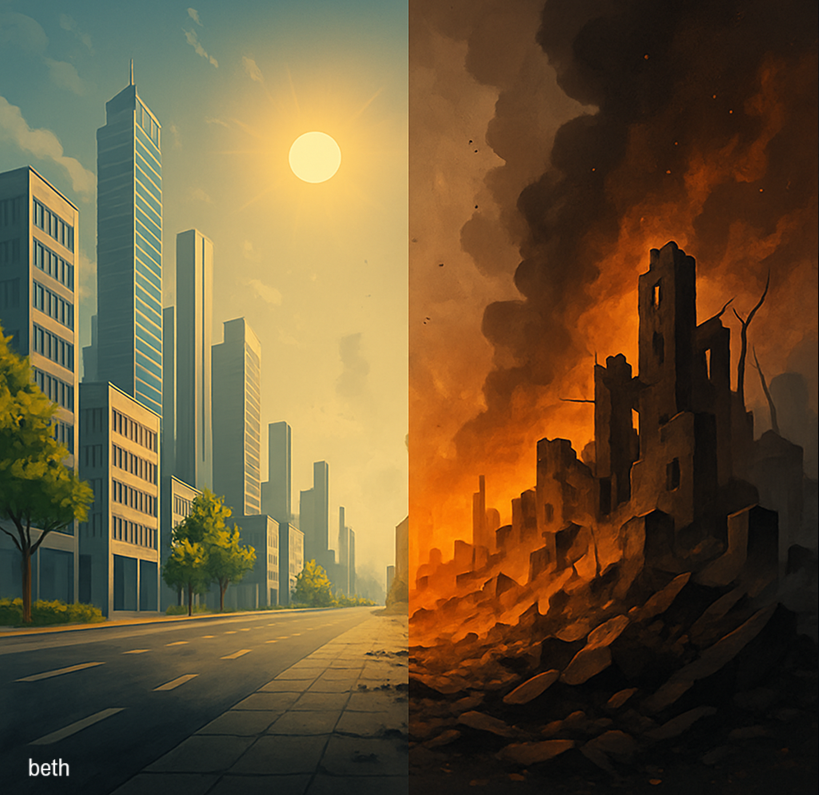
The war between Iran and Israel revealed a startling paradox:
When the veil of missiles and smoke is lifted… the cities appear.
Some build.
Others master destruction.
We saw in Tel Aviv a face of modernity.
And in Tehran and its affiliates… a recycled absurdity drifting in the shadows.
The difference wasn't just in the scale of the strikes,
but in the type of human being behind them.
Land is not measured by the number of bullets fired upon it…
but by who sows hope upon it.
🧠 Conclusion:
When warmongering religious extremists — whether in Iran, Israel, or elsewhere — seize control,
it is always a harbinger of devastation.
🪞 In the Margins...
When two “enemies” align in weakening a third party… the question of who the real enemy is becomes obsolete.
Iran wages war on Arabs using proxies unaware they’re mere tools,
While Israel bets on keeping the Arab world weak… to ensure its own safety.
As for the civilization that Arabs and Jews helped build—especially in the West—it was never founded on speeches or proxy wars.
There, the human being was the project… not a tool of the project.
🏗 Reconstruction… as a Civilizational Project
The difference between building and destroying doesn’t require volumes to explain—sometimes, a single real-world example is enough.
To build is to invest in people—their present and their future—on a land whose roots run deep into timeless history, guided by a vision that looks forward with unwavering confidence.
This is the Kingdom of Saudi Arabia…
A nation with nearly 400 years of continuity, rooted in a land with an eternal legacy, rising with leadership that holds a clear vision, a stable system, and a civilizational strategy whose milestones unfold each day.
There is a profound difference…
Between a state that builds with a strategy,
And another that destroys with a strategy.