



The Missile of the Absent… and Borders Unwatched
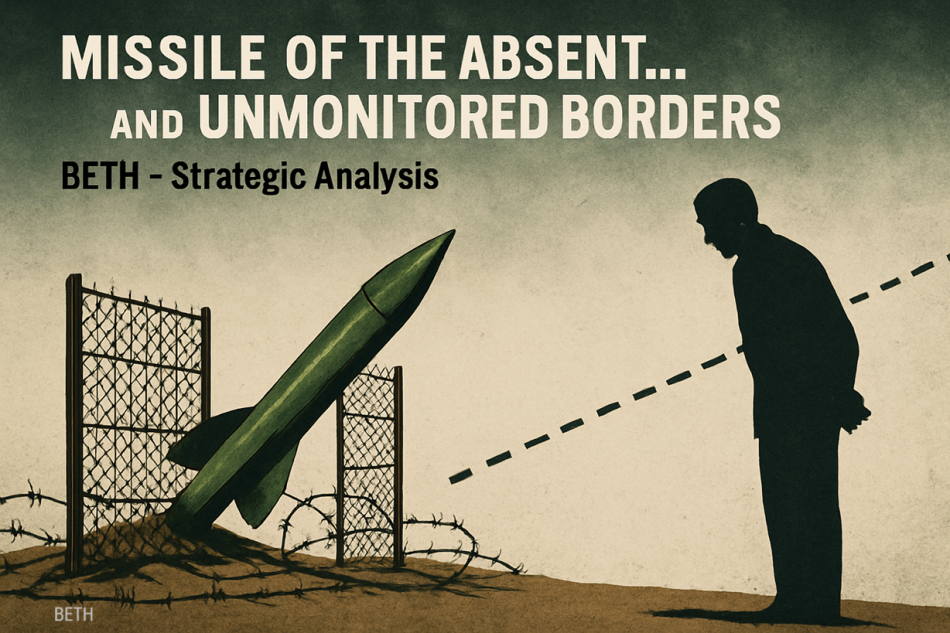
BETH – Strategic Analysis
Amid the noise of missiles and drones, there remains far more that is unsaid than said.
And in the theater of proxy warfare stretching from the ports of Hodeidah to the hills of southern Lebanon, the threads of a precise network unravel—managed from afar—while silent questions strike deeper than the roar of explosions.
🛳 How Do Iran’s Missiles Reach the Houthis?
This is not merely a technical question—it's a key to understanding the complex economy of Iranian arms smuggling, where missiles do not arrive whole but are smuggled as ideas, assembled as components, and launched as messages.
◾ Maritime Route:
The most frequently used path involves weapons disguised as fishing equipment or hidden within commercial vessels, traveling from Bandar Abbas or Qeshm Island through the Arabian Sea, landing on the shores of Hodeidah or secret southern ports.
◾ Border Infiltration:
Despite official denials, the al-Mahra Desert—stretching between Yemen and Oman—remains a potential land corridor for smuggling small, high-precision components, passed through tribal smuggling networks difficult to monitor.
◾ Local Assembly:
More critical than the route is the destination.
Iran’s model doesn’t rely on delivering ready-made missiles but on sending minds and parts:
Microchips
Engines
Guidance systems
Software modules
These are assembled inside Yemen, under the supervision of IRGC and Hezbollah experts in increasingly advanced local workshops.
🎯 Bottom Line:
All Iran needs is:
“An unwatched port… and an obedient mind.”
🎯 Why Has Hezbollah Not Launched a Missile at Israel?
It’s not a sign of weakness…
But rather, a meticulously calculated decision.
🔹 The Silent Deterrent:
Since 2006, Hezbollah hasn’t needed to fight daily—it merely needs to scare daily.
Its presence along the border serves as a missile on standby, continuously poised.
🔹 Orders from Above:
Hezbollah doesn't fire without Iran’s consent.
And Tehran, ever pragmatic in proxy warfare, doesn’t play all its cards at once.
“Lebanon is the reserve card… not to be played unless the original deck burns.”
🔹 Threat Without Activation:
Firing missiles means revealing stockpiles and positions, prompting devastating retaliation.
Whereas the threat of possession offers free deterrence—no cost, high value.
🧠 BETH’s Strategic Vision:
The real war isn’t the one that erupts… but the one managed without ever erupting.
Yemen is drained, Lebanon is threatened, and Iran orchestrates its proxy symphony through the language of silence.
When ports are bombed…
When the southern front is hushed…
And when the seas are open without inspection…
A new equation is carved into the region:
Missiles smuggled without ports…
And silence igniting a war that hasn’t yet begun.❓ An Obvious Question… Yet More Dangerous Than It Seems:
Why are the borders left unmonitored?
Are they merely gaps in sovereignty?
Or are they kept deliberately open when needed… and closed when not?🔹 Is it a weakness among the powerful?
🔹 Or are these routes silently paved for arms dealers under the watch of eyes that "do not see"?
🔹 Or perhaps these borders are left loose for objectives that are never written… yet always executed?🧠 When borders are not monitored, the real question is no longer:
Who crossed?
But rather: Who allowed them to cross?