

The war turns off the camera... but not the wounds
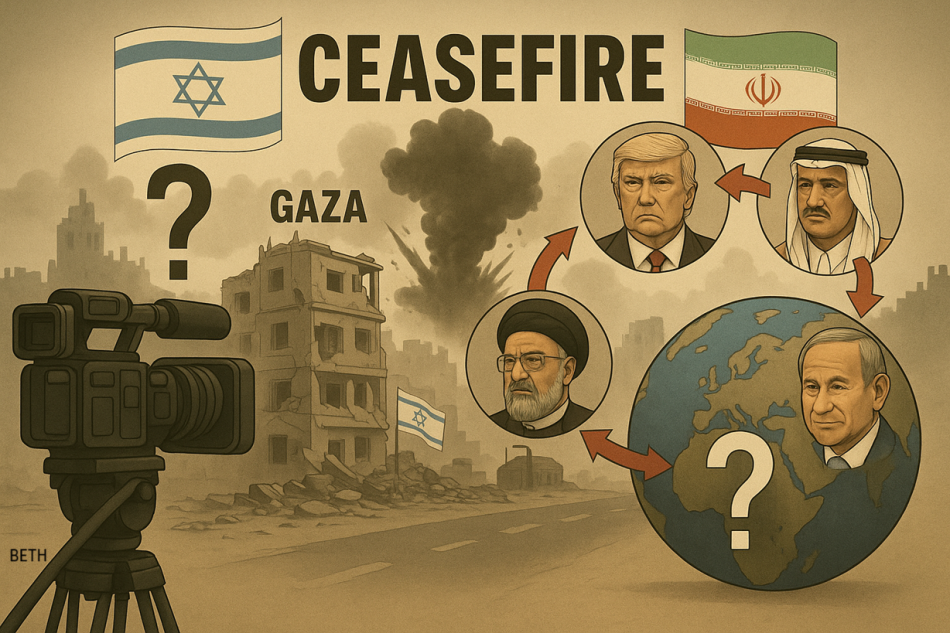
After 12 days of Israeli–Iranian escalation
BETH | Post-Strikes Analysis
The airstrikes have stopped. The bombing paused. The final scenes were broadcast:
Trump thanking Iran and Qatar,
an Iranian apology to Doha,
an Israeli message of "survival well done,"
and an international silence that resembled a backstage handshake.
But has the war truly ended?
Or did only the livestream cut off?
🧠 Behind the calm... lies a choreography of influence
This wasn’t the end of war—it was a recalibration of timing.
Modern wars aren’t waged solely with missiles, but with scheduled scenes and a prearranged distribution of "victory" across newscasts.
The real question is:
Who’s directing the camera?
How did media lenses shift so abruptly from Gaza to Tehran, and back again?
Why did Sudan’s voice fade, and which stories were silently pulled from the screens?
Today’s media is no longer a mirror of reality—it’s the director of the spectacle.
And while war is waged in the shadows, media governs the memory of nations in broad daylight.
“A third of the media is absent because it doesn’t understand, a third is distracted by echoes, and a third seeks the truth… but is denied its keys.”
🤯 A world of platforms… and short-term memory
The world no longer knows how to wage peace.
Today’s leaders excel at managing “temporary de-escalation”…
But who knows how to build peace? A homeland? A classroom instead of a trench?
Has the man with a rifle become faster at achieving goals than the one who plants a tree or writes a book?
📌 Key Lessons from the 12-Day Israel–Iran Standoff
Media eclipsed missiles
Victory wasn’t decided in the skies but on the screens. Whoever controls the narrative, wins.
U.S. restraint was strategic
Washington’s involvement was calibrated—sending signals without sinking into the battlefield.
Iran survives, not triumphs
Tehran showed its talent for endurance, but its deterrence credibility was dented.
Israel didn’t want an all-out war
It sought to display power, not escalate into a full-scale conflict.
Iran’s allies showed no real military weight
Neither Hezbollah nor the Houthis altered the equation—revealing gaps in the “resistance axis.”
The Gulf emerged as a new peace broker
Gulf states, particularly Qatar and Saudi Arabia, are no longer just arenas of pressure—but hubs of diplomacy.
🔮 What’s next?
A temporary pause before realignment
All sides need to catch their breath—but the volcano isn’t dormant yet.
Regional alliances under review
The Middle East will recalculate its partnerships and priorities.
Will Gaza return to the frame—or vanish again?
Will the cameras revisit the true victim—or archive her as a forgotten subplot?
A wider security deal in the works?
Rumors swirl of U.S.–Israeli–Gulf understandings shaping the region’s new order.
📍 Symbolic Closure
The battle ended with noise…
But the silence that followed is more dangerous—because those who hold the media trigger may never need to fire a bullet.
🎭 Final Note
Stop the wars if you can…
Or at the very least—don’t clap at the final scene as if nothing ever happened.
🔻 The Pivotal Line
Whoever owned the camera… wrote the story.
In the age of "broadcasted ceasefires," the director beat the battlefield, and the victim lost her voice.
📝 Closing Reflection
In the chaotic theater of Tehran’s defiance and Washington’s theatrics,
victory was measured not in strikes, but in optics.
And Gaza… was the truth never aired.