📘 Special Report – Prepared and Analyzed by the Strategic Media Department BETH Media Agency
🧭 Historical Prelude: How Did It All Begin?
In 1979, the world witnessed one of the most mysterious and multi-layered revolutions: the Islamic Revolution in Iran, which overthrew the rule of Shah Mohammad Reza Pahlavi, the closest ally of the West—especially the United States.
But the deeper question that still echoes after 46 years is: Was the Iranian revolution a natural birth… or a C-section orchestrated by external hands?
👑 The Shah’s Rule: A Monarchy in a Western Mask
The Shah's regime represented the peak of the Western project in Iran: rapid modernization, strategic ties with the U.S. and Israel, a rentier economy, and secular elites. But beneath this shimmer lay a deep legitimacy crisis, a widening gap between elites and people, and growing discontent among Shia clerics.
🧕 Who Was Khomeini?
Khomeini—revered by his followers as Ruhollah Al-Musawi Al-Khomeini—was born in the city of Khomein in 1902. He studied at the Shia seminary and rose to prominence as a scholar in jurisprudence and theology. Known for his religious rigidity and open hostility toward the Shah, he was exiled in the 1960s, moving between Iraq and then France (Neauphle-le-Château), where he played a pivotal role in fueling the revolution.
📌 The Grand Irony: Khomeini’s daily cassette messages to Iranians from Paris became a striking sign of indirect Western facilitation of his rise to power.
🔄 How Did the Shah Fall? And How Did the New Regime Rise?
Protests began in Qom (January 1978) and spread rapidly
The Shah hesitated to use excessive force and lost support from key allies
He left Iran in January 1979 under a so-called “medical leave”
Khomeini returned in February to a massive public welcome
The monarchy was toppled, and a “Revolutionary Leadership Council” was formed
A public referendum in April 1979 established the Islamic Republic
🎯 The declared goal: Establishing an “Islamic” system to replace Western corruption and monarchical despotism 🎯 The concealed goal (per Western analysis): Curbing the spread of communism through an isolated, strict theocratic system. But the outcome quickly slipped from the hands of those who had choreographed the scene.
🔁 The shocking historical paradox: A regime created to confront communism is now one of the staunchest allies of former communist powers: Russia and China.
🧠 Who Engineered the Regime?
According to many studies:
Western intelligence agencies (notably French and British) did not oppose Khomeini’s rise
The U.S. was searching for an alternative to the increasingly illegitimate Shah
Shia religious networks inside and outside Iran played a crucial role in framing Khomeini as a “redeemer”
But once consolidated, the new regime effectively rebelled against its enablers:
Expelled liberal and secular factions
Seized the U.S. embassy staff
Severed ties with Israel
🔮 Will the Current Regime End?
The regime is facing unprecedented internal challenges:
A deep generational rift between youth and the clerical establishment
Recurrent protests led by women and university students
An economy crushed by sanctions and internal corruption
A fierce struggle between hardliners and pragmatists seeking relief from isolation
🔻 Despite its iron grip, structural indicators suggest the regime is on the brink of a major shift:
Either internal reform (possibly led by the Revolutionary Guard)
Or a gradual collapse paving the way for a new system
👥 Who Is the Alternative?
The royalist current (led by Reza Pahlavi, the Shah’s son) remains media-active but lacks real grassroots support
Reformist opposition inside Iran is brutally suppressed
Civil movements—especially among women and students— are gaining momentum but lack unified leadership
If change occurs, the most likely scenarios are:
A shift from within the system (Revolutionary Guard, Assembly of Experts), or a public uprising that forces new leadership through accumulated national unrest.
❓ And What of Those Who Brought Khomeini?
The circles that enabled Khomeini may no longer approve of what he became:
Iran has emerged as a regional power challenging global balance
It has aligned with Western adversaries (Russia – China)
It manages unofficial military proxies across the region
Therefore, those who once built the revolution… may now seek to re-engineer it with new tools and less radical faces.
🛡️ Israel’s Role… and the Desire for Finality
Israel’s accelerated strikes on Iran—whether nuclear site bombings or symbolic assassinations of security figures—cannot be ignored.
Israel views the downfall of the clerical regime as an existential necessity, and might—indirectly—be expediting the regime’s final unraveling.
🧩 Symbolic Ending – BETH
In the beginning, one was summoned from exile… On a plane labeled “Alternative Legitimacy.” Khomeini entered—with all the demons masked in revolution. When the regime veered off-script, the writers tried to drop their pens… and start a new scenario.
But—
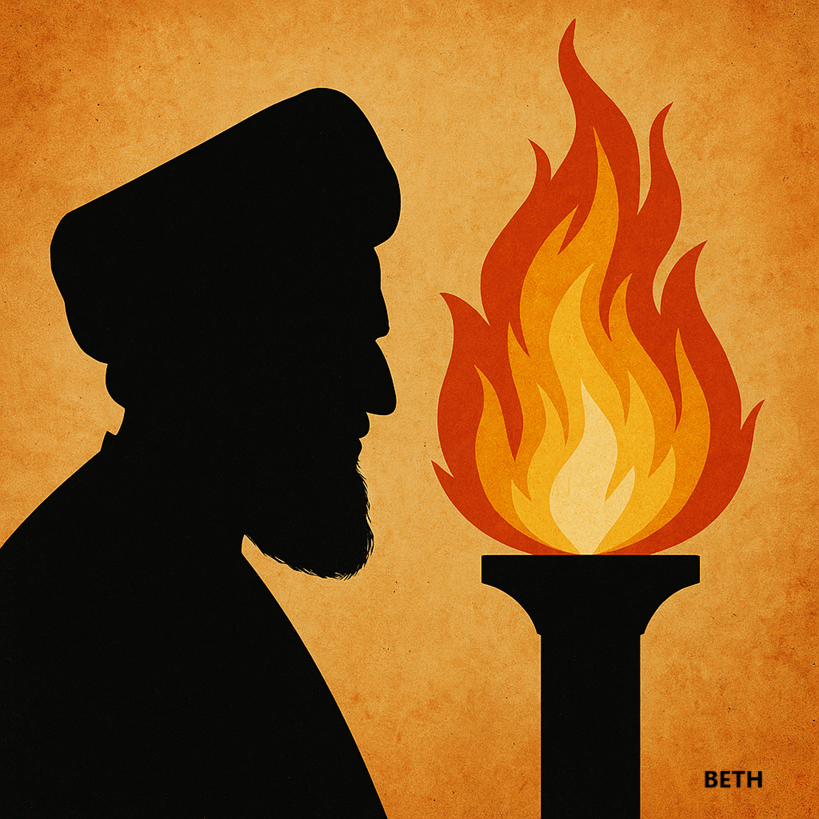
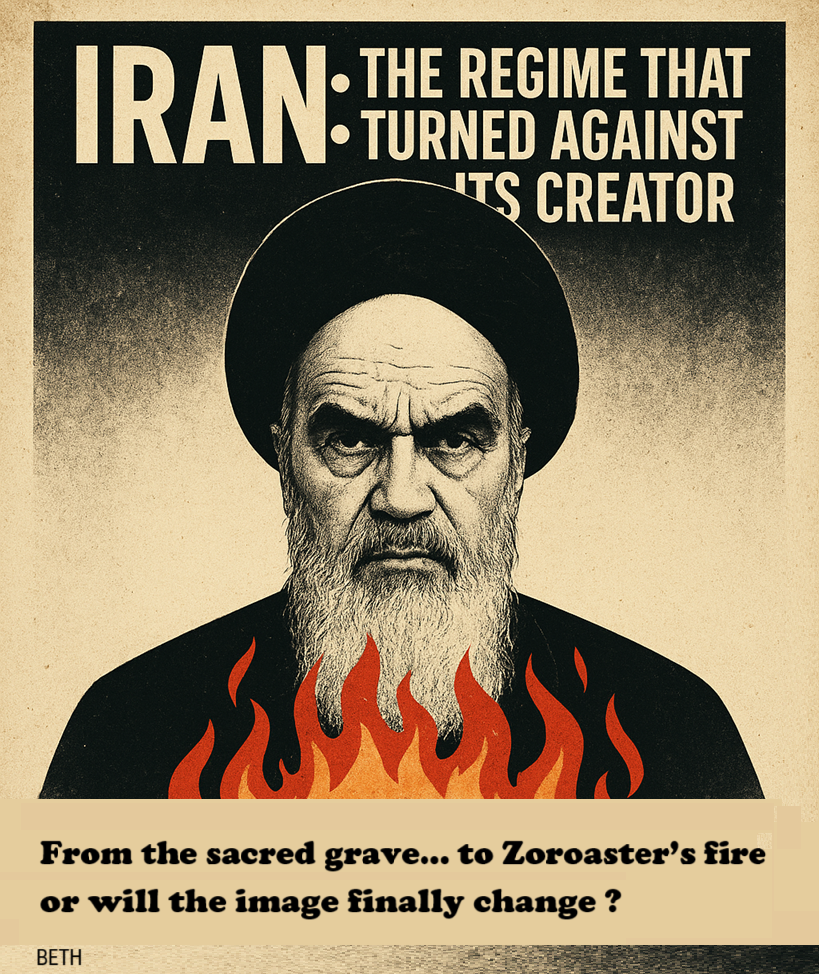
✍️ Those who write history with Western ink may be shocked to find the page burns from the very first line.\n\n> 🔥 From a system that worshipped graves, to one that worships fire… from the saint’s tomb to Zoroaster’s flame… the rituals may shift, but the temple remains the same: ruled by foreign will, guarded by local ignorance.\n\n> 📜 Between a burnt Shah’s grave… and a Supreme Leader who never realized the scene wasn’t his—Iran now stands before the camera… not to perform a finale, but to enter a new act in the grand drama of deception."
🧭 Open-Ended Conclusion – The Way Back
The clerical regime was brought in to serve as a wall against communism—yet it went on to build bridges with those it was meant to oppose. Religion was invoked to liberate the people from tyranny, only to become a power immune from questioning or accountability.
But the real question today is not just about the past…
✍️ Did those who brought this regime learn their lesson?
Will the next regime be a genuine turning point— or just a new mask for familiar faces?
Will Iran ever witness the birth of a modern state— one that values pluralism and transparency, and respects human dignity more than rituals?
And can a place long skilled in conspiracy transform into a beacon of civilization rather than a source of fear?
Maybe… But one truth remains:
He who plants a spark in scorched ground doesn't always get to choose the fire that follows.