


World Press Today – September 27 | BETH Eyes
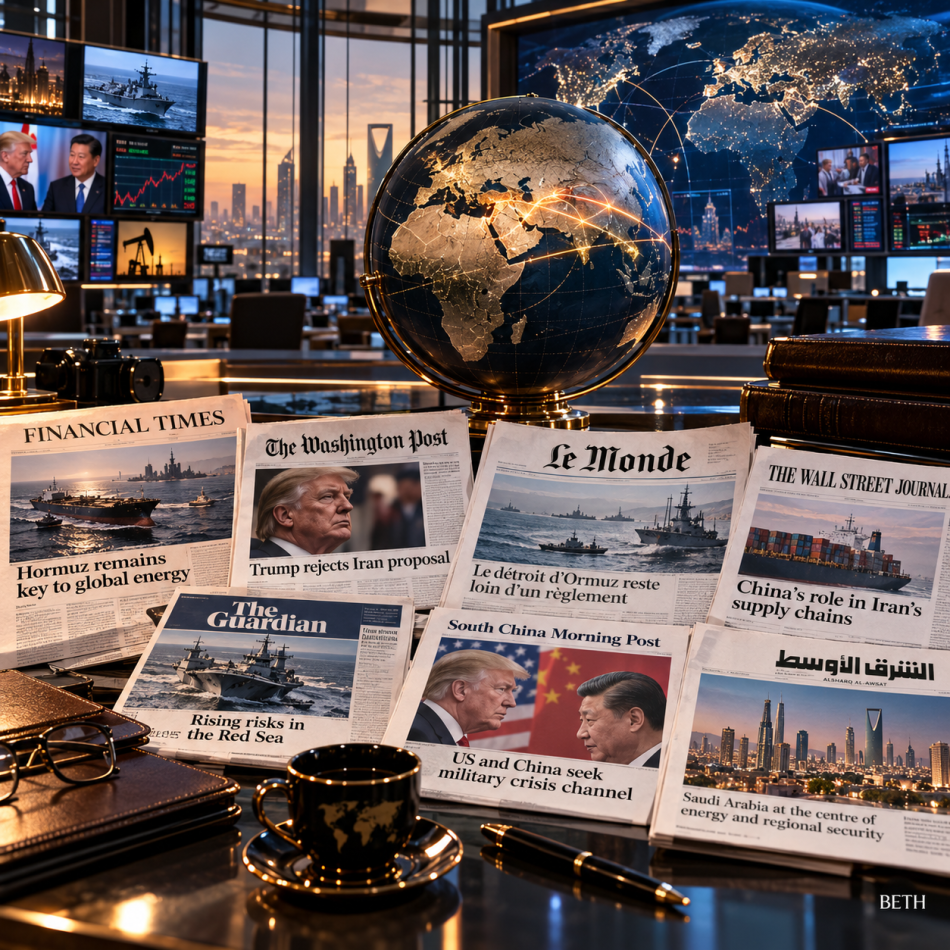
The global press watches the aftermath of the Trump–Xi summit and opens the file of Chinese support for Iran and the Houthis, while Saudi Arabia advances in international coverage through the lenses of energy security and Red Sea protection
Monitoring and Analysis | Strategic Media Department – BETH Agency
Supervision: Abdullah Al-Omairah
Beijing and Washington | A Direct Military Channel
South China Morning Post focused on a U.S.-China agreement to work toward establishing a military crisis communication mechanism following the Trump–Xi summit, signaling that both sides are trying to prevent competition from turning into an unintended confrontation.
By contrast, Global Times presented the summit as a step toward “strategic stability” in the relationship, while major disagreements over trade, technology, and Taiwan remain unresolved.
Washington | China Behind Iran
The Wall Street Journal opened a more sensitive file, pointing to Iranian trade data showing an inflow of Chinese components that support Tehran, while also examining the growing flow of Chinese supplies reaching the Houthis and strengthening their offensive capabilities.
BETH Eyes: U.S.-China competition is no longer only economic; it now extends into arms networks and influence across the Middle East.
Europe | Hormuz Remains the War’s Central Knot
Le Monde focused today on Trump’s rejection of the Iranian proposal and Tehran’s refusal to back down from its conditions, arguing that the Hormuz crisis remains far from resolution despite intensive contacts.
Saudi Arabia in the International Press
The Kingdom stood out from two main angles:
Energy: Financial Times followed the return of Saudi Arabia’s East-West pipeline, viewing it as a strategic artery that bypasses Hormuz and directly affects global oil prices.
Security: The Wall Street Journal reported on France’s readiness to deploy forces, radars, and defensive systems to protect facilities in Yanbu, indicating that Red Sea security is becoming a broader international responsibility.
Leading Editorials | How Does the World Think?
Paris: In Le Monde, concern over the volatility of U.S. decision-making is emerging as a factor that makes it harder to build stable understandings in international crises.
Abu Dhabi: In Al Khaleej, the prevailing argument calls for a broader approach to crises based on diplomacy and lasting stability rather than temporary de-escalation.
Doha: In Al Sharq, attention remains focused on investment and attracting capital despite regional instability, suggesting that Gulf economies continue to expand alongside ongoing crises.
Bottom line:
Today’s editorials are not only watching the war; they are asking three questions: Who is managing it? How can it be contained? And how does the economy continue despite it?
BETH Eyes Summary
The world today is moving along three lines:
Washington and Beijing are managing their competition, China is extending its reach behind the lines of war, and Saudi Arabia is becoming a central point in the equation of energy and Red Sea security.