

World Press Today – September 26 | BETH Eyes
The Washington summit keeps U.S.-China competition under control without ending it; Iran and Hormuz return to the forefront of the economic and political press, while Saudi Arabia advances in international coverage through the lenses of security, energy, and the Makkah Agreement
Monitoring and Analysis | Strategic Media Department – BETH Agency
Supervision: Abdullah Al-Omairah
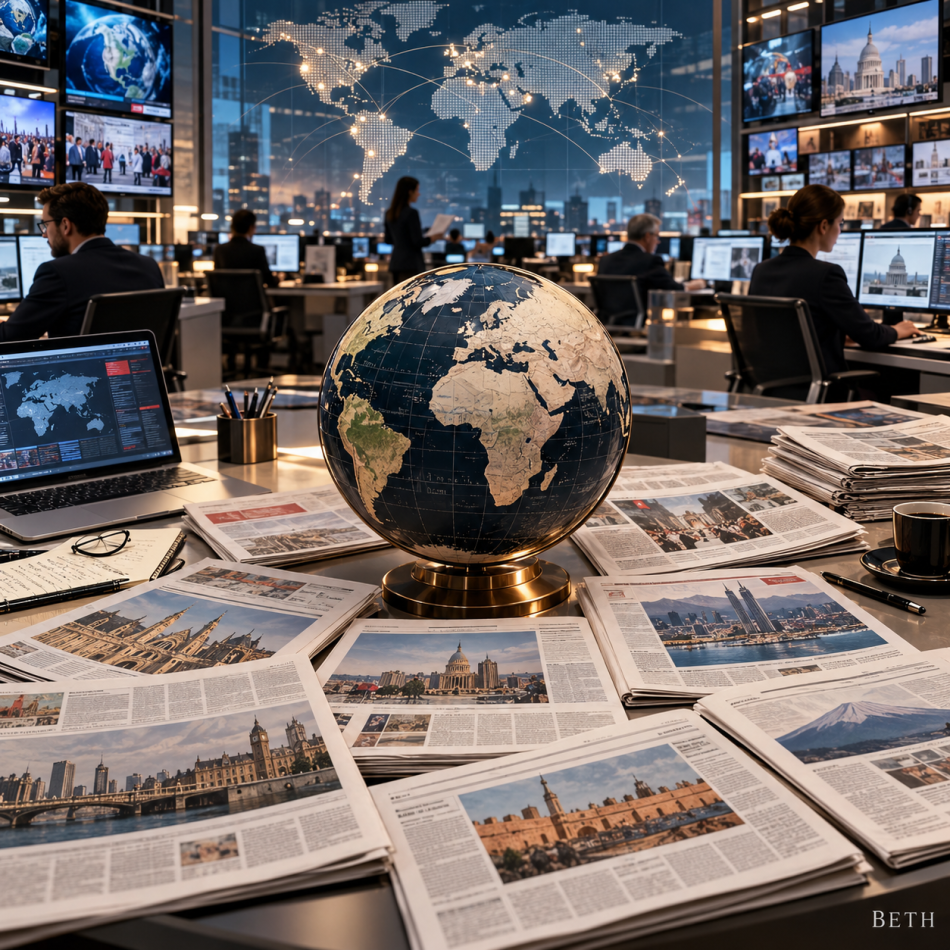
The attention of the world press today was divided among the aftermath of the Trump-Xi summit, the future of the U.S.-Iran war, the security of maritime corridors, energy prices, and the war in Ukraine.
But the broader picture suggests one thing: the world is not experiencing a single isolated crisis, but rather several interconnected crises that the major powers are trying to prevent from turning into a wider confrontation.
Washington | Trump and Xi: A Truce Under Test
The Wall Street Journal and South China Morning Post focused on the aftermath of the Trump-Xi summit in Washington, where both sides sought to project a degree of stability, while the major issues remained open: trade, artificial intelligence, Taiwan, and relations with Iran.
The American press noted that Beijing views Washington’s hesitation on some Taiwan-related issues as a political opening that could be built upon, while the Asian press highlighted both sides’ desire to continue dialogue without speaking of a comprehensive settlement.
BETH Eyes:
The summit did not end the competition; rather, it brought the management of competition back to the forefront, an important distinction in a relationship where any mistake could affect global trade, technology, and security.
Middle East | Trump Rejects the Iranian Formula
The Wall Street Journal made U.S. President Donald Trump’s rejection of Iran’s latest proposal one of the day’s leading stories. It reported that Washington did not accept Tehran’s formula linking the reopening of Hormuz and a halt to fighting with U.S. measures concerning sanctions and the blockade.
Other international newspapers treated the development as another setback for the negotiating track after months of inconclusive contacts.
The broader meaning in today’s press is that Hormuz has once again moved from the negotiating table back to the balance of power.
Economy | Oil Remains in the Grip of Politics
Financial Times is closely following the impact of the war on oil, after the alternatives used by Gulf states to bypass Hormuz became costly solutions that are not entirely stable.
The newspaper also focused on the restart of Saudi Arabia’s East-West pipeline and its impact on markets, and on how continued regional tensions leave oil prices directly tied to every political or military development.
In Asia, the economic press views the depletion of Chinese inventories and rising transportation costs as factors that could put renewed pressure on prices if the crisis continues.
BETH Eyes:
The economic question is no longer: Is there oil?
Rather: At what cost does it arrive, by which route, and for how long can the alternatives continue to operate?
Beijing | Taiwan Remains the Red Line
In the Chinese and Asian press, Taiwan remained at the forefront of interpretations of the Washington summit.
Coverage by South China Morning Post showed that Beijing once again pushed Taiwan to the center of its relationship with Washington, while artificial intelligence and trade continued as parallel tracks of competition between the two countries.
Global Times, meanwhile, argued in its editorial that the United States and China should be partners, not rivals, calling for disciplined competition that does not slide into confrontation.
Europe | Russia Returns to the Forefront
In Le Monde, Russia and Ukraine remained central issues in opinion and analysis.
In its latest editorial, the newspaper criticized what it considered an ill-judged French compromise on Russian sanctions, arguing that any retreat weakens Europe’s message toward Moscow. It also continued to call for a more cohesive European position in confronting the Russian war and hybrid attacks.
Europe today therefore appears less preoccupied with ending the war quickly and more focused on the question:
How can it preserve its cohesion and deterrence capability?
Türkiye | The Makkah Agreement Becomes a Real Test
Daily Sabah has offered in recent days one of the clearest readings of the transformation in the Makkah Agreement, arguing that the Houthi attacks on Saudi Arabia have placed the agreement before its first serious test of deterrence credibility, with attention focused on areas such as early warning, air defense, intelligence, and infrastructure protection.
In another analysis, the newspaper raised a direct question about how far Pakistan is prepared to go in practice in defending Saudi Arabia, arguing that a defense commitment can take several forms, beginning with intelligence and technical support and potentially extending to military deployment if necessary.
This coverage has become even more significant following the start of the practical military activation of the Makkah Agreement in Riyadh.
Saudi Arabia in the International Press
Today, Saudi Arabia appears in the international press from four main angles:
Security: Continued Houthi attacks have made the defense of Saudi cities and facilities a regular part of international coverage.
Alliances: The Makkah Agreement is no longer being read merely as a political declaration, but as a defense structure that has begun testing its actual mechanisms, particularly with the Turkish and Pakistani roles.
Energy: Financial Times is following Saudi Arabia’s reliance on the East-West pipeline and alternative routes amid the continuing vulnerability of Hormuz, linking this directly to the stability of the global oil market.
Relations with Washington: Financial Times has also examined the limits of a direct U.S. military role in confronting the Houthis, and what this could mean for Riyadh’s search for a broader network of defense partnerships rather than reliance on a single track.
BETH Reading
What is new in Saudi Arabia’s image in the international press is not merely that it is being targeted by attacks.
What is new is that the Kingdom now appears at the intersection of three major global issues:
Energy security, Red Sea security, and the reshaping of regional alliances.
This explains why international coverage of Saudi Arabia is no longer confined to a local or regional story; every development related to the Kingdom’s security has repercussions for navigation, energy, and markets.
Leading Newspaper Editorials | How Does the World Think?
America | China Remains the Greatest Challenge
In the American press, opinion pieces and editorials focus on the fact that the Trump-Xi summit did not end the fundamental disagreements, particularly over Taiwan, artificial intelligence, and trade.
The Wall Street Journal reflects concern that Beijing may exploit any U.S. hesitation on Taiwan to gradually alter the balance of deterrence.
Bottom line: Washington wants to calm the competition without appearing to retreat.
Europe | Russia and Sanctions
In its latest editorial, Le Monde chose the issue of sanctions on Russia, criticizing the prioritization of French interests over European unity in one sanctions dispute, and warning that contradictory messages weaken Europe’s position toward Moscow.
Bottom line: Europe fears that internal differences could become a source of strength for Russia.
China | Partnership, Not Rivalry
A Global Times editorial stressed that stability in U.S.-China relations is an interest that goes beyond the two countries, and called for keeping competition within manageable limits.
Bottom line: Beijing wants to stabilize the competition, not end it.
Asia | Searching for Space Between the Two Powers
In South China Morning Post, a notable analysis today argued that Southeast Asian countries should not merely avoid choosing between Washington and Beijing, but should also build partnerships with middle powers to protect their independence of decision-making.
Bottom line: Middle powers are beginning to seek greater space for themselves between the two giants.
Editorials in the Gulf States
Saudi Arabia | The Economy Holds Firm During War
In “Kalimat Al-Riyadh,” the newspaper Al Riyadh focused on the resilience of the Saudi economy despite the uncertainty of the regional scene and the repercussions of war.
It cited growth in operating revenues across the business sector and the increasing contribution of non-mining activities as evidence of a broader economic base and greater diversification of income sources.
Bottom line: The Saudi economic mood suggests that the true test of the Vision is not growth under normal conditions alone, but the ability to continue during crises.
UAE | Water Before It Becomes the World’s Next Crisis
The newspaper Al Khaleej chose water security as the subject of its editorial today, warning that the world is entering a more dangerous stage of “water bankruptcy” as shortages and demand expand.
It called for moving from conferences and pledges to actual investment and implementation in water projects.
Bottom line: Abu Dhabi is looking beyond wars; water may become one of the world’s biggest future security issues.
Kuwait | Economy and Human Knowledge
In Kuwait’s Al-Anbaa, attention today focused on artificial intelligence and human capital as priorities for Kuwait, alongside investment and Gulf-European partnerships.
No separate institutional editorial appears in the available edition today, but the newspaper’s economic direction clearly links future competitiveness to technology and human development together.
Bottom line: Kuwait looks at future growth through investment and human intelligence, not resources alone.
Bahrain | The Gulf Between Building and Threat
In Al Ayam, a notable opinion piece titled “The Strong and the Stronger” compared the Gulf states’ path of economic diversification and development in education, healthcare, and investment with continuing regional tensions and security threats coming from Iran and its proxies.
It is a prominent opinion article, not an official newspaper editorial.
The newspaper’s political coverage today also reflected a clear Bahraini position rejecting the use of the Strait of Hormuz as a tool of pressure or economic blackmail, and linking the region’s security to its prosperity.
Bottom line: Manama reads the crisis from a direct angle: the Gulf wants to build, but security is a condition for sustaining that development.
Qatar | Diplomacy and International Presence
In Qatar’s Al Sharq, the latest available “Al Sharq Opinion” focuses on Qatar’s presence in the international arena, emphasizing Doha’s approach based on dialogue, diplomacy, and multilateral action.
The newspaper’s coverage today also reflects growing interest in Gulf integration in energy, trade, and transportation, as well as condemnation of Houthi attacks on Saudi Arabia.
Bottom line: Doha maintains a consistent line: diplomacy first, alongside stronger Gulf integration economically and in security.
Oman | The Local Economy First
On the opinion pages of Oman Observer today, there is a focus on local development and building prosperity from within, alongside discussion of priority industries, technology financing, and Oman’s economic transformation.
The newspaper does not present a single clearly designated institutional editorial today, but its editorial mood leans toward a fundamental economic question:
How can diversification move from plans to scalable local production?
Bottom line: Muscat looks at the world from within the economy: strength begins by building domestic capacity, then opening outward.
BETH Eyes | What Is the Gulf Saying Today?
If these six perspectives are brought together in one picture, it becomes clear that the Gulf press is not thinking about war alone:
Saudi Arabia is watching economic resilience.
The UAE is raising the water issue.
Kuwait is looking at investment and artificial intelligence.
Bahrain links security to development.
Qatar maintains its emphasis on diplomacy and Gulf integration.
Oman focuses on building the economy from within.
The common thread among all of them is clear:
The Gulf is trying to protect what it is building today and prepare for what may threaten it tomorrow.
Inside the Capitals | Each Country Has Its Own Concern
Washington: China and Iran, and how to manage two fronts without expanding the conflict.
Beijing: Stabilizing the economic truce while maintaining Taiwan as a red line.
Paris and Berlin: Russia, European defense, and divisions within the continent.
Ankara: Testing the Makkah Agreement and the limits of defense commitments.
Tokyo: Energy, Hormuz, and the impact of conflict on an import-dependent economy.
Riyadh: Protecting territory and energy, and expanding the regional defense network without being drawn into others’ wars.
BETH Eyes Summary
The world press today does not present a single crisis dominating the world.
It presents an international system trying to manage tension across several tracks at the same time:
Washington and Beijing are preventing competition from exploding.
Washington and Tehran are unable to end the war.
Europe is searching for cohesion in the face of Russia.
And Saudi Arabia is becoming a point of intersection between regional security, energy, and international trade.
This is where the importance of BETH Eyes lies:
Not in collecting what the newspapers published, but in reading what brings it all together into one picture.