

Saudi Diplomacy Moves from New York
From Gaza and de-escalation to Syria, Gulf, Arab and Islamic coordination, and engagement with Washington and Europe; Prince Faisal bin Farhan’s activity reveals a multi-layered Saudi diplomatic movement that goes beyond the number of meetings to building a political network around the region’s key files
New York | Special Report
Prepared and analyzed by | Strategic Media Management – BETH Agency
Supervised by: Abdullah Al-Omairah
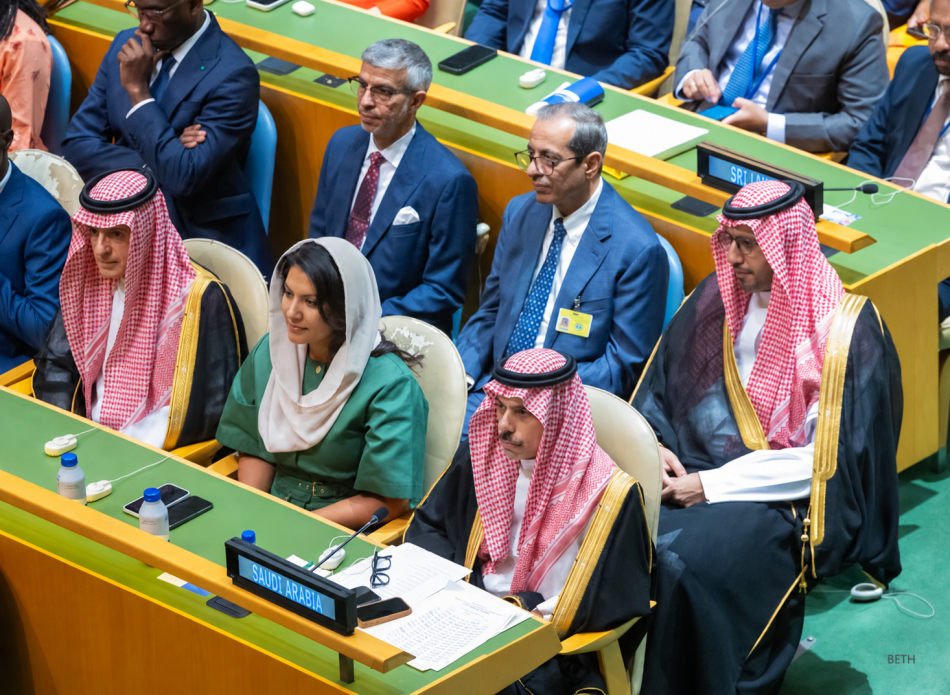
Saudi Foreign Minister Prince Faisal bin Farhan’s movements in New York do not appear to be merely a crowded schedule on the sidelines of the 81st session of the United Nations General Assembly.
When the scattered meetings and engagements are brought together into a single picture, a clearer trajectory emerges: Riyadh is moving simultaneously across several circles — Gulf, Arab and Islamic, regional, and then with the United States and Europe — while keeping the Palestinian issue at the forefront of its diplomatic activity. Prince Faisal is leading the Kingdom’s delegation during the high-level week, alongside Saudi officials working across politics, climate, humanitarian relief, health and multilateral affairs.
From Gaza as a File to Gaza as a Track
The Palestinian issue is the most prominent line of activity.
Prince Faisal took part in a coordination meeting of the foreign ministers of eight Arab and Islamic countries, focusing on the humanitarian situation in Gaza, developments in the West Bank and the coordination of international positions. The Kingdom also participated in other meetings that brought together Egypt, Qatar, Jordan, the UAE, Indonesia, Pakistan and Türkiye to follow up on the ceasefire, humanitarian aid and the rehabilitation of basic infrastructure.
But the diplomatic movement went beyond managing the daily crisis.
In New York, the Saudi foreign minister joined France, the United Kingdom and Canada in chairing a high-level meeting titled “The Way Forward: One Year after the New York Declaration and the Comprehensive Peace Plan.” This places Saudi diplomacy within a broader track linking an end to the war with a political solution and the future of the Palestinian cause.
A clear characteristic emerges here:
Saudi Arabia does not treat Gaza as a separate humanitarian crisis, but as a political issue that must ultimately lead to a sustainable political path.
A Broader Regional Circle
Alongside Palestine, the minister is operating within a regional network bringing together Saudi Arabia, Egypt, Türkiye and Pakistan.
The quadrilateral meeting in New York addressed regional crises, ways to reduce tensions, intensify diplomatic efforts and strengthen coordination among the four countries — a group bringing together four major states whose political, military and geographic weight extends from the Gulf to the Eastern Mediterranean and South Asia.
The value lies not in a single meeting.
It lies in the continuity of the framework itself.
As meetings among Riyadh, Cairo, Ankara and Islamabad recur, coordination shifts from being a reaction to a crisis into a political channel capable of addressing multiple files at the same time.
Syria on the Table
In a more focused track, Prince Faisal brought together the foreign ministers of Syria and Türkiye in a trilateral meeting in New York.
Saudi Arabia’s presence in this framework carries practical significance, because the Syrian file intersects with Türkiye both politically and in security terms, while Damascus seeks to consolidate its regional ties and rebuild state institutions and external relations.
Riyadh is therefore not merely approaching the Syrian crisis from the outside; it is bringing the directly concerned parties into one space for dialogue.
From the Region to Washington
Saudi diplomatic activity has not remained within the Arab and Islamic sphere.
Prince Faisal also participated in a U.S.-regional meeting on the sidelines of the General Assembly, at a time when Iran, maritime security, Gaza, energy and regional escalation all intersect with Washington’s relations with the region.
This adds another level to Saudi diplomacy:
coordination within the region first, followed by carrying that regional position into dialogue with the international power most influential in its major files.
It is not a move from one camp to another, but work in both circles in parallel.
The Gulf as a Collective Bloc
In New York, the foreign minister also participated in the Gulf ministerial coordination meeting, followed by ministerial meetings between the Gulf Cooperation Council and both France and Switzerland.
This track is important because it reflects a different way of managing international relations:
Saudi Arabia acts as a state, but it also acts within the collective weight of the Gulf Cooperation Council.
With Europe, discussions are not limited to crises; they also extend to relations, cooperation and shared interests.
Politics Does Not Halt Relations
Amid the major regional meetings, the bilateral track continued.
Prince Faisal met Paraguay’s foreign minister, and the two sides signed a mutual visa exemption agreement for holders of diplomatic and special passports. He also met Pakistan’s deputy prime minister and foreign minister, and the two sides signed a similar agreement.
He also met the chairman of the Gates Foundation, reflecting the breadth of the Saudi delegation’s agenda, which extends to development and international partnerships alongside politics and security.
These smaller details matter because they show that, for Riyadh, New York is not only a place to manage crises.
It is also an open diplomatic marketplace for building relationships.
Three Circles at the Same Time
When the scene is organized, Saudi activity appears to be moving through three simultaneous circles:
The crisis circle: Gaza, Syria, regional tensions and de-escalation.
The coordination circle: the Gulf, Arab and Islamic countries, Egypt, Türkiye and Pakistan.
The international relations circle: the United States, France, the United Kingdom, Canada, Switzerland and other countries.
What stands out is not the number of meetings, but the fact that these three circles converge around the same files from different angles.
The Palestinian issue moves from Arab and Islamic coordination to dialogue with Western states.
Regional security moves from the quadrilateral framework to engagement with the United States.
And Gulf relations move collectively toward Europe.
Each meeting thus becomes part of a network, rather than an isolated event.
The Peak of the Diplomatic Activity
Prince Faisal bin Farhan’s activity in New York reached its highest point on the Palestinian issue, where he stressed that the establishment of an independent Palestinian state and the end of occupation are fundamental to the region’s security and stability, and called for implementation of the peace plan, guaranteed humanitarian access, and an end to settlement expansion and annexation policies.
At the same time, Iran, the Houthis, maritime security and military escalation remained part of the background to Saudi diplomatic activity. These are files the minister addressed in contacts preceding the New York meetings, while recent official statements used broader language focused on de-escalation and regional security.
Saudi diplomacy has therefore combined clearly stated positions on major issues with quiet management of sensitive files away from publicly disclosed details.
BETH Analysis
It is easy to read Prince Faisal bin Farhan’s program in New York as simply a long list of meetings and engagements.
But once the pieces are brought together, a different picture emerges.
Saudi diplomacy is not waiting for one meeting to solve one crisis; it is building more than one circle of movement around each file.
It coordinates within the Gulf.
It brings together Arab and Islamic positions.
It maintains regional channels with influential powers.
Then it enters dialogue with Washington and European capitals from a position backed by a network of prior relationships and coordinated positions, rather than from an isolated standpoint.
This is where the importance of New York this week becomes clear.
While the world meets inside the General Assembly Hall, Saudi diplomacy is working outside it to connect the rooms to one another.
That may explain the intensity of the foreign minister’s movements:
The objective is not for the Kingdom to be present at every meeting, but to be able to connect the meetings when the tables differ and the issue remains the same.