



U.S.-Iran Negotiations in New York
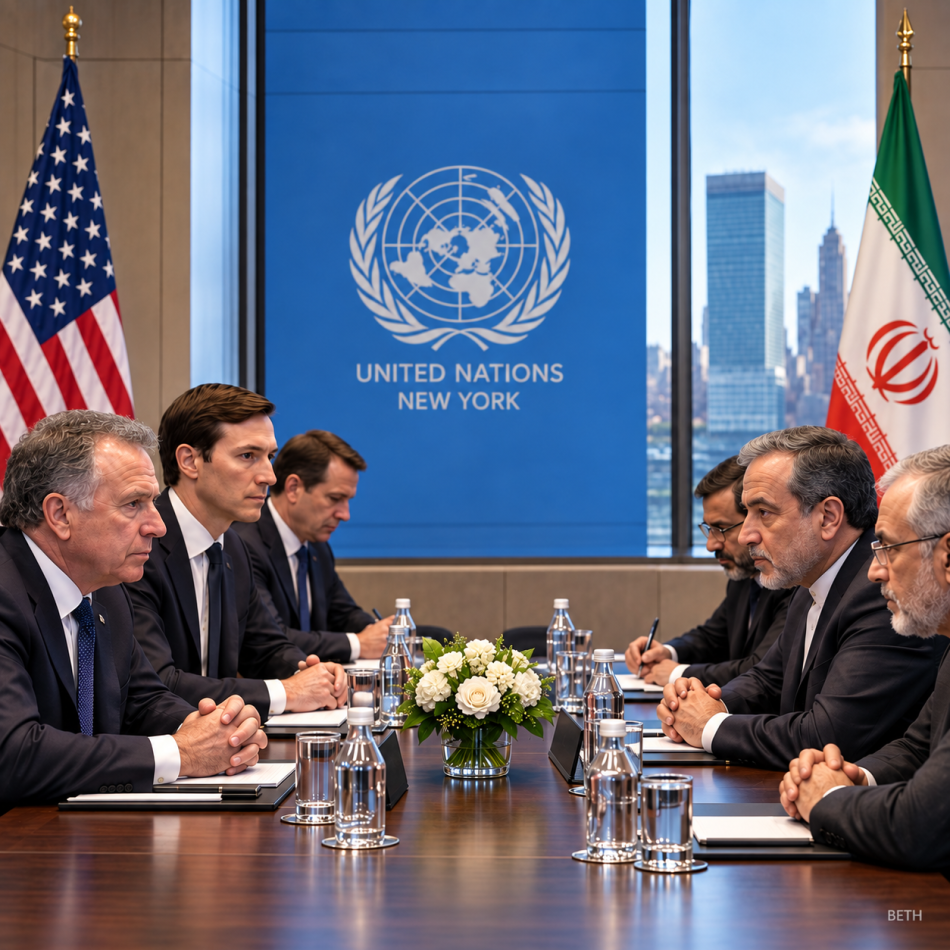
Hours of talks on the sidelines of the General Assembly; Washington speaks of “momentum” toward an agreement, while Tehran links progress to lifting the maritime blockade and releasing frozen assets, as Qatar and Pakistan move to de-escalate tensions and guarantee freedom of navigation through Hormuz
New York | BETH
The United States and Iran entered a new round of negotiations in New York, lasting several hours on the sidelines of the United Nations General Assembly, in the clearest diplomatic movement in weeks following military escalation and the breakdown of the previous track.
U.S. envoy Steve Witkoff said the talks were conducted through mediators moving between the two delegations, while President Donald Trump said his team held discussions lasting around three hours with the Iranian side, describing them as “very good” and “productive” and pointing to “momentum” toward an agreement, with another round expected soon.
Tehran Sets Its Conditions
Iran entered the talks with clear conditions.
According to reports on the negotiations, Tehran focused on three main issues:
Lifting the U.S. maritime blockade on Iranian ports.
Releasing frozen Iranian assets.
Ending the war.
Iran also linked any progress on the Strait of Hormuz to reciprocal U.S. action, indicating that the strait could be reopened within a short period if military pressure were reduced and the blockade on Iranian ports lifted.
Washington wants Hormuz and the nuclear file first; Tehran wants relief from the blockade and sanctions first.
Qatar Steps In
The diplomatic movement is not limited to Washington and Tehran.
Qatar’s Ministry of Foreign Affairs officially confirmed that Doha is working with Pakistan to reduce tensions between the United States and Iran, guarantee freedom of navigation through the Strait of Hormuz, and strengthen regional stability.
This is significant because mediation is no longer simply about passing messages; it is becoming an effort to sequence reciprocal steps so that neither side is forced to make a major concession first.
Hormuz at the Center of the Deal
All roads lead back to the strait.
Qatar had previously supported an interim framework that included a joint navigation corridor through Hormuz and a joint mine-clearing project, while stressing that freedom of navigation is a fundamental part of any sustainable solution.
This makes Hormuz more than a maritime issue.
It is now an Iranian bargaining card, an American demand, a Gulf interest, and a fundamental condition for stability in global energy markets.
Why Negotiate After Military Superiority?
The military balance clearly favors the United States, and U.S. and Israeli strikes have achieved significant results against Iranian capabilities.
But this is where the debate begins.
Critics of negotiations argue that a rapid return to the table gives Tehran what it needs most: time, a degree of restored psychological balance, and a shift from being the party absorbing strikes to one whose consent is required for a settlement.
In this view, Iran’s current leverage does not come from military parity with Washington, but from a negotiating process that restores some of the cards it lost on the battlefield.
The U.S. administration, by contrast, sees the objective not as continuing the war indefinitely, but as converting military superiority into an agreement that addresses the nuclear file, navigation, and stability.
This raises the real question:
Will Washington turn its military success into a binding agreement, or will negotiations give Tehran another opportunity to reorganize its position?
The Threats Continue
The negotiations have not softened the public rhetoric.
Following Trump’s hard-line speech at the United Nations, Iran’s General Staff warned of strikes that would be “more severe and less predictable” if escalation continued, while Trump continues to present an agreement as the alternative to an even harsher military phase.
This means the two sides are negotiating from within the war, not after it has ended.
What Is Actually New?
The new development is not that Washington and Tehran are talking.
The new development is that the terms of a possible deal are beginning to emerge:
Tehran wants relief from the blockade and the release of frozen assets.
Washington wants freedom of navigation through Hormuz and progress on the nuclear file.
Mediators are trying to sequence implementation in stages.
And Trump is speaking of another round soon.
BETH Analysis
The New York negotiations do not mean the war is close to ending, but they move the crisis into a different phase.
The problem now is no longer the absence of dialogue.
It is:
Who moves first?
Iran does not want to reopen Hormuz and then wait for something in return.
Washington does not want to ease the blockade and then wait for an Iranian concession.
This makes the role of mediators critical in building synchronized steps:
A partial reopening of navigation in exchange for partial relief from the blockade, followed by movement on the nuclear file, sanctions, and the remaining issues of the war.
If this arrangement succeeds, New York could move from being a venue for exchanging threats to the beginning of a genuine negotiating track.
If it fails, both sides will return to the instrument that remains available to them:
Weapons.
The Bigger Question
If the negotiations drag on, the real test will not be limited to the nuclear file, Hormuz, and sanctions.
The test will also be inside the Iranian system itself:
Will negotiations produce a settlement that restores the system’s cohesion, or will they open new cracks between those who want to continue the confrontation and those who believe the cost of war has become greater than the risks of compromise?
In long wars, change does not always begin from the outside.
Sometimes it begins when those inside the system itself start to disagree over what survival means.