


World Press Today, September 23 | BETH Eyes
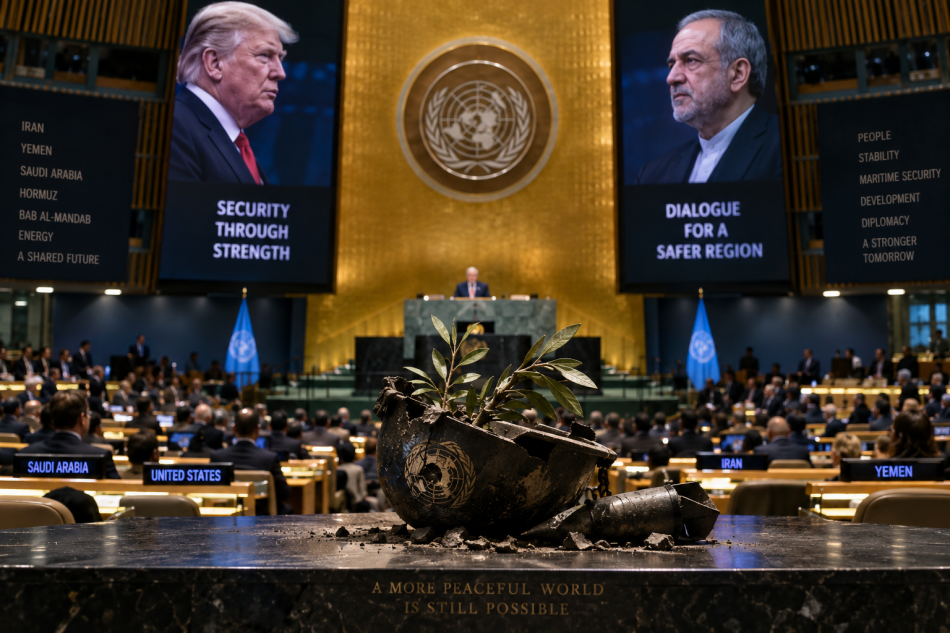
New York dominates the world’s headlines; Trump’s speech on Iran, U.S.-Iran contacts, Yemen and Hormuz lead the coverage, while Saudi National Day appears in the international press as a different image of the Kingdom amid regional tensions
Monitoring and Analysis | Strategic Media Department – BETH Agency
Supervision: Abdullah Al-Omairah
The world press today is turning almost entirely toward one place: New York.
The United Nations General Assembly has become a stage where war and negotiation come together; Trump raises the tone of his rhetoric against Iran, Tehran prepares to respond, and political contacts continue behind the scenes, while Yemen, the Strait of Hormuz and energy remain the files most closely tied to the global economy.
Washington | Threat and Negotiation
The American press presents Trump’s speech as an explicit defense of the war against Iran, while at the same time it came alongside direct and indirect contacts with Tehran.
It focused on the obvious contradiction: the president used harsh language against Iran, then later spoke of a U.S.-Iran meeting that he described as “very good.” At the same time, Washington continues to leave open the possibility of an agreement after the midterm elections.
The American scene today: threats from the podium, negotiations beyond it.
London | Beyond Hormuz
The Financial Times went beyond the war itself, revealing a U.S. proposal to establish an investment fund with Arab countries with an initial value of around $10 billion, aimed at developing energy infrastructure and alternative routes that reduce dependence on the Strait of Hormuz.
According to the newspaper, the idea could later expand to more than $50 billion and include pipelines and more flexible energy transport projects.
This is an important development, because the question in London is no longer only:
When will Hormuz reopen?
But rather:
How can the world reduce its dependence on it in the first place?
Paris | Yemen Returns to the Forefront
In the French press, Yemen has returned strongly to the headlines.
Le Monde focused on the fighting around the western coast and the port of Mokha, directly linking the operations there to the importance of Bab al-Mandab and navigation in the Red Sea. It also continued to follow Houthi attacks on Saudi Arabia and the risks they carry of a broader regional confrontation.
The French angle is clear:
Yemen is no longer a separate war; it has become a direct extension of Iran in the struggle over maritime routes and energy.
Tokyo | Bab al-Mandab and the Human Cost
The Japan Times placed Yemen at the forefront of its coverage today, focusing on rising displacement, fighting along the western coast, and the risks threatening global trade through Bab al-Mandab.
It reported that the number of displaced people had exceeded 130,000, with UN estimates that the figure could rise to more than 230,000 if the fighting continues.
Japan’s interest is understandable; the country depends heavily on energy imports and secure shipping routes, and therefore views Hormuz and Bab al-Mandab as an economic Japanese issue as well, not merely a Middle Eastern crisis.
Beijing | Fear of a Wider Front
The Chinese press continues to view the crisis through the lens of regional stability and energy.
China Daily has highlighted in recent days that the targeting of Riyadh and the widening fighting with the Houthis increase the risk of the war expanding to a broader front, while Beijing continues to reject unilateral U.S. sanctions on Iran and call for a political solution.
China is not looking here for one side’s victory as much as it is looking for stability that guarantees the continuity of trade and energy.
Seoul | Yemen Moves Closer to Asia
Even the South Korean press has begun clearly linking Houthi advances in Yemen to Red Sea security and energy.
The Korea Herald focused on attempts by the Houthis to seize strategic highlands and cut off the western coast from other areas, considering this a development that threatens trade routes through the Red Sea.
In this way, the war is moving from the Middle East pages to the pages of the Asian economy.
Saudi Arabia in the International Press
Saudi Arabia’s presence today has two completely different faces.
The first is security and politics: Houthi attacks, the Kingdom’s right to defend itself, and the security of energy and navigation.
The second is celebratory, as the international and regional press follows Saudi Arabia’s 96th National Day, with air shows and events extending from Jeddah to Riyadh and the Eastern Province. Coverage has also highlighted Saudis abroad taking part in celebrations, and the occasion becoming a way to introduce Saudi culture.
Notably, the international press reported that TikTok recorded a major increase in searches for National Day content inside the Kingdom, alongside the launch of a digital initiative focused on heritage and local memory.
Here, a different image of Saudi Arabia appears in today’s press:
A country facing a security threat while, at the same time, celebrating its identity and its future.
Arab Press Brief | From the Atlantic to the Gulf
The Arab press is moving today between four main files:
Iran and Trump’s speech at the United Nations.
The future of U.S.-Iran negotiations.
The war in Yemen and its repercussions for Saudi Arabia, the Arab countries overlooking the region, and Bab al-Mandab.
And Saudi National Day, which is receiving broad coverage in the Gulf and Arab press.
In some Arab coverage, one clear question is advancing:
Will the New York meetings turn into the beginning of real negotiations, or remain merely a political pause inside an open war?
Inside the Capitals | Each Country Has Its Concern
In Washington: Can Trump end a war that has entered U.S. domestic politics forcefully?
In Tehran: Can negotiations take place without offering concessions that appear as surrender?
In Riyadh: How can the Kingdom protect its territory and energy corridors without being drawn into a wider war?
In London and Paris: How can navigation and energy be protected if disruption in Hormuz and Bab al-Mandab persists?
In Beijing: How can China preserve its relationship with Tehran without putting its interests with the Gulf at risk?
And in Tokyo and Seoul: How can energy be secured if maritime routes become a permanent battlefield?
Indicator Pulse
Markets quickly picked up signals of negotiation; oil prices fell amid talk of U.S.-Iran meetings in New York, with Brent dropping below $100 in some trading, while markets remained highly sensitive to any development involving Hormuz or Yemen.
This means that the market has begun reading political words the way it reads missiles.
BETH Eyes
The world press today is not talking about one war.
It is talking about an interconnected network:
Iran.
Yemen.
Hormuz.
Bab al-Mandab.
Energy.
And the U.S. elections.
But what distinguishes this day is that diplomacy has regained a seat beside the weapon.
Trump threatens, then speaks of a meeting.
Iran rejects surrender, then sends its delegation to New York.
Arab countries demand security, while at the same time searching for a way out of the crisis.
That is why the most important news today may not be what was said from the General Assembly podium.
The most important may be what is happening behind closed doors, between one meeting and another, away from the microphones.
In New York today:
The world speaks before the cameras, while trying to negotiate and search for a peaceful way out away from them.