


Trump’s War with the Media
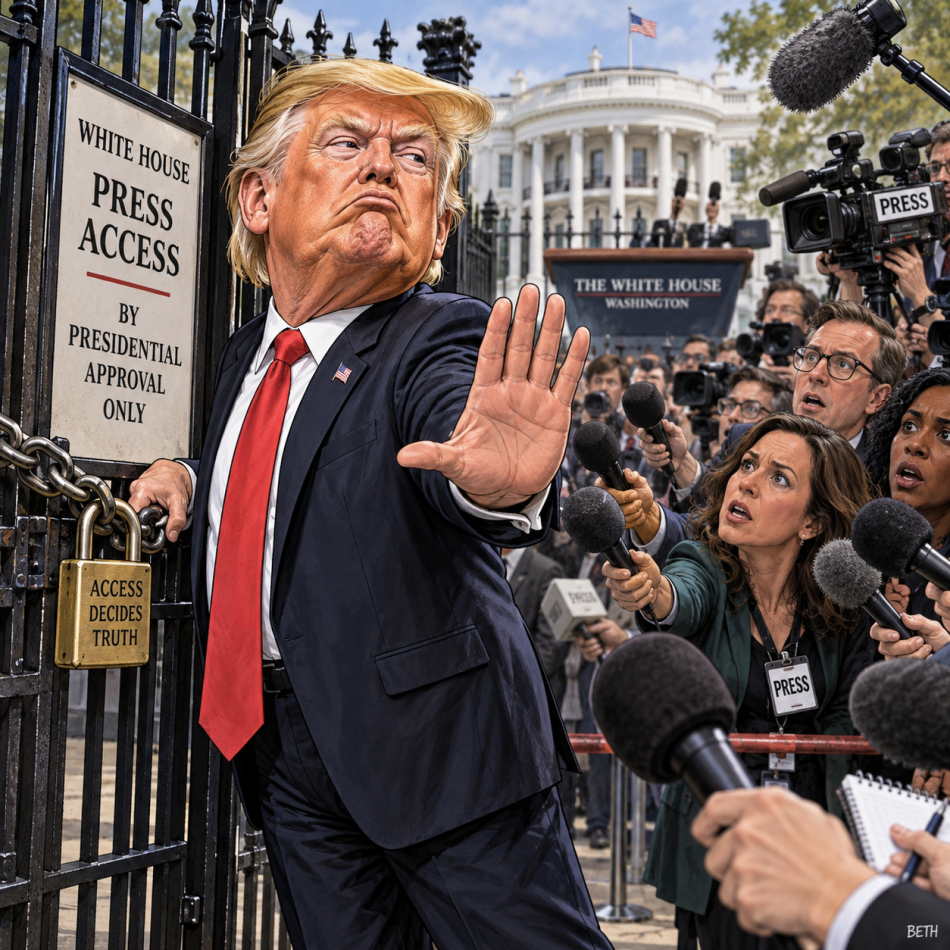
From “fake news” to barring media organizations from the White House; the U.S. president is moving his confrontation with the press from political insults to a battle over access, information, and who has the right to define the truth
Prepared and Analyzed by | Strategic Media Department – BETH Agency
Supervision: Abdullah Al-Omairah
Donald Trump’s war with the media did not begin this week.
It began years ago, when he turned the phrase “fake news” into a permanent political weapon against institutions that criticize him or question his narrative.
But what is new is that the war has changed.
It is no longer a dispute between a president and journalists over a headline or a report.
It has become a dispute over who enters the White House, who gets close to the president, who participates in the coverage, and who is considered an acceptable journalist in the first place.
On September 18, Trump announced that CNN, MS NOW and Politico would be barred from entering the White House, justifying the decision by pointing to what he describes as their long history of “fake news” coverage. Journalists from the three organizations were subsequently denied access, before the outlets filed a federal lawsuit accusing the administration of violating their constitutional rights under the First and Fifth Amendments.
The Media Responds
The American press did not stop at protesting.
CNN, MS NOW and Politico turned to the courts, while major television networks suspended participation in some shared coverage of the president in solidarity with the excluded organizations. The Press Pool system, designed to ensure shared coverage of presidential movements when space is limited, has itself become a new arena of confrontation between the White House and the media.
This is an important development.
Because the press is not merely defending a particular organization; it is defending a principle that says access to power should not become a reward for editorial approval.
The Courts Enter the Confrontation
The dispute quickly moved from the doors of the White House to the courtroom.
CNN, MS NOW and Politico filed a federal lawsuit against the administration after being denied White House access and requested a temporary court order restoring that access, with a hearing scheduled for Wednesday before Judge Timothy Kelly.
The case is not constitutionally simple. The White House has the authority to regulate access and security arrangements, but the dispute begins when exclusion becomes linked to editorial positions or the substance of coverage.
American legal precedent distinguishes between regulating access and punishing a media organization because of its viewpoint, placing the legal basis of the ban under direct judicial scrutiny.
The expected ruling, however, will not settle the entire case.
The court will first consider whether the three organizations should regain temporary access while the lawsuit proceeds, or whether the ban should remain in place until the underlying dispute is resolved.
If an order restoring access is issued, it would place an early restriction on the White House’s ability to exclude media outlets because of their coverage.
If the request is denied, the case will continue and could later move to appeal.
Either way, the case extends beyond Trump and these three organizations.
The question that will remain before the court is:
Where does the president’s authority to regulate access to the White House end, and where does the press’s right not to be punished for its views or coverage begin?
Who Governs the Press?
In the United States, there is no “Ministry of Information” that grants newspapers a general license to practice journalism. The starting point is the First Amendment to the Constitution, which protects freedom of speech and the press and places strict limits on government interference in media content.
Laws and courts, led by the Supreme Court, then determine the boundaries of that protection.
What is striking is that the U.S. Constitution protects the press without granting a closed category exclusive ownership of the profession; constitutional protection does not simply depend on holding a press card or belonging to a major institution.
In Europe, freedom of the press and expression is also protected, but its exercise is associated with duties and responsibilities and may be subject to specific and proportionate legal restrictions to protect security, the rights of others, privacy and the prevention of crime.
Here lies the difference between freedom and lawlessness.
Freedom does not mean that a journalist is exempt from verification, correction, defamation laws or privacy rules. At the same time, responsibility does not mean that the authorities alone should decide what may or may not be published.
The more precise equation is:
Broad freedom to publish, matched by professional and legal responsibility after publication.
For this reason, the American press is not a state institution and cannot be described as “national” in the sense of defending the government. It operates within an American society, legal system and constitution, and one of its central functions is to monitor and hold power accountable.
In the digital age, almost anyone can publish.
But two things must be distinguished:
Freedom to publish is a broad right.
Journalism, however, is a profession with standards.
Not everyone who owns an account or a camera becomes a journalist, just as the absence of licensing does not mean the absence of professionalism.
Freedom protects the right to publish; professionalism gives publication its value.
The danger begins when one side, whether the government or the media itself, tries to monopolize the definition of truth.
Why Is Trump Doing This?
Trump does not hide his reasoning.
He believes that some organizations are not practicing journalism, but are instead taking part in a political campaign against him.
He repeatedly argues that negative coverage, or coverage he considers misleading, is not merely criticism but a threat that can extend to “national security.”
From the perspective of his supporters, the president is not attacking a free press, but confronting institutions that have lost their neutrality and become political actors.
His critics, however, see a dangerous line:
Who decides when the media is biased, and when criticism of the president becomes grounds for losing access to him?
Why Now?
The confrontation is intensifying at a particularly difficult moment for Trump.
The war comes first. The confrontation with Iran has entered its seventh month, and its costs have reached the American public through fuel prices, broader price pressures and growing concern over how long the conflict may last, while a Reuters/Ipsos poll showed that public approval of Trump’s handling of the war remains limited.
Then comes the economy. The cost of living and rising prices are putting pressure on the president’s approval ratings, which stood at around 32% in the latest Reuters/Ipsos poll.
On top of that, the midterm elections are approaching, turning the war, the economy and every new confrontation into political material for Democrats and other Trump opponents, while some Republican candidates have begun distancing themselves from his positions on the war.
For that reason, the escalation in his battle with the media may not be separate from this moment: a president under external, economic and electoral pressure, facing a press that is asking more questions at the most sensitive possible time.
The Battle Predates the White House
Trump did not invent conflict between the presidency and the press.
American history is full of confrontations between presidents and the media.
What distinguishes Trump is that he has made this confrontation part of his political identity.
To him, the media is not merely an intermediary carrying his message.
At times, it is an electoral opponent and a tool for mobilizing his base.
Trump has therefore benefited from attacking major media institutions as much as he has been harmed by them; each new confrontation reinforces his image among supporters as a president challenging what they call “the media establishment.”
But the Media Has Changed Too
The paradox is that Trump is fighting a media environment that is no longer what it once was.
Twenty years ago, the White House needed major networks and newspapers to reach the public.
Today, the president can reach tens of millions directly through his platforms and accounts, without an editor, presenter or journalistic question; the White House has also added “Trump TV,” launched on Monday evening and broadcasting around the clock.
This changes the balance of power.
The press no longer monopolizes access to the public.
And the president no longer depends on it as his predecessors once did.
Yet it still possesses something a personal platform does not provide:
the unwanted question.
And that may be the essence of the battle.
A Battle Over the Middleman
Trump wants to reduce the role of the intermediary.
The press wants to preserve its function as the institution that questions power rather than simply transmitting what power wants to say.
The war, therefore, is not only about the media.
It is about the very idea of mediation.
Does the citizen need a newspaper or television network to interpret what the president says?
Or is it enough to hear him directly?
Is direct communication more democratic because it removes barriers?
Or less democratic because it removes the question?
BETH Analysis
The current confrontation does not determine who is “truthful” and who is “false.”
The press can make mistakes, show bias and exaggerate.
And the president has every right to criticize it and reject its narrative.
But the situation changes when the battle shifts from criticizing content to controlling access.
Then the question is no longer:
Does Trump like the media?
It becomes:
Can those in power choose the press that monitors them?
At the same time, there is another question the media itself must confront:
Has it maintained enough distance between journalism and politics over the years, or has it also contributed to turning the relationship into open warfare?
That may be why the current battle appears larger than Trump and larger than CNN.
It is a new test of a very old relationship:
Who watches whom?
The president controls the White House.
The press controls the question.
And each side is now trying to decide which is more powerful.
Freedom and the Law
It is often said that the West built its experience on the equation of freedom and law.
But that equation does not mean freedom is absolute, nor that the law has the right to suffocate it.
Freedom without responsibility can become disorder, while law without safeguards can become a form of power that uses legal texts to silence those who disagree.
That is why the scope of freedom is not measured only by what the law permits, but also by the law’s ability to protect the dissenter, the critic and even the person who irritates those in power.
This is where Trump’s war with the media reveals the real challenge.
The president says he is protecting the truth from biased media.
The media says it is protecting society from a government that wants to choose who is allowed to question it.
Between the two stands the law.
Not to grant either side total victory, but to prevent either from monopolizing power or truth.
True freedom does not mean the absence of law; it means the presence of a law that protects your right to speak, protects me from being wronged by you, and protects society from either side becoming a power without limits.
And this may be the hardest test for any country that says it is a nation of freedom and law:
Not how it deals with those who agree with it, but how it protects the rights of those who do not.
Who Needs Whom?
Today, the president can bypass the press in delivering his message, but he cannot eliminate its role.
A personal platform says what the president wants to say; the press looks for what he does not want to say and asks the question he did not choose.
The press, in turn, cannot dispense with power, because those in power remain among the most important subjects of its scrutiny and accountability.
So perhaps the real question is not: Who will win?
The president can bypass the intermediary, but he cannot eliminate the question.
And the press can hold the president to account, but it cannot replace him in speaking directly to the public.
And in the space between the message and the question, this war will remain open.