



World Press Today, September 22 | BETH Eyes
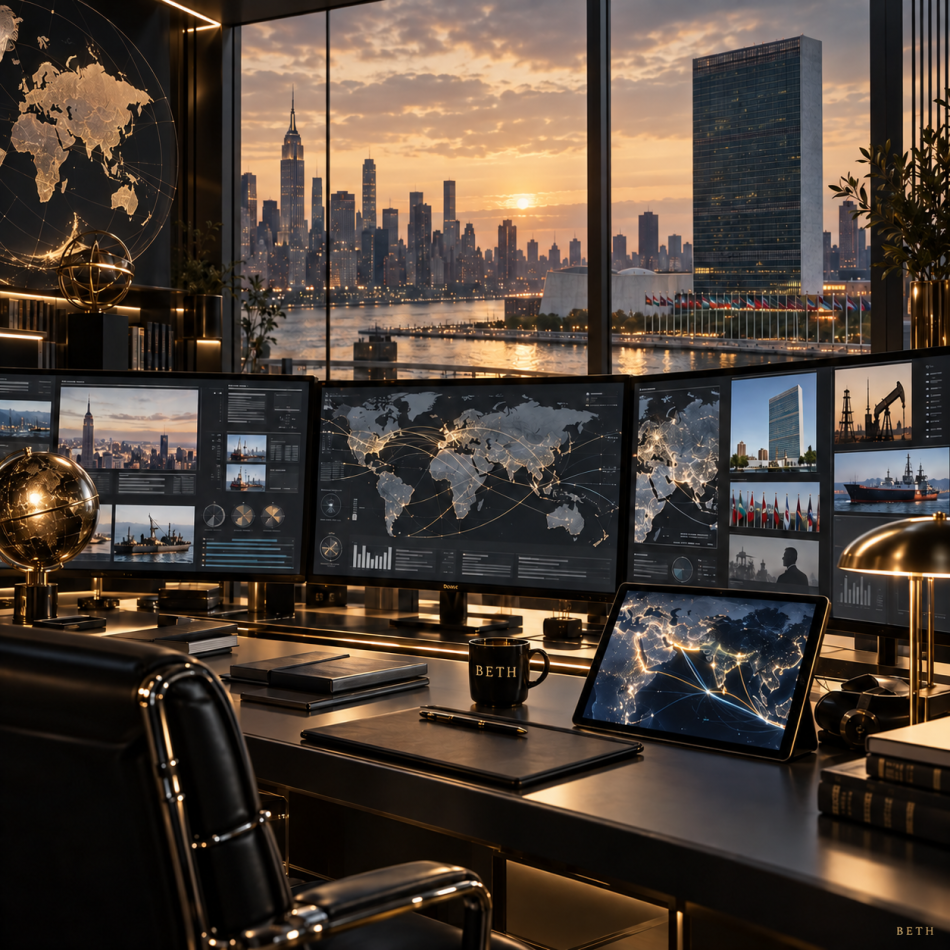
New York brings the world’s wars under one roof; Iran, Hormuz and Yemen move to the forefront, Ukraine enters through the energy gate, and the Trump-Xi summit casts its shadow over Asia.. while Saudi Arabia appears in the international press at the intersection of energy security and navigation
Prepared and Analyzed by | Strategic Media Department – BETH Agency
Supervision: Abdullah Al-Omairah
New York Takes the Lead
The international press this morning is not treating the United Nations General Assembly as an ordinary speaking occasion.
Around 130 heads of state and government are gathering in New York at a time when the Middle East war coincides with the war in Ukraine, energy disruptions, and rising concern over artificial intelligence. For this reason, the questions being asked are becoming less about what will be said on the podium, and more about what bilateral meetings outside the hall may produce.
The American and European press places President Donald Trump at the center of the diplomatic movement; he enters a busy day of meetings related to Iran, Ukraine and the Gulf states, while Iranian President Masoud Pezeshkian and his Foreign Minister Abbas Araghchi have arrived in New York amid the continuation of the war and the absence of any announced agreement to hold a U.S.-Iranian meeting.
Washington | War and Energy
The most striking American angle is not the war alone, but its cost to the energy system.
The Wall Street Journal focuses today on the continued risks in Hormuz, with oil rising again, and points out that shipping traffic has become more active despite the threats, while Saudi Arabia has moved to increase its use of the strait.
The newspaper also reveals a U.S. proposal to establish an initial fund of around $5 billion to support the rebuilding and fortification of energy infrastructure in the Gulf and increase its resilience against conflict and disruptions to export routes. The proposal is still under discussion, and consultations include Saudi Arabia, the UAE and other countries in the region.
What is notable here is that the American discussion has begun shifting from how do we protect the tanker today? to how do we redesign the energy system?
Paris | Two Battles and One Barrel
Le Monde almost brings Ukraine, the Middle East and oil prices together under one headline.
Macron discussed with Trump in New York ideas to reduce pressure on the energy market, including an attempt to stop mutual Russian and Ukrainian attacks on energy facilities, alongside a French move to restore freedom of navigation in Hormuz. Paris also says it is ready to contribute to protecting Saudi energy facilities in Yanbu and the East-West corridor within a defensive approach.
Here, a relationship appears that was not this strong months ago:
The oil barrel has become a link between the Ukraine and Middle East fronts.
A strike on a Russian refinery, a tanker in Hormuz, or a facility in the Gulf; all now enter the same equation watched by the consumer, the central bank and the government.
London | War and Artificial Intelligence
The Financial Times places alongside the wars a different file: artificial intelligence.
British Prime Minister Andy Burnham intends to use his appearance at the United Nations to call for a greater international effort to control the risks of artificial intelligence, and wants to make the issue one of the pillars of Britain’s G20 presidency in 2027. At the same time, he carries with him the files of Ukraine, the Middle East and relations with Washington, after London’s decision to provide limited defensive support to Saudi Arabia.
The British picture is striking: the old war with weapons, and the coming war with technology, on one agenda.
Beijing | We Do Not Want Another Front
China Daily presents the Iranian scene from a different angle; Tehran speaks of continuing the fighting and negotiations at the same time, while Beijing watches the possibility of the crisis extending to Yemen and its impact on trade and energy. The newspaper also highlights that Iran is suffering severe economic contraction as a result of the war and trade disruption.
In the broader Chinese press, the expected Xi Jinping-Donald Trump summit in Washington on Thursday appears as an event that precedes many other files. Two days before it, the United States, Japan and South Korea announced a new mechanism for consultation on economic security and supply chains, while reaffirming their position on stability in the Taiwan Strait.
This means that New York is only a stop; Asian eyes will then turn directly to Washington.
Moscow and Kyiv | Energy Enters the Negotiations
The Ukrainian war is not absent, but today it appears through a different entry point.
Trump pressured Zelenskyy to stop targeting Russian refineries because of the impact of the strikes on diesel supplies and prices, while Kyiv maintains that targeting the Russian energy sector is a military and economic pressure tool. A Trump-Zelenskyy meeting is expected today in New York.
In return, Europe remains committed to sanctions on Russia, despite a dispute within the Union over lifting sanctions on some Russian businessmen. U.S. Secretary of State Marco Rubio is also expected to meet his Russian counterpart Sergey Lavrov in New York.
So even Ukraine comes to the United Nations carrying the same question that follows the Iran war:
Can diplomacy stop what energy does to war, and what war does to energy?
Saudi Arabia in the International Press
Saudi presence today is clear, but it comes through a different gateway than in previous days.
The Wall Street Journal focuses on the return of a larger portion of Saudi oil exports to the Hormuz route, and sees in this a revelation of how difficult it is to dispense entirely with the strait, even for a country that has built extensive infrastructure to bypass this geographical point.
In Paris and London, Saudi Arabia appears as a major center in calculations of protecting energy infrastructure; France spoke of possible defensive readiness around Yanbu and the East-West corridor, while Britain announced limited defensive support that includes air capabilities. These details appeared in Western sources, while no official Saudi confirmation had been issued as of this morning for everything published regarding the French and British arrangements.
In New York, the statement by G7 foreign ministers added another political dimension, condemning Houthi attacks on Saudi Arabia and calling on Iran to stop arming and supporting the group.
The image being created by the press today of Saudi Arabia is no longer linked only to oil; but also to the security of the route that carries the oil.
Arab Press Brief | From the Atlantic to the Gulf
Iran, the Houthis and the United Nations occupy wide areas of Arab coverage this morning.
Asharq Al-Awsat places on its front page the G7 call on Iran to stop arming the Houthis, alongside Asian developments including a new North Korean missile test.
Al-Araby Al-Jadeed focuses on the opening of the 81st session of the General Assembly under the weight of wars and international division, while also highlighting casualties in new Russian attacks on Ukraine ahead of the Trump-Zelenskyy meeting.
Arab economic coverage, meanwhile, is closely watching oil; prices have returned to rising after four sessions of decline, while markets await any indication of the possibility of opening a U.S.-Iranian track in New York and improved passage through Hormuz.
The Saudi press highlights the United Nations’ renewed condemnation of Houthi attacks on the Kingdom, including attempts to target civilians and energy facilities.
Inside the Capitals | Each Country Has Its Concern
New York: How can dozens of meetings be turned into implementable agreements?
Washington: How can the cost of the Iran war be reduced without granting Tehran free gains?
Paris: How can energy in the Gulf and Ukraine be protected at the same time?
London: How can Britain combine Middle East security, regulation of artificial intelligence, and the reshaping of its relationship with Washington?
Beijing: How can the war be prevented from striking trade and energy before the Xi-Trump meeting?
Moscow and Kyiv: Will energy facilities become the first file open to agreement, or remain the most important tools of mutual pressure?
These are not the newspapers’ answers so much as the questions revealed by their headlines today.
Beyond Politics | Artificial Intelligence Enters the Hall
Among the notable items outside the war, more than twenty countries, including Germany and Canada, signed a statement calling for stronger human oversight of artificial intelligence systems, while the United States, China and France did not join it, according to Le Monde.
This is a file worth following; because the United Nations is no longer discussing only how to stop an existing war, but how to prevent a new technology from producing crises that have not yet begun.
Indicator Pulse
Oil remains the indicator most quickly responsive to any political whisper from New York; Brent is moving above elevated levels, while markets alternate between fear of disruption in Hormuz and hope for a negotiating track. In the United States, Monday’s decline in oil and investor optimism about artificial intelligence helped push the Nasdaq to a record level, before crude prices returned to rising on Tuesday morning.
And this is today’s paradox: war raises oil, one word about negotiations lowers it, then a new piece of news sends it rising again.
BETH Eyes | Beyond the Pages
There is no single story dominating the world press today.
There is one place dominating it: New York.
Iran came to defend its narrative.
Trump came carrying the files of Iran, Ukraine, the Gulf and China.
Europe came looking to ease the pressure of energy and wars.
And Beijing is watching New York, while preparing for what it considers more important two days later: the Xi-Trump meeting.
For this reason, the most important journalistic material in the coming hours may not come from a speech before the General Assembly.
It may come from the door of a closed room, a meeting that was not on the schedule, or a short sentence after a bilateral meeting.
This week, the podium appears to belong to the world.
But the real decisions may be made away from the microphone.