World Press Today, September 21 | BETH Eyes
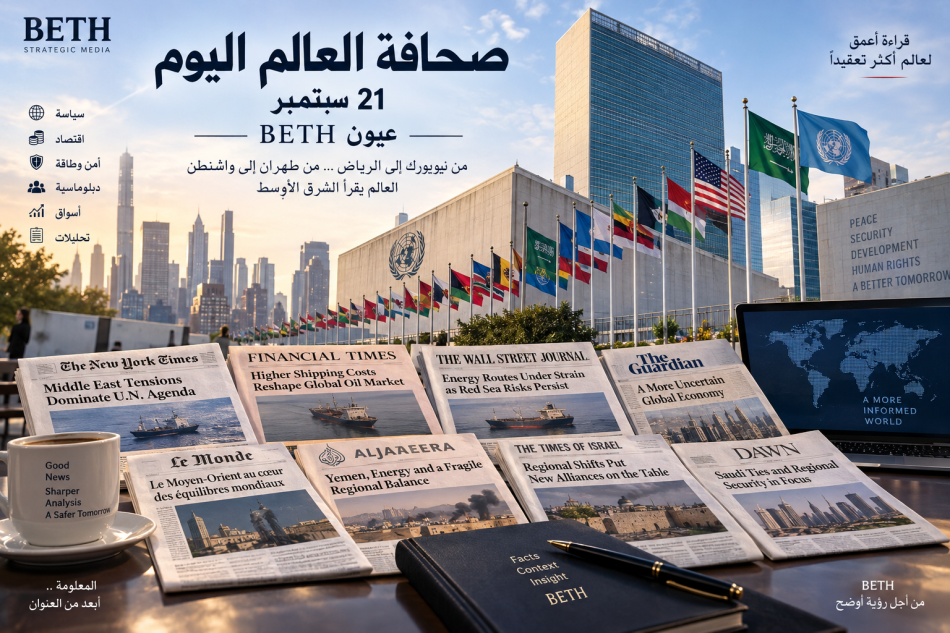
Saudi Arabia, Yemen and the Red Sea move to the forefront of international coverage; New York prepares for a UN week burdened by wars, energy markets shift the cost of the crisis from the price of oil to the cost of moving it, while Washington and Beijing enter decisive summit days
September 21, 2026
Monitoring and Analysis | Strategic Media Department – BETH Agency
Supervision: Abdullah Al-Omira
The global press today is distributed across three major circles:
The Middle East war and energy routes.
New York and the United Nations high-level week.
And the global economy, which has begun paying the cost of war in shipping, energy, interest rates and markets.
At the intersection of these three circles stands Saudi Arabia; not because it is a party to every file, but because its security, global energy, the Red Sea, Yemen and Gulf diplomacy have become more interconnected in international coverage than ever before.
Saudi Arabia in the Global Press
Saudi Arabia is prominent today in the international press through two completely different gateways:
Security.
And energy.
The Wall Street Journal focused today on the direct economic consequence of the disruptions around Saudi Arabia and the Gulf: a shortage of giant oil tankers and a rise in their operating costs to record levels, with Aramco forced into more complex arrangements to move crude through Hormuz and the Gulf of Oman. The newspaper sees the problem as no longer being only the price of oil, but the scarcity of the means to transport it itself, which could keep fuel prices high even if crude prices fall.
The Financial Times, meanwhile, presents a darker picture, linking the Houthis, pressure on the Red Sea, oil disruptions and Saudi infrastructure. But it is important here to distinguish between facts and the newspaper’s interpretation of the scene; expressions such as “attempts to pressure Saudi Arabia from all directions,” or the suggestion that the balance of power has shifted permanently, are the newspaper’s analysis, not a militarily settled conclusion.
In U.S. coverage, the Associated Press continues to focus on Houthi attempts to target Saudi Arabia, but today it also carries Houthi rhetoric warning other countries against supporting Riyadh. The value of the piece is not in treating the threat as an indicator of power, but in revealing the political message the group is trying to send at this stage.
What Does the International Picture Say?
What stands out is that international interest in Saudi Arabia has moved beyond the traditional question of oil to a broader question:
How does a central state in the global energy market protect itself while at the same time maintaining the flow of trade and energy through two unstable regions?
This explains why Saudi air defense, Yemen, Hormuz, Yanbu and Bab al-Mandab are increasingly read internationally as part of one story.
At the Security Council itself, several countries condemned Houthi attacks on Saudi Arabia and linked them to threats against navigation and global trade, while interventions in the Council affirmed support for the Kingdom’s right to protect its territory and citizens under the UN Charter and international law.
Arab Press Brief | From the Atlantic to the Gulf
Three main files intersect in the Arab press today: the U.S.-Iran war, Yemen, and the security of maritime routes.
Asharq Al-Awsat led with the return of mutual threats between Washington and Tehran, noting Trump’s interruption of his break and return to Washington, against Iranian warnings of a new attack, alongside Turkish and Pakistani efforts to reduce escalation.
Al Jazeera News Website follows the scene on two parallel fronts: the U.S.-Iran escalation and developments in Yemen, where it reported government forces carrying out strikes on Houthi positions in Al-Bayda, amid continuing battles on several fronts and U.S. warnings to its citizens of a possible widening of the escalation.
Al Arabiya Channel Website continues its regular coverage of the Gulf war and the Russia-Ukraine war, highlighting today warnings from the Revolutionary Guard to the United States, the Iranian president’s welcome for negotiations, and developments in drone production in Russia.
In Saudi Arabia, Okaz highlights the field angle from Yemen, reporting from the Taiz Axis Command the recapture of new positions and continued fighting in Al-Kadha, Jabal Habashi and Al-Wazi’iyah, with clear focus on the western coast and Bab al-Mandab. The newspaper also highlights the wave of Arab and international condemnations of Houthi attacks on the Kingdom.
From a parallel Saudi political angle, local media report Foreign Minister Prince Faisal bin Farhan’s affirmation in New York of the Kingdom’s commitment to the security of international navigation, respect for state sovereignty, and the peaceful resolution of disputes, alongside Gulf coordination ahead of the General Assembly.
In Arab media outside the Gulf, attention remains focused on the larger question: Are we facing a new military round, or final pressure before the opening of a broader negotiating track? It is an angle repeated across coverage in the Levant and North Africa, with differences in tone more than in the underlying facts.
BETH Analysis
The Arab scene is not unified in its interpretation of the war.
Some newspapers put military escalation first.
Others read it through the lens of diplomacy and mediation.
Gulf newspapers give wider space to Saudi security, Yemen and Bab al-Mandab.
But the common thread today is clear:
The region no longer views the war as merely a U.S.-Iran confrontation; it is increasingly seen as a crisis whose effects extend to Gulf security, Yemen, navigation, energy and the entire Arab economy.
This is what makes the window genuinely “From the Atlantic to the Gulf” rather than merely a survey of two newspapers.
From tomorrow, the standing rule for this section should be: five to seven Arab sources daily, from different regions, taking one angle from each so the section remains concise and diverse.
New York: The World Enters One Room
The general debate of the 81st session of the United Nations General Assembly begins tomorrow, with around 130 heads of state and government participating, under the theme “Restoring Trust and Managing Transformation.” Alongside wars, the week’s agenda includes climate, development, health, artificial intelligence and global security.
But regional and international media largely agree that the Middle East will dominate a large part of the week: Iran, Yemen, Hormuz, Bab al-Mandab, Palestine and energy. The Turkish press describes the UN gathering as one likely to be dominated by Middle East turmoil, with the U.S.-Iran war and maritime security directly present.
Most importantly, New York now brings together in one city:
Washington.
Tehran.
Riyadh.
The Gulf capitals.
And European and Asian powers.
This makes side meetings and diplomatic corridors at times more important than the speeches delivered from the podium.
Israel Watches Saudi Arabia From Its Own Angle
In the Israeli press, Saudi Arabia and Yemen appear from a different perspective.
The Times of Israel presents an analysis that sees Houthi escalation as a possible opening for a larger Israeli role in regional security arrangements, and suggests that Saudi Arabia may seek additional security partners. This is an Israeli reading and a potential Israeli interest, not an expression of an announced Saudi position.
This coverage matters because it reveals something beyond the Houthis:
Israel is watching how instability in the Red Sea and Yemen may reshape the regional security network, while seeking a place within it.
Israeli press coverage therefore also needs to be read as an attempt to understand the position Israel wants to occupy in the emerging regional order.
Pakistan: The Mecca Defense Agreement Under Media Test
The Pakistani press continues to place the Mecca Defense Agreement at the forefront of debate.
Dawn reports Pakistani military officials saying that the agreement is defensive and intended for collective deterrence, and that it carries no “regional ambitions.” Pakistan’s Foreign Ministry also says its operational mechanisms are still being built, and that any move toward direct military intervention is not automatic.
But Pakistani interest reveals a larger question:
When does the agreement move from a political and strategic framework into a joint operational structure?
This question has become more prominent after the attacks on Saudi Arabia, particularly following earlier remarks by Pakistan’s defense minister that the agreement could come into effect if the confrontation expands to the Kingdom.
India: Why Has the Alliance Not Moved?
The Indian Express yesterday posed a direct question: Why have Türkiye, Pakistan and the United States not entered the confrontation with the Houthis militarily, despite having defense arrangements with Saudi Arabia?
But the article itself shows that the answer does not lie in weakness of the agreements, but in differences in their scope, their operational readiness, and each country’s calculations toward Yemen and Iran.
This is an important angle:
Alliances are not measured only by what is written in their texts.
They are also measured by the timing of their use, the conditions governing their use, and the political and military interests behind them.
China: Trump and Xi Ahead of the Summit
In the East, attention is turning to Chinese President Xi Jinping’s visit to the United States between September 23 and 25 and his meeting with Trump.
The American press sees Xi entering the summit backed by strong Chinese trade performance and a large surplus, while Washington wants to discuss trade, artificial intelligence, Iran and other strategic issues. Western analyses believe the United States wants China to use its economic influence with Tehran to help reduce escalation, though how far Beijing is prepared to do so remains unclear.
Here, today’s files intersect:
China needs energy stability.
America wants greater pressure on Iran.
And the Gulf has become part of the U.S.-China calculation itself.
Energy: The Barrel Is Not the Only Problem
Perhaps the most important economic shift in today’s press is that attention is moving from the price of oil to the cost of moving it.
The Wall Street Journal says the cost of chartering some giant tankers has exceeded $1 million per day, while longer routes and ship-to-ship transfers have effectively tied up part of the global fleet.
The Financial Times tracks another aspect of the crisis: a sharp collapse in commercial container traffic through Hormuz, higher insurance costs and longer journey times, with some cargo diverted to more expensive ports and alternative routes.
This produces today’s economic line:
The price of oil may fall, while the bill does not.
Because consumers do not pay only for crude.
They also pay for:
Transport.
Insurance.
Delay.
And risk.
Markets Fear Something Bigger
In London, The Guardian raises a broader question: Are the ingredients of a new financial crisis beginning to gather?
The article links higher energy prices, rising bond yields, and tension in technology and artificial intelligence stocks, but it does not say that a financial crisis has become inevitable; rather, it warns that the combination of these factors makes markets less comfortable than they appear.
This reading takes us back to what we said yesterday:
War does not need to bring down the global economy in order to hurt it; it is enough to make energy, money and shipping more expensive at the same time.
Inside the Capitals | Each Country Has Its Own Concern
Washington: Iran first, then the Xi meeting, and the domestic and international cost of the war.
New York: receives world leaders as the Middle East becomes the most urgent file in diplomatic corridors and side meetings.
Riyadh: security, Yemen, the Red Sea, energy and Gulf coordination at the United Nations.
Tehran: preserving tools of pressure, raising the cost of war, while keeping a political window open through New York.
Ankara and Islamabad: building the mechanisms of the Mecca Agreement without automatically rushing into a new war.
Tel Aviv: watching Yemen and Iran and asking about its place in the new security arrangements.
Beijing: the Washington summit, trade, and the Gulf energy it needs.
Europe: energy, inflation, interest rates, and fear that Middle East instability will spread more widely into the economy.
BETH Eyes
The picture presented by the global press today does not say that the center of the world has moved to the Middle East.
But it says something more precise:
The Middle East has become the place where several global crises intersect at the same time.
Energy security.
Freedom of navigation.
Iran.
Yemen.
U.S.-China relations.
And the global economy.
Saudi Arabia stands at the center of a large part of these intersections; a major energy producer, a state overlooking both the Red Sea and the Gulf, a principal actor in Yemen’s security, and a political and economic partner of the major powers.
But what deserves the most attention today is not the size of the headlines.
It is which of them will turn into a decision.
This week will fill the world with words.
The real test will be:
Which words will remain speeches, and which will turn into actions that change the scene?