



Saudi Arabia: How Is Power Built?
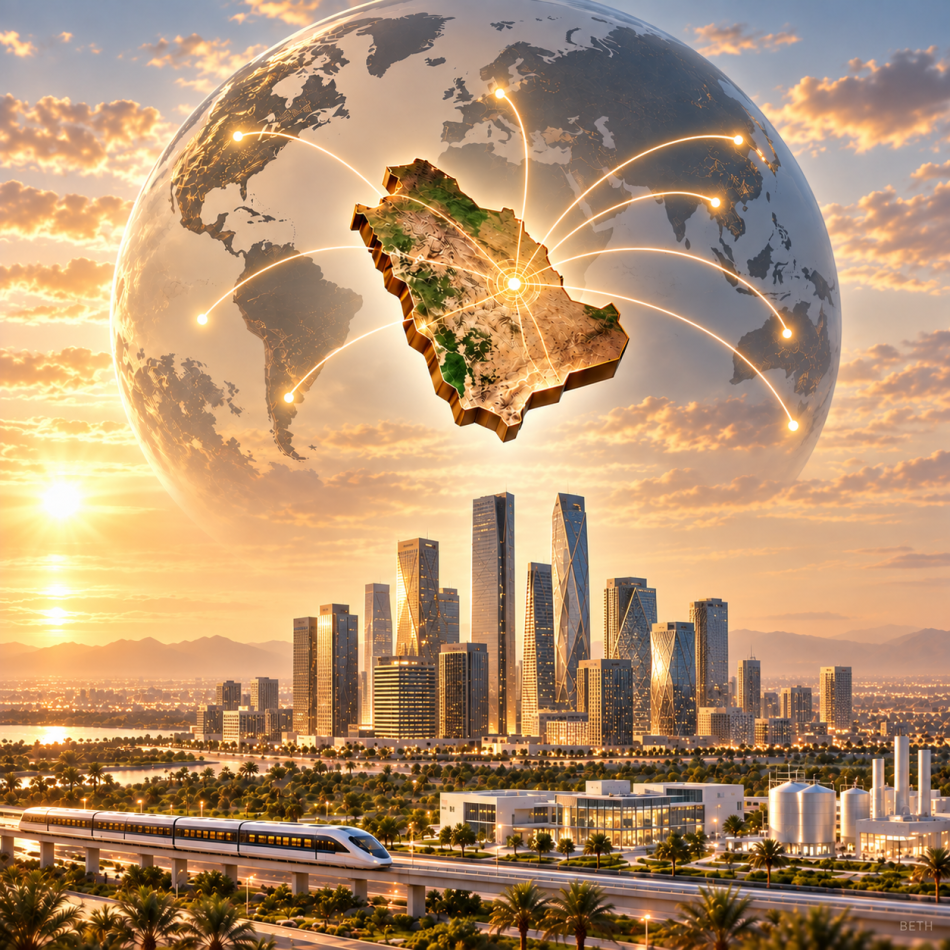
An economy exceeding $1.27 trillion, the world’s eighth-largest military spender, third among G20 countries in competitiveness, and a location at the crossroads of energy and trade; beyond that, an Islamic standing and an aid network that has reached 175 countries
Special Report | BETH
A nation’s power is not a single number.
A country may possess a large military and a weak economy.
It may have wealth without political influence.
It may occupy an important location, yet lack the stability needed to turn that location into influence.
That is why no single international ranking can say, on its own: this is “the most powerful” country.
But when indicators of the economy, defense, competitiveness, investment, financial stability, location, and political and humanitarian influence are brought together, Saudi Arabia emerges as a country with several sources of power operating at the same time.
And this is where the story begins.
The Trillion-Dollar Economy
Saudi Arabia’s gross domestic product reached around $1.277 trillion in 2025, placing the Kingdom at roughly nineteenth globally in nominal GDP according to IMF and World Bank data. It is the only Arab country in the G20, whose members collectively account for around 80% of global GDP and three-quarters of international trade.
But more important than size is the transformation taking place within the economy.
In its latest review, the IMF said the economy entered 2026 with strong momentum after growth of 4.6% in 2025, supported by non-oil activity and domestic demand, alongside low inflation and a banking sector with strong buffers. Even amid regional war pressures and disruption around the Strait of Hormuz, the Fund described the Saudi economy as showing resilience and adaptability, supported by strong fundamentals and diversified oil and logistics infrastructure.
This is a central point:
The strength of the Saudi economy no longer lies in oil alone, but in its ability to keep functioning when oil itself comes under pressure.
Third Among the G20 in Competitiveness
In the 2026 IMD World Competitiveness Ranking, Saudi Arabia advanced to 13th globally out of 70 economies, and third among G20 countries.
The index is built on four pillars: economic performance, government efficiency, business efficiency, and infrastructure.
This gives a more precise meaning to the word management.
Management is not the number of decisions a government issues, but its ability to convert resources into infrastructure, investment, regulation, services, and an environment in which companies can operate.
The result is also visible in foreign investment. According to UNCTAD, Saudi Arabia rose to 13th globally in foreign direct investment inflows in 2025, after inflows reached $32.6 billion, up by around 53% from the previous year.
Capital does not look for slogans; it looks for opportunity, stability, and the ability to enter, exit and operate.
The Power of Long-Term Capital
Alongside the public and private economy stands a different form of financial power: the Public Investment Fund.
PIF’s assets under management exceeded $900 billion by the end of 2025, up from around $150 billion in 2015. Since 2021, its investments in new projects inside the Kingdom have exceeded $199 billion, while the Fund estimated its cumulative contribution to real non-oil GDP at more than $342 billion between 2021 and 2025.
This is not merely domestic financial strength.
When a sovereign wealth fund of this scale owns stakes, partnerships and investments across sectors, countries and markets, money becomes a network of long-term international economic relationships.
Eighth Globally in Military Spending
Military power also requires careful interpretation.
The Stockholm International Peace Research Institute, SIPRI, estimated Saudi military spending in 2025 at around $83.2 billion, placing the Kingdom eighth globally in military expenditure.
Meanwhile, Global Firepower, a private index rather than a government assessment or final judgment on combat capability, ranks Saudi Arabia in 2026 at 25th out of 145 countries in conventional military power, and second in the Gulf under its methodology. The index uses more than 60 factors, including air power, land forces, naval capability, financing, logistics and geography.
The point is not the ranking alone.
Saudi Arabia combines substantial financial capacity, advanced weaponry, significant air power, vast geography, defense partnerships and a growing ability to localize military industries.
Money, in other words, is not separate from defense. It finances a long-term ability to modernize.
Geography That Cannot Be Moved
Some sources of power can be built.
Others cannot be purchased: location.
Saudi Arabia overlooks the Red Sea to the west and the Gulf to the east, and sits between Asia, Africa and Europe. Around 13% of global trade passes through the Red Sea, while the Kingdom’s location gives it access to markets comprising more than six billion people.
This helps explain why any disruption in or around Saudi Arabia quickly becomes global news.
The question is not simply one of a large country.
It is a country positioned between:
Hormuz.
The Red Sea.
Bab al-Mandab.
Asian markets.
Europe.
And Africa.
Add energy production, ports, railways, roads, airports and investment in logistics, and geography turns from a map into economic and political power.
Reliability: The Power That Is Not Seen
A strong state needs something less visible than weapons and oil: trust.
Economically, trust appears in risk assessments. In 2025, Saudi Arabia held high investment-grade sovereign ratings: A+ from S&P, A+ from Fitch, and Aa3 from Moody’s, all with stable outlooks, according to the National Debt Management Center.
Politically, it appears in the Kingdom’s ability to maintain strategic relationships with powers that differ among themselves: the United States, China, Europe, Russia, India, Pakistan, Türkiye and the wider Islamic world.
The strength here is not that Saudi Arabia agrees with everyone.
It is that everyone has a reason to preserve the relationship with it.
Energy with one side.
Investment with another.
Security with a third.
Trade with a fourth.
And political, religious and humanitarian ties with others.
This flexibility raises the cost of ignoring Saudi Arabia in any major regional arrangement.
A Standing the Economy Cannot Create
Then there is a completely different source of strength.
Makkah and Madinah.
The Kingdom is not simply a major Islamic country. It is the home of the Two Holy Mosques and the annual destination of millions of Muslims for Hajj and Umrah. Jeddah also hosts the headquarters of the Organisation of Islamic Cooperation, which comprises 57 member states.
This standing cannot simply be converted into a number on a soft-power table.
It is an emotional and religious connection with peoples stretching from Indonesia to Morocco, and from Africa to Asia and Europe.
It gives Saudi Arabia a weight that no country acquires merely by increasing its GDP or military spending.
Why Does the World Pay Attention to Saudi Arabia?
For all these reasons, Saudi Arabia appears constantly in the international press.
When it makes an oil decision, markets move.
When it announces an investment, companies pay attention.
When its policy shifts on a regional issue, calculations in other capitals change.
When its maritime routes are threatened, energy and shipping prices move.
And when it hosts a summit, mediation effort or international meeting, it can bring together parties that may not easily sit at the same table.
Saudi news is no longer local in many cases, because the impact of Saudi decisions extends beyond its borders.
That is one practical definition of power.
Wisdom Is Not Weakness; It Is a Form of Power That Only the Wise Fully Recognize
What is described in Saudi policy as “wisdom” does not need rhetorical embellishment.
It can be measured more simply:
Can the state preserve its options?
A state that can speak with Washington and Beijing, work with both West and East, maintain its Arab and Islamic relationships, and protect its interests without confining itself to a single axis enjoys greater room for decision-making.
Power in politics is not the use of everything one possesses.
Sometimes it is knowing when to use it, and when to hold it back.
That is precisely why the world sometimes watches Saudi silence as closely as it watches Saudi decisions.
The Power That Gives
Here we reach what may be the most distinctive dimension of the Saudi picture.
Countries are usually measured by what they possess.
But there is another measure:
What do they do with what they possess when others are in need?
According to the Saudi Aid Platform operated by the King Salman Humanitarian Aid and Relief Centre, the total value of aid, contributions and services recorded to date stands at around $145.77 billion, or SAR 546.66 billion. The platform includes not only emergency relief, but also humanitarian, development and charitable assistance, contributions to international organizations, and services provided to visitors and refugees inside the Kingdom.
And the importance of the figure lies not only in its size.
Saudi aid recorded under projects alone amounts to $123.65 billion, distributed across 9,036 projects in 175 countries, spanning 48 sectors and implemented with 512 partners.
175 countries.
That may be the most eloquent line in the entire story.
Because it means the map of Saudi giving reaches almost the whole world.
Not Just a Food Basket
The details reveal something else of importance.
Of the projects recorded, development assistance exceeds $108.5 billion across 3,589 projects, covering industry and mining, budget support, transport, education, energy, water, health and financial services.
In other words, Saudi aid does not simply mean arriving after a disaster with a food parcel or a tent.
It includes:
A school.
A hospital.
A road.
Water.
Energy.
Agriculture.
Infrastructure.
And financing that helps a state regain the ability to stand on its feet.
Direct humanitarian assistance recorded on the platform amounts to around $14.7 billion across 3,816 projects, led by food security, health, shelter, early recovery, education, water and protection.
There are also 1,435 humanitarian volunteer projects, most of them in healthcare.
Who Benefits?
The platform clearly demonstrates the breadth of the geography.
Across the total recorded data, Egypt ranks first among recipient countries with around $32.5 billion, followed by Yemen with roughly $29 billion, Pakistan with $13.37 billion, Syria with about $7.95 billion, Iraq with $7.34 billion, and Palestine with around $5.58 billion.
But the platform’s lists extend far beyond the Arab and Islamic neighborhood.
From Mali and Benin in Africa, to Kosovo in Europe and Belize in Central America, dozens of countries have benefited from programs in education, health, water, energy and agriculture.
This is where describing aid as merely a political tool becomes far too narrow an interpretation.
Its geographic and sectoral spread is too broad to be reduced to a single political file.
Even Those Living Inside the Kingdom
There is another aspect that is rarely mentioned when discussing Saudi aid.
The platform records around $20.43 billion in services provided to visitors and refugees inside the Kingdom, including millions of Yemenis, Syrians, Rohingya and Sudanese who have benefited from education, healthcare and essential services.
In other words, part of the giving does not travel abroad.
The person comes, and the service reaches them inside the Kingdom.
Giving That Is Documented
Given the importance of this file, Saudi Arabia did not stop at providing assistance. It also created a platform to document it according to international standards linked to the OECD Development Assistance Committee, the United Nations Financial Tracking Service, and international aid transparency principles.
This matters for a simple reason:
Good that is not documented may disappear from the world’s memory, even if it reaches the person who needed it.
Saudi assistance has therefore moved from being a collection of efforts spread across many entities into a national record that can be measured, compared and tracked.
BETH Analysis
When we ask: why does Saudi Arabia matter?
The answer is not: because it has oil.
Nor: because it buys weapons.
Nor even: because it is a member of the G20.
Those are only parts of the answer.
Saudi power comes from the combination of things that rarely come together in one country:
A trillion-dollar economy.
Global financial and investment capacity.
Defense spending among the world’s largest.
A location between some of the most important routes for energy and trade.
Institutional and financial stability.
A religious standing that cannot be replicated.
A network of relationships extending East and West.
And the ability to be an investor in one place, a partner in another, a mediator somewhere else, and a donor elsewhere.
But perhaps the most beautiful part of the picture remains the final number:
175 countries have received Saudi aid.
Because power, when it preserves what it has, is called capability.
When it protects itself, it is called deterrence.
When it influences decisions, it is called influence.
But when it reaches a person whose religion, color and language it does not know, and gives them food, treatment, education, water or a path back to life, then power has another name:
Humanity.
Saudi Arabia’s strength can therefore be summarized in an equation broader than economics and military capability:
To be able to protect your interests, influence your surroundings, remain trusted by your partners, and be useful to those with whom you have no direct interest.
Perhaps this is precisely where the kind of power begins that no international ranking can fully capture.