


The Global Economy Pays the Bill
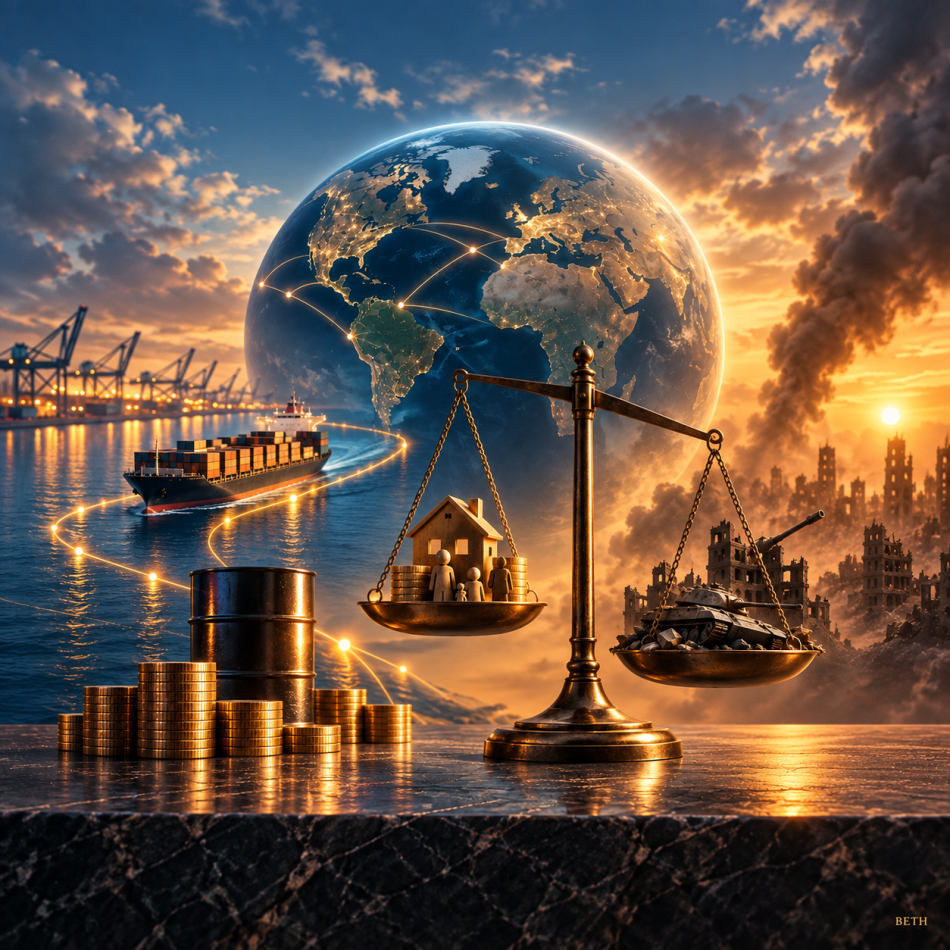
War is raising the cost of energy and shipping, inflation is pushing interest rates higher again, and growth is slowing; meanwhile, countries differ sharply in their ability to absorb the new wave of rising prices
Special Report | BETH
The war in the Middle East is no longer only a military crisis.
Its impact is moving through the global economy in a clear chain:
Maritime routes pressure energy.
Energy pushes prices higher.
Prices drive interest rates up.
And higher interest rates weigh on growth.
So the most important question is no longer: How high is the price of oil?
It is:
How far does the cost of war travel — to the factory, the truck, the aircraft, the home, and the loan?
Oil Is Only the Beginning of the Bill
Oil remaining above $100 does not simply mean more expensive fuel.
The pressure extends to diesel, aviation fuel, refining, shipping and insurance, then passes through to the cost of goods and services.
That is why the price of a barrel may fall slightly while transport and production costs remain high.
The energy shock is no longer a single price; it has become an entire chain of costs.
Inflation Pushes Interest Rates Higher
Rising energy costs are bringing inflation back to the forefront at a time when markets had been expecting interest-rate cuts.
But central banks have returned to tightening, and higher interest rates raise the cost of:
Loans.
Housing.
Corporate financing.
Government debt.
And new projects.
This is where the broader problem begins:
Prices are rising while borrowing and investment are becoming more difficult.
Growth Under Pressure
The biggest risk is the combination of inflation and slowing growth.
The global economy is still functioning, but at a higher cost and with less room for governments, companies and consumers.
At the same time, financial markets remain relatively resilient thanks to strong corporate profits and the surge in artificial intelligence investment.
This creates a striking contradiction:
The real economy feels the pressure of energy and interest rates, while markets are betting on technology and future profits.
But this disconnect cannot continue indefinitely if energy and financing costs remain elevated.
Artificial Intelligence Carries Part of the Growth
Investment in artificial intelligence, semiconductors and data centers has become one of the main drivers of global trade and investment.
This gives the economy an important boost, but it also reveals growing dependence on a single sector.
If the AI boom slows, weaknesses elsewhere in the global economy may become much more visible.
China and the West: Different Problems
The West fears inflation and high interest rates.
China faces a different challenge: strong production alongside weaker domestic demand.
Yet both sides arrive at the same conclusion:
The global economy has become less balanced and more sensitive to shocks.
Who Pays for the Wave of Rising Prices?
Not all countries will be affected in the same way.
In wealthy countries, the new wave of inflation will be painful but relatively manageable. Governments have greater capacity to support vulnerable groups, and central banks have broader monetary and financial tools.
But citizens will still pay part of the price through:
Higher interest rates.
More expensive loans.
A slower housing market.
And higher living costs.
Middle-income countries will face a more difficult equation.
Many of them import energy and food, while already carrying high debt levels and facing pressure on their currencies.
If they raise interest rates to defend their currencies, they weaken growth.
If they keep rates low, they risk even higher inflation.
Poorer and more fragile countries are the most exposed.
There, rising prices may mean more than a loss of purchasing power. They can quickly turn into:
A food crisis.
Fuel shortages.
Higher poverty.
And social unrest.
These countries have smaller reserves, weaker access to financing, and less capacity to subsidize their populations.
How Will Countries Confront Rising Prices?
Wealthy countries will most likely rely on targeted support and tighter monetary policy.
Middle-income countries will try to balance price support, currency protection and spending restraint.
The weakest countries will need external financing, aid, direct food and energy support, and stronger social safety nets.
This reveals the most important truth:
Inflation is global, but the ability to withstand it is not.
BETH Analysis
The world has not yet entered a full-scale economic crisis.
But it is operating under growing pressure:
More expensive energy.
More expensive shipping.
More expensive financing.
More expensive debt.
And more complicated trade.
So the key question in the next phase will not simply be:
Will oil prices rise?
It will be:
How long can economies withstand high oil prices and high interest rates at the same time before growth begins to break?
In wealthy countries, the question will be about living standards.
In middle-income countries, it will be about economic stability.
In the weakest countries, the question may become much harsher:
How do we prevent rising prices from turning into hunger and unrest?
The war has not stopped the global economy.
But it has made the cost of keeping it moving much higher.