


World Press Today, September 17 | BETH Eyes
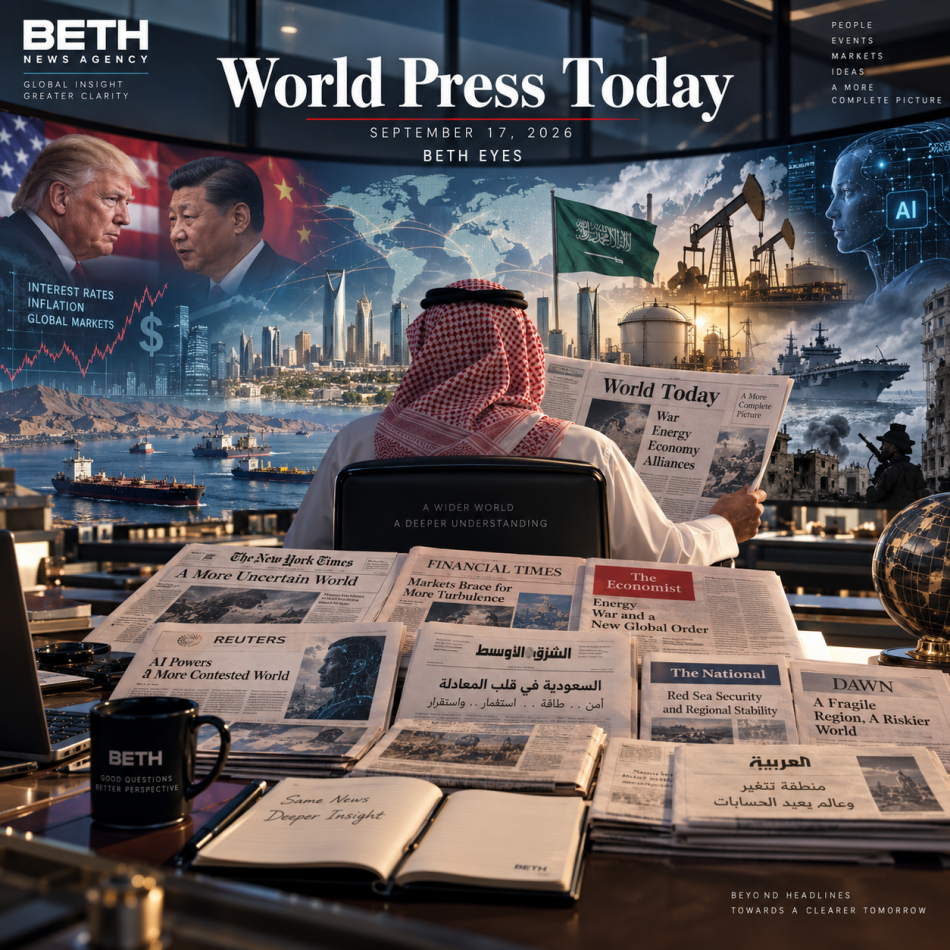
War, interest rates, and energy take the lead .. Saudi Arabia moves to the forefront through Red Sea security, oil, and monetary policy, Asia awaits the Trump–Xi summit, while concern over artificial intelligence and the global economy continues to widen
September 17, 2026
Monitoring and Analysis | Strategic Media Department – BETH Press
Supervision: Abdullah Al-Omira
The global press this morning sees a world moving under three simultaneous pressures:
War, money, and the reshaping of alliances.
The U.S.-Iran war is no longer only a military story; it has become a factor in oil, interest rates, currency prices, and concerns over navigation. At the same time, the Asian press has begun to view the upcoming meeting between Trump and Xi Jinping as a new test for U.S.-China relations, while Europe continues to search for greater independence in an increasingly turbulent world.
Saudi Arabia Advances in Coverage
Saudi Arabia is present in the international press today through more than one gateway.
First, Yemen and the Red Sea; international media are following the confrontation with the Houthis, developments at Bab al-Mandab, and threats that have reached Saudi cities and facilities, alongside Washington’s tightening of travel warnings near the Yemeni border.
Second, energy; Saudi Arabia has eased some market concerns by increasing oil shipments to Asia through the Oman route, contributing to a decline in Brent while it remains above $100.
Third, monetary policy; SAMA raised the repo and reverse repo rates by 25 basis points following the Federal Reserve’s decision, bringing the Kingdom directly into the new tightening cycle linked to the dollar and global inflation.
On the domestic economic front, the Saudi Industry Forum in Jeddah concluded with agreements and memoranda of understanding related to technology localization and promising industries, while the Riyadh Global Biotechnology Summit recorded outcomes exceeding SAR 5 billion through more than 40 agreements, initiatives, and announcements.
BETH Eyes | Saudi Arabia Is Not One Story
What stands out in Saudi Arabia’s presence today is that the press is not viewing it through a single window.
It is, at the same time:
A state facing a security threat.
A major source of energy.
An economy adapting to higher interest rates.
And a center for investment, industry, and technology.
This explains why the intensity of global coverage of Saudi Arabia is rising; not because of one event, but because several international files are now converging around it.
War Enters Money
The Federal Reserve’s decision to raise interest rates for the first time in more than three years has shifted the attention of the economic press from asking when cuts will begin to asking about the number of increases to come.
The dollar rose to a seven-week high, and markets are now pricing in another increase before the end of the year, while attention turns to the Bank of England and the Bank of Japan to see how they will deal with a new wave of inflation fueled by higher energy prices.
Here, the impact of the war becomes direct:
Oil pressures inflation, inflation pressures interest rates, and interest rates reprice the global economy.
Oil: Fear Has Eased, But Not Ended
Brent fell this morning to around $104 after Saudi shipments through Oman eased concerns over supply shortages, but markets are still pricing in the risk of an expanding war and disrupted passageways.
The economic press is now looking at energy from two angles:
Can Saudi Arabia and the Gulf create enough alternative routes to reduce the impact of disruption in Hormuz?
And will higher oil and gas prices turn from a temporary shock into a long-term global inflation problem?
Arab Press Brief | From the Atlantic to the Gulf
In the Gulf, Yemen, Bab al-Mandab, maritime security, and energy lead the agenda; newspapers continue to follow the attempted targeting of Mecca and the Islamic and international reactions. In Pakistan, the debate has reached calls to activate defense commitments toward protecting the Two Holy Mosques.
In Lebanon, President Joseph Aoun’s visit to Paris is taking the lead, alongside an international discussion over support for the Lebanese army, the future of the south, and post-UNIFIL arrangements.
In Syria, coverage is focusing on expanding economic and trade relations, energy, and the return of investments, including moves involving the United States, Turkey, France, and Saudi Arabia.
In Sudan, heavy domestic files continue, from the economy and services to the war, while Sudan also remains present in international discourse as the UN Secretary-General calls on the international community to acknowledge its failures toward the victims of Sudan, Gaza, and Lebanon.
In Egypt, Red Sea issues, Lebanon, Gaza, the economy, and technological cooperation are leading the agenda; Cairo is also continuing to develop its regional relations in energy and maritime security.
Inside the Capitals | Every Country Has Its Concern
Washington: interest rates, Iran, and the upcoming meeting with Xi Jinping; alongside an internal debate over whether Trump may use the Taiwan issue as an economic bargaining card with Beijing.
London: the Bank of England is under pressure; rates are expected to be held today, but higher energy prices are reopening the possibility of further tightening later.
Tokyo: a government reshuffle while retaining key economic ministers, and markets expect the Bank of Japan to continue tightening.
Beijing: manufacturing and technology are advancing, but consumption, real estate, and domestic investment remain clear weaknesses; technological growth does not conceal the divisions within the Chinese economy.
Brussels: tensions with Washington are expanding into trade and alliances; Trump has threatened measures against the European Union over proposals to deepen Canada’s ties with Europe.
Pyongyang: North Korea is responding to the U.S.-South Korea-Japan military alliance by stressing that the expansion of its nuclear capabilities is “irreversible.”
Artificial Intelligence: From Innovation to Power
Artificial intelligence continues to compete with war and the economy for space on the front pages.
In Europe, discussions are moving toward protecting children from platforms and artificial intelligence, with a proposal to ban the use of social networks and chatbots for those under the age of 15.
Meanwhile, an analysis published by Reuters argues that the artificial intelligence race has become part of the broader geopolitical competition, making any slowdown in development more difficult even as warnings over its risks increase.
In the United States, meanwhile, the courts are pressing Google to relax its advertising-market rules and appoint an antitrust compliance monitor, in another sign that Big Tech is no longer facing only the question of innovation, but the question of who owns the market and who sets the rules?
What Are the Editorials Saying?
Pakistan’s Dawn focused in its editorial on the danger surrounding Bab al-Mandab, arguing that disruption there alongside instability in Hormuz would place the global economy in a highly dangerous position.
The National, meanwhile, focused today on the impact of the war on civilian sectors; from declining hotel revenues to Sudan, alongside continued coverage of the development of Houthi capabilities.
Across the broader international discourse, one direction is recurring: the world does not fear the war alone, but also its indirect consequences that are difficult to control; from navigation to inflation, and from interest rates to alliances.
What Does the Press Expect?
Four signals are recurring today:
First: oil will remain high and volatile even if Saudi Arabia succeeds in easing part of the supply pressure.
Second: the interest-rate cycle may extend beyond a single U.S. decision; Britain, Japan, and others are now under the same pressure.
Third: Saudi Arabia will remain at the forefront of coverage because Yemen, energy, navigation, interest rates, and investment are all converging around it at the same time.
Fourth: next week’s Trump–Xi summit may become the next major international event to partially reorder priorities away from the war, especially if Washington seeks economic gains with Beijing.
Conclusion | BETH Eyes
Today’s press is not saying that the world is living through one war.
It is saying that the war has become part of a broader system of crises:
Hormuz pressures energy.
Energy pressures inflation.
Inflation pushes interest rates higher.
Interest rates reprice the economy.
And alliances are being reassessed under the pressure of cost and interest.
In the middle of this, Saudi Arabia appears in a striking position; seeking to protect its security, open alternative energy routes, preserve monetary stability, and at the same time continue investing in industry and technology.
And the question that appears larger than all of today’s headlines is:
Are we facing a temporary phase of disruption, or has the world actually begun building new rules for the economy, security, and alliances?