



Will Oil End?
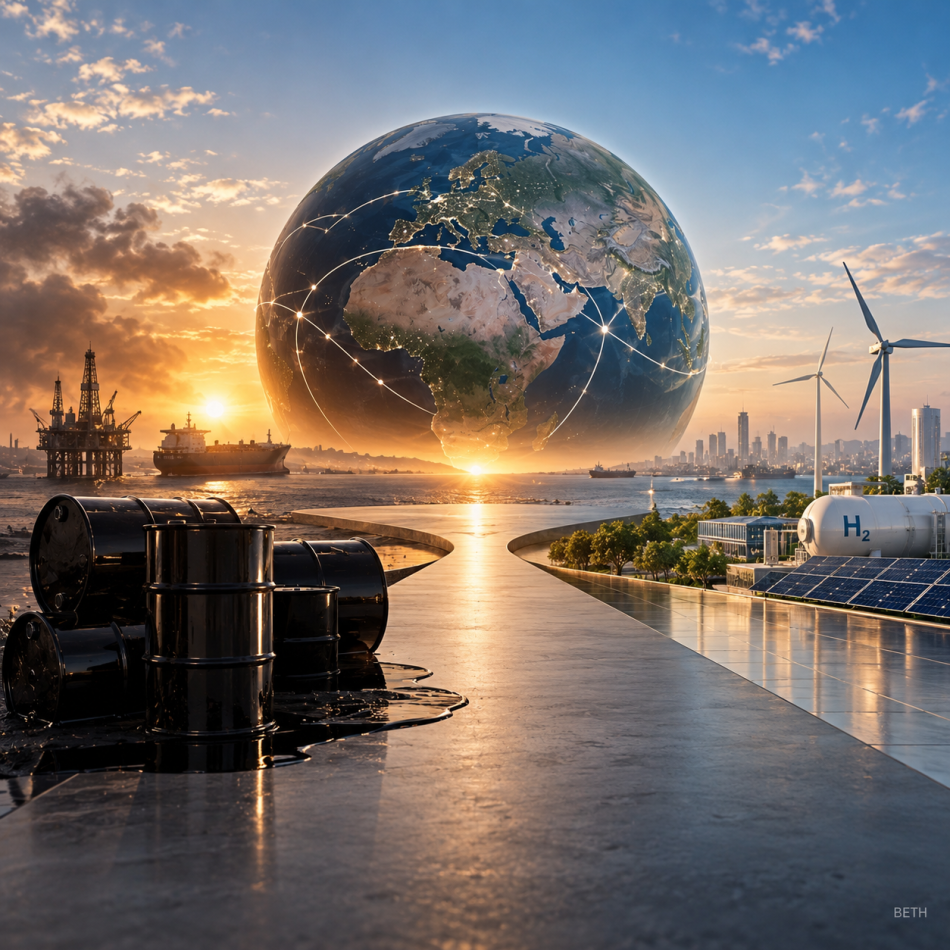
The crises in Hormuz and Bab al-Mandab revive the question of the “post-oil” era; yet the world is not approaching the abandonment of the barrel as much as it is redefining how it is used, while the Gulf challenge shifts from exporting crude to owning value chains, industry, and technology
Special Report | BETH
Prepared and analyzed by | Strategic Media Department – BETH Agency
Supervised by: Abdullah Alomairah
Whenever a maritime passage is closed or the price of a barrel rises, the old question returns:
Can the world do without oil?
Despite everything said about the energy transition, the answer appears more complicated than yes or no.
Electric vehicles and renewable energy are gradually reducing some sectors’ dependence on fossil fuels, but oil does not go only into vehicle fuel tanks. It is used in aviation, shipping, petrochemicals, plastics, synthetic fibers, chemicals, and hundreds of products that are difficult to replace quickly.
The International Energy Agency, in a report issued before this year, sees demand for oil used as fuel approaching its peak in the coming years. At the same time, however, it expects petrochemicals to become the main driver of oil demand growth starting in 2026, with polymers and synthetic fibers alone consuming around 18.4 million barrels per day by 2030.
The Disagreement Is Not About the End
Even major institutions do not agree on the future of demand.
The International Energy Agency sees global demand reaching a peak of around 102 million barrels per day around 2030 before beginning a gradual decline. OPEC, however, expects a completely different path and sees demand reaching around 124 million barrels per day by 2050.
Yet the disagreement between the two sides hides an implicit point of agreement:
No one is talking about oil disappearing.
The real question is: how much of it will be needed? Where will it be used? And who will own the highest value in the chain?
The Chokepoints Reveal the Problem
The current Hormuz crisis has revived awareness of a fact that is not directly related to peak demand.
In the first half of 2025, around 20.9 million barrels per day of oil and petroleum liquids passed through the Strait of Hormuz, equivalent to roughly one-fifth of global consumption, in addition to more than one-fifth of global liquefied natural gas trade.
This means that the world may one day succeed in reducing its oil consumption, but as long as it still needs tens of millions of barrels per day, the passages carrying them will remain of enormous strategic value.
Therefore, solving the Hormuz crisis does not lie only in searching for alternative energy; the energy transition itself requires years and decades, while the global economy needs fuel and raw materials today.
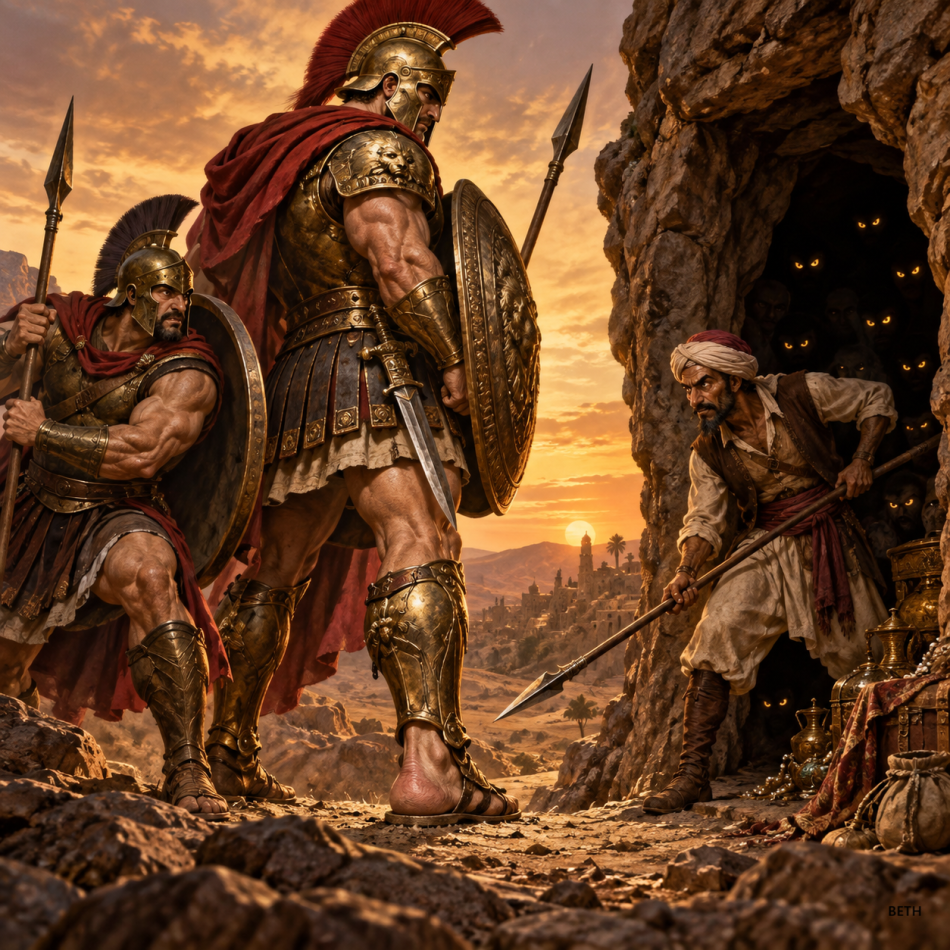
Achilles and Ali Baba
Who disrupts the passage of oil and the movement of trade?
Achilles or Ali Baba?
The world possesses fleets, military bases, missiles, and satellites, yet it remains vulnerable to disruption when a small group turns into “highwaymen” at a narrow passage.
Ali Baba does not need to bring Achilles down; it is enough for him to reach his heel. And when he reaches the gate of the heel, only a valiant ally who understands the value of alliance can stop him.
The Achilles heel of the global economy today is not a lack of power, but its dependence on a small number of passages that cannot tolerate much disorder.
This is why energy security in the future will not be measured only by the number of barrels or the size of fleets, but by countries’ ability to diversify routes, build alternatives, and reduce the ability of any single passage to hold global trade hostage.
Will the Gulf’s Power End?
Here, the Gulf question becomes more important.
For decades, Gulf power has rested to a large extent on possessing vast reserves and a high capacity to produce and export oil and gas.
But the future does not necessarily impose the end of that power; rather, it imposes a change in its form.
If Gulf states remain merely exporters of crude, then any long-term decline in demand or any disruption to shipping routes will directly affect their economic weight.
But if oil, gas, and minerals within the Gulf are transformed into petrochemicals, aviation fuel, advanced materials, manufacturing industries, hydrogen, electricity, and technologies, then value shifts from beneath the ground into the economy itself.
The global trend supports this reading; the Middle East is expected to add around 860,000 barrels per day of refined product supply to the global market by 2030, strengthening its role as a refining and export hub, not merely a crude exporter.
The Barrel Should Not Leave as It Came In
Perhaps this is the most important message revealed by crises in maritime chokepoints.
Every exported barrel of crude depends on a port, a tanker, and a strait.
But when a larger share of it is transformed locally into higher-value products, materials, and industries, the economy captures a greater share of the wealth before it reaches the sea.
This does not eliminate the importance of chokepoints, but it reduces the tendency to define economic power solely by the number of barrels that can pass through the strait.
Post-Oil.. or Post-Crude?
Perhaps the more accurate expression is not “post-oil.”
Rather:
Post-exporting crude oil as the economy’s primary task.
Oil may lose part of its role in road transport, but it retains other roles, some of which are expanding.
Renewable energy does not immediately eliminate oil; nor does oil prevent the growth of renewables.
The new equation is not about replacing one source with another, but about building a more diversified system capable of using every resource where it can generate the highest value.
BETH Reading
The Hormuz crisis raises a question for the Gulf that is bigger than protecting oil tankers:
What do we want to export twenty years from now?
If the answer is: crude only, then the strait will remain part of the definition of Gulf power.
But if the answer becomes: energy, materials, industries, finance, technology, and knowledge, then Gulf power will become less tied to a single maritime passage and more connected to what it builds within itself.
For this reason, talk of the end of the Gulf’s oil power appears premature.
What is more likely to end gradually is a phase in which power was measured by barrels alone.
The real challenge for Gulf states may not be waiting for the end of oil, but anticipating it by turning every barrel, cubic meter, and mineral into greater value before exporting it.
The Gulf states did not wait for crises to impose this transformation. Saudi Arabia launched Vision 2030 in 2016 to reduce dependence on oil and build a more diversified economy. What the Energy Minister revealed today about the uranium map shows that the path is no longer confined to oil, but extends to minerals, energy, industry, and new value chains.
The age of oil may change, but wealth does not have to end with it.
And whoever owns the resource today, and owns the industry and technology tomorrow, may be stronger after oil than they were in the age of crude.