


Riyadh Puts AI Ethics on the International Table
Riyadh | BETH
Saudi Arabia brings together more than 60 ministers and international representatives at UNESCO’s Global Forum on the Ethics of Artificial Intelligence, pushing for an equation that combines accelerating innovation with sound governance, while the national experience moves from principles to training programs, risk frameworks, and responsible-use policies
The common thread linking the two developments is clear: Saudi Arabia is not only seeking to accelerate the adoption of artificial intelligence, but also to participate in shaping the rules that govern its use globally.
While SDAIA presented the Kingdom’s path in capacity building and governance, the closed ministerial meeting in Riyadh concluded with a joint international statement placing cooperation, reducing gaps, and human responsibility at the forefront of the future of artificial intelligence.
Innovation and Governance
Dr. Abdullah bin Sharaf Al-Ghamdi, President of the Saudi Data and Artificial Intelligence Authority (SDAIA), affirmed that the challenge is no longer limited to accelerating innovation, but rather lies in achieving a balance between developing technology and governing it in a way that ensures its benefits remain accessible to individuals, societies, and different sectors.
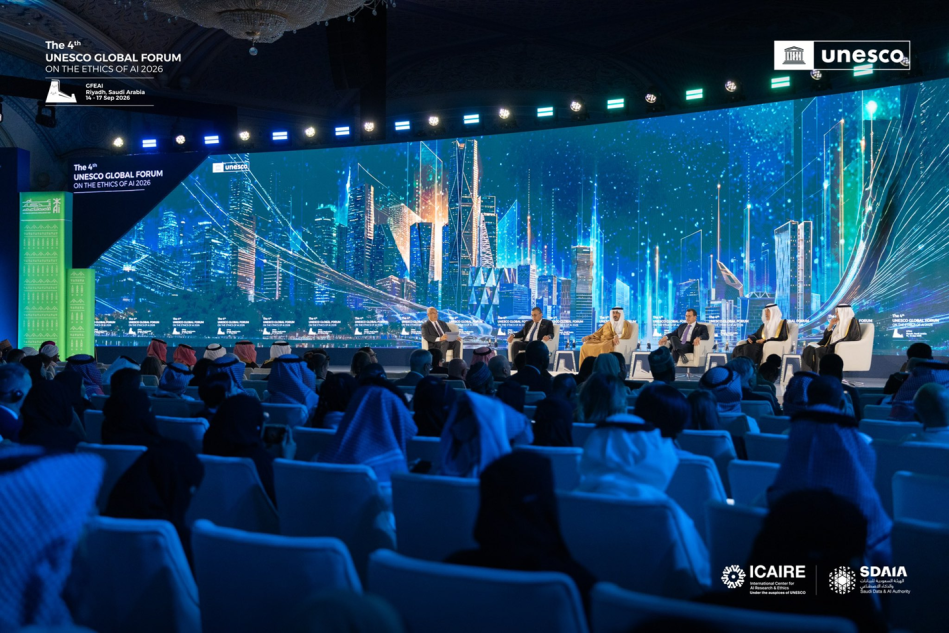
His remarks came with the launch of the fourth edition of UNESCO’s Global Forum on the Ethics of Artificial Intelligence in Riyadh, hosted by the Kingdom from September 14 to 17, 2026, with more than 100 speakers across 30 sessions and more than 16,000 registered participants.
Al-Ghamdi noted that designating 2026 as the Year of Artificial Intelligence in Saudi Arabia does not mean expanding the technology alone, but also carries a parallel responsibility to build the policies and controls governing its use.
1.2 Million Participants
During the year, the Kingdom launched more than 40 academic programs in data and artificial intelligence, while participation in the national “SAMAI” program exceeded 1.2 million people.
“SAMAI 2” was also launched in a sector-based format covering energy, healthcare, industry, education, and agriculture, alongside governance initiatives including an AI Risk Management Framework, a Responsible AI Use Policy, and AI badges for individuals.
Saudi Arabia’s governance path dates back to 2021, when UNESCO adopted its Recommendation on the Ethics of Artificial Intelligence, before the Kingdom announced its national AI ethics principles in 2022, followed by the establishment of the International Center for AI Research and Ethics (ICAIRE) in 2023, which UNESCO later recognized as a Category 2 center under its auspices.
From Principles to Practice
On the same day, a joint international statement was issued by Saudi Arabia, UNESCO, and ICAIRE following a closed ministerial meeting in Riyadh attended by more than 60 ministers and international representatives.
The statement affirmed that the future of artificial intelligence requires international cooperation that goes beyond national borders, while continuing to be guided by UNESCO’s 2021 Recommendation as a global framework for developing and using AI in an ethical, safe, inclusive, and sustainable manner.
It also called for expanding the use of readiness assessment and ethical impact assessment tools, and for supporting countries in building national strategies that take into account differences in capabilities and cultural and linguistic contexts.
The Global Divide
One of the most prominent themes of the statement was the warning that the benefits of artificial intelligence remain concentrated in a limited number of countries and companies.
Participants stressed the need to narrow gaps in access to infrastructure and capabilities, particularly in developing countries and Africa, while expanding the participation of women and youth and strengthening general and institutional skills.
The statement also emphasized cooperation among governments, international organizations, universities, the private sector, and civil society, on the basis that many AI-related challenges can no longer be solved within the borders of a single country.
Humans Inside the Loop
The most sensitive theme in both the forum and the statement was the emphasis that humans must remain inside the loop of control.
The discussion is no longer only about the capabilities of models and algorithms, but also about responsibility and accountability, protecting rights and dignity, empowering children and young people, and preserving cultural and linguistic diversity.
Here, ethics moves from theoretical discourse into part of the regulatory structure of the technology itself.
BETH Reading
The real story in Riyadh is not the holding of another forum on artificial intelligence.
What matters more is that Saudi Arabia is moving along two parallel tracks:
Expanding its domestic capacity to use artificial intelligence, while participating in shaping the rules governing its use globally.
A million trainees or dozens of academic programs create a human base, but risk frameworks, policies, and an international forum build something different: a position in the global debate over who defines the limits of the technology and its responsibilities.
As artificial intelligence moves from laboratories into the economy, education, healthcare, and energy, the global question becomes less about what the technology can do, and more about another question:
Who decides what it should do?