



Day 190: The Nuclear Front Returns to the War
Trump threatens to strike “Pickaxe Mountain” near Natanz after new activity is detected, Hormuz traffic falls to seven ships, and the U.S. president ties the end of the war to the November elections as pressure widens from the Gulf to Bab el-Mandeb
September 10, 2026
Prepared & Analyzed by | Strategic Media Department – BETH Agency
Supervision: Abdullah Al-Omairah
The U.S.-Iran war entered Day 190 with a new shift:
The nuclear file has returned to the forefront of the confrontation.
U.S. President Donald Trump said Washington had detected “activity” at Pickaxe Mountain, the fortified site near the Natanz nuclear facility, and warned Iran that the United States could strike it “very hard” if that activity continues.
The site lies about two kilometers from the Natanz complex and contains two deep underground tunnel systems. Although Natanz has previously been struck, this particular complex has not yet been targeted.
That makes the threat different from the recent strikes on tankers and shipping.
Washington is effectively telling Tehran:
If you try to rebuild your nuclear capability underground, the war may return to Iran’s nuclear infrastructure.
Trump Sets a Timeline
But the most politically consequential statement was not the threat of bombing alone.
Trump said he expects the war to end immediately after the U.S. midterm elections in November, and accused Iran of trying to prolong the conflict and influence the outcome of elections that will determine whether Republicans retain control of Congress.
This time, military rhetoric has acquired an openly electoral timetable.
Oil is above $100 a barrel, fuel prices and inflationary pressure are becoming a domestic political burden for the president and the Republican Party, while reports suggest that senior White House advisers do not share Trump’s confidence that the war is close to ending and warn that it could continue much longer.
A new equation is emerging:
Trump wants Iran militarily weaker before November, and lower energy prices before voters go to the polls.
It is far from certain that both goals can be achieved at the same time.
$5,000 for the Voter
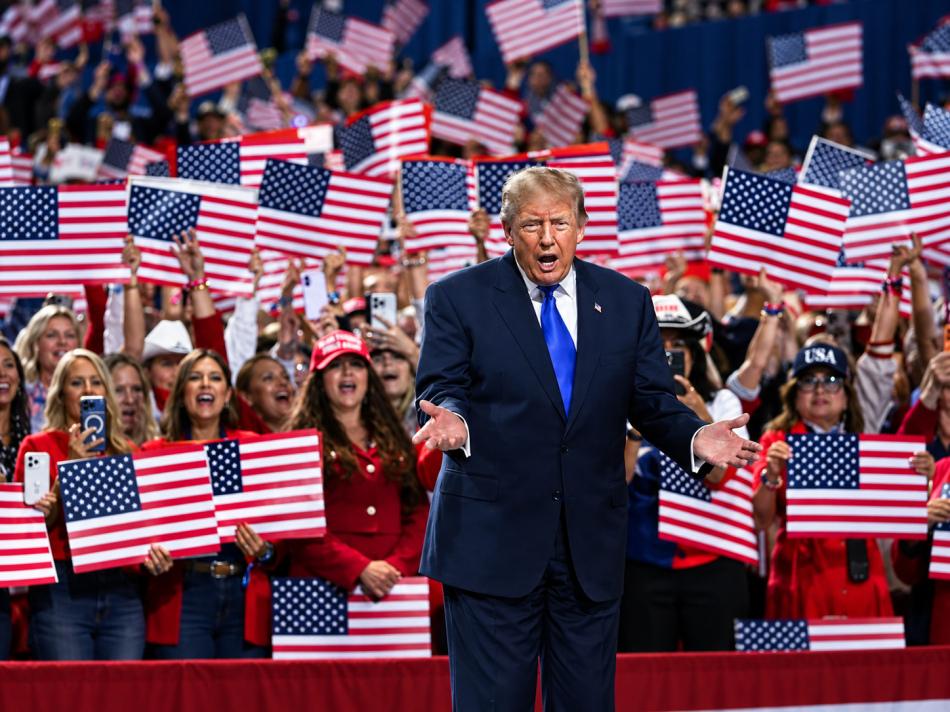
At the same Republican conference in Dallas, Trump added a striking economic promise to his campaign.
He pledged to give every adult American citizen $5,000 if Republicans retain both the House and Senate in the November elections, on the condition that the money be spent inside the United States. He did not provide details on funding or implementation.
Linking that promise to a war speech is not incidental.
In one night, Trump is trying to present voters with two images:
The president who threatens Iran abroad, and the president who promises money to Americans at home.
That confirms that the war has become a direct part of the midterm election battle.
Hormuz | Seven Ships
In the Strait of Hormuz, the numbers show the scale of the decline.
Preliminary vessel-tracking data showed that only seven ships passed through on Wednesday; four exited the strait and three entered, compared with 12 the previous day and a ten-day average of 14. No LNG tanker departed.
This means Hormuz is not closed.
But it is now operating at a small fraction of its normal capacity.
At the same time, shipping markets are beginning to adapt partially to the crisis. The marine-fuel shortage seen during the first months has eased, but costs in Singapore remain more than 60% above prewar levels.
The market is learning how to live with the war.
But it is paying for that adjustment.
Oil Above $100
Brent crude held near $100.5 a barrel on Thursday morning after crossing the psychological threshold the previous day, while prices have risen by around 30% since the beginning of August.
More worrying than the price itself is the shrinking global safety margin.
Traffic through Hormuz is down, alternative routes are under pressure, and U.S. strategic reserves are limited compared with earlier periods, while markets are increasingly building a permanent risk premium into prices rather than treating the crisis as a temporary shock.
Oil is therefore becoming one of the political keys to the war as well.
The higher it rises, the greater the pressure on Trump.
And the greater the pressure on Trump, the stronger his incentive to change the course of the war quickly.
Bab el-Mandeb | The Second Front
The other front that deserves close attention today is not inside Iran.
It is Yemen.
Yemeni government military sources said the Houthis are moving closer to consolidating control over strategically important coastal areas near Mokha and Dhubab, which directly overlook Bab el-Mandeb, as fighting intensifies with Yemeni forces backed by Saudi Arabia.
If this trend is confirmed and continues, Iran and its allies could gain simultaneous pressure over two routes:
Hormuz in the east.
Bab el-Mandeb in the west.
That would be one of the most dangerous possible equations for global energy trade, because the natural alternative to Hormuz would then face another threat before reaching the Suez Canal.
Saudi Arabia | Pressure Continues
In southern Saudi Arabia, authorities issued new emergency alerts in Khamis Mushait for the fourth time within 24 hours before later declaring the danger over, amid the continuing confrontation with the Houthis.
This links Day 190 directly to yesterday’s developments surrounding the Makkah Joint Defense Agreement.
Continued Houthi attacks do not place Saudi Arabia alone before a decision on how to respond; they also increase the possibility that Saudi-Pakistani-Turkish consultation mechanisms could move into a more operational phase if the escalation continues. Pakistan has already conveyed a Saudi warning to Iran urging it to rein in the Houthis.
Saudi Arabia has the military capability to deter the threat and neutralize its sources. If it decides to shift the confrontation from intercepting attacks to striking the military infrastructure that produces them, the equation on the Yemeni front will change completely.
What Does Trump Want From “Pickaxe Mountain”?
The threat to strike the mountain does not necessarily mean that a decision to attack has already been made.
But it serves three functions at once.
First: warning Iran against using Washington’s preoccupation with Hormuz to rebuild deep underground nuclear capabilities.
Second: restoring the military initiative to Washington after a series of Iranian strikes on ships and bases.
Third: sending an electoral message to the American public that the president still sets the ceiling of escalation, not Tehran.
But a strike, if it occurs, carries a clear risk.
It could move the war from the phase of choking Iranian oil exports back to direct targeting of nuclear infrastructure, pushing the conflict to a much higher level of escalation.
What Comes Next?
The next few days are most likely to reveal three trends.
First: intensified U.S. surveillance of Pickaxe Mountain, with the possibility of a strike if Washington concludes that the activity is linked to rebuilding enrichment capability or protecting nuclear materials and equipment.
Second: continued Iranian use of missiles and maritime attacks to demonstrate that the cost of American pressure is not one-sided, while avoiding a massive strike that could give Trump justification to widen the war.
Third: the growing importance of the Yemeni front, as the Houthis’ movement toward Bab el-Mandeb and continued attacks on Saudi Arabia could transform the file from a supporting front for Iran into an independent center of the war.
BETH Reading
Day 189 brought oil itself into the war.
Day 190 has brought the nuclear file back into it.
And between the two, a third factor has emerged more openly than before:
The U.S. elections.
Trump wants the war to end after November, while at the same time threatening a new strike that could widen it before November.
That is the paradox of the day.
The U.S. president wants to raise the pressure high enough to force Iran to retreat, but every additional degree of pressure carries the risk that the war expands rather than ends.
So the question is no longer only:
Will Washington strike Pickaxe Mountain?
But rather:
Can Trump use escalation to end the war without allowing escalation itself to become the reason it continues?