


Pakistan Signals Possible Activation of the Makkah Agreement After Houthi Attacks
Islamabad links continued attacks on Saudi territory to the possible activation of the trilateral defense agreement with Riyadh and Ankara; Pakistan’s warning to Tehran moves the “Makkah Alliance” from institutional buildup toward its first field test
Special Report | BETH
The Makkah Joint Defense Agreement has entered its first real test after Pakistan signaled that it could be activated if Houthi attacks on Saudi territory continue or expand.
Pakistani Defense Minister Khawaja Asif said that continued “unjustified aggression” or any further extension of the conflict into Saudi Arabia could make the defense agreement between Saudi Arabia, Pakistan and Türkiye operational, in the clearest link yet between the ongoing attacks and the principle of collective defense at the core of the pact.
The statement came after two days of Houthi attacks targeting Abha, Khamis Mushait, Jazan and Najran with missiles and drones, striking oil facilities, national assets and an air base, and injuring 73 people. The attacks continued into Wednesday for a second day, while the Saudi-led coalition said it would respond in a way that protects sovereignty, infrastructure and civilians.
A Message to Tehran
Pakistan’s position went beyond an expression of solidarity.
Islamabad conveyed to Iran a Saudi warning urging Tehran to rein in the Houthis. At the same time, Pakistani officials clarified that any possible military role would be defensive and limited to protecting Saudi territory.
Pakistan’s Foreign Ministry also issued an official statement strongly condemning the attacks, describing them as a violation of the Kingdom’s sovereignty and territorial integrity, and reaffirming full support for Saudi Arabia’s right to take all necessary measures to protect its territory, citizens, residents and national assets.
This is important because Islamabad is moving along two parallel tracks:
Potential military deterrence through the Makkah Agreement, and political pressure on Iran to avoid reaching that point.
From Agreement to Alliance
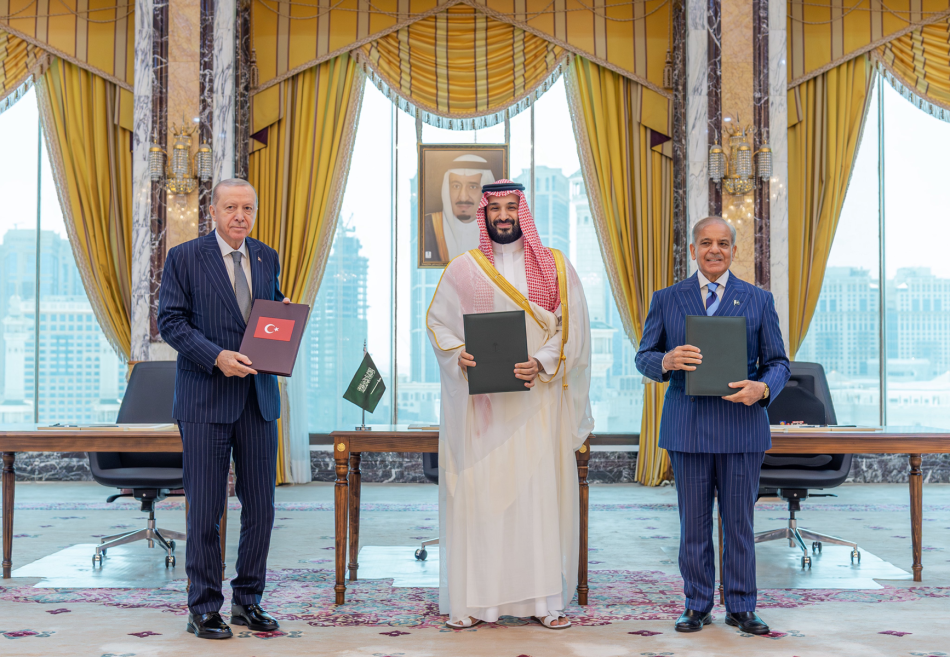
The Makkah Agreement was signed on August 7 by Saudi Arabia, Türkiye and Pakistan. It stipulates that any armed attack on one of the three countries is considered an attack on all, in a formula broadly comparable to the principle of collective defense in NATO.
The agreement also includes joint exercises, coordination in air defense, unmanned systems and electronic warfare, as well as cooperation in defense industries.
It then moved quickly into institutional development.
On August 31, the Strategic Political and Defense Committee held its first meeting in Istanbul, with the participation of foreign and defense ministers and military chiefs. The parties also agreed to establish a permanent secretariat in Saudi Arabia, headed in its first term by a Pakistani secretary-general for three years.
In other words, this is no longer merely an agreement on paper.
There is leadership, a committee, a secretariat and mechanisms being built.
The Houthi attacks came before that structure was fully completed, but they may accelerate its transition from institutional architecture to actual deterrence.
Why Pakistan’s Position Matters
For three reasons.
First: Pakistan is a nuclear power and possesses one of the largest armed forces in the Islamic world. Its mere declaration of readiness to defend Saudi territory raises the cost of any further escalation.
Second: Islamabad has a direct relationship with Tehran, allowing it to combine deterrence with mediation rather than acting only as a military partner.
Third: the position tests the credibility of the agreement at an early stage. Alliances are not measured only by what they write in founding documents, but by what they do when one of their members comes under attack.
That is why Khawaja Asif’s statement sends a message that goes beyond the Houthis:
The Makkah Agreement is not merely a political umbrella.
Nor does discussion of the agreement mean that Saudi Arabia depends on its partners to repel aggression. The Kingdom has the capability to deter the threat and neutralize its sources; if it decides to shift from intercepting attacks to striking the military infrastructure that produces them, the entire equation of confrontation will change.
Where Is Türkiye?
Ankara has not yet announced a similar move toward activating the agreement in response to the latest attacks.
But the absence of a public statement does not mean Türkiye is absent from the equation. It is a core partner in the pact, took part in building its military and political mechanisms, and has stated from the outset that the goal is to place defense cooperation among the three countries on an institutional and sustainable footing.
This makes the next step particularly important.
If the attacks continue, the issue could move from a Pakistani statement to formal trilateral consultations within the agreement’s mechanisms, which would become the first practical test of the principle that “an attack on one is an attack on all.”
What Does This Mean for Iran and the Houthis?
The equation is becoming more complex.
The Houthis are attacking Saudi Arabia as an armed militia, not as a regular army, but continued attacks elevate the confrontation from a Saudi-Houthi arena into an issue affecting three countries bound by a joint defense agreement.
This means that Tehran, even if it continues to insist that it does not directly control Houthi decision-making, could face a larger political risk:
that the actions of one of its most prominent regional allies may accelerate the consolidation of a new defense alliance around Saudi Arabia.
In other words, every new Houthi strike could produce the opposite of what Iran intends.
Instead of increasing pressure on Saudi Arabia, it could strengthen the defensive framework surrounding the Kingdom.
The Real Test
The Pakistani statement does not mean that the Makkah Agreement has been formally activated.
This distinction must remain clear.
So far, we are facing a political and military signal of possible activation, not an announcement that joint forces have entered operations.
Although the agreement considers any armed attack on one of the three countries an attack on all, the transition from the principle of collective defense to actual military participation must pass through the agreement’s political and military mechanisms and consultations among its parties; the occurrence of an attack alone does not automatically mean that joint forces will enter operations.
But the gap between the two is beginning to narrow.
The attacks are continuing, the Kingdom has declared that it will defend its sovereignty and national assets, and Pakistan has linked continued aggression to the possibility of bringing the agreement into operation.
The question for the coming days is therefore:
Will deterrence and mediation succeed in stopping the attacks?
Or will we see the first emergency meeting of the Makkah Agreement’s mechanisms to take a collective decision?
BETH Reading
When the agreement was signed, the question was:
Would it become a real alliance?
Today, the question has changed.
When?
Alliances are born through documents, but they gain meaning when the first threat arrives.
The Houthi attacks have placed the Makkah Agreement before that moment much earlier than expected.
And if it moves from signaling to activation, the development will not merely be a response to a Houthi attack.
It will be the practical declaration of the birth of a new regional defense architecture.