



Day 184: The War Without a Name
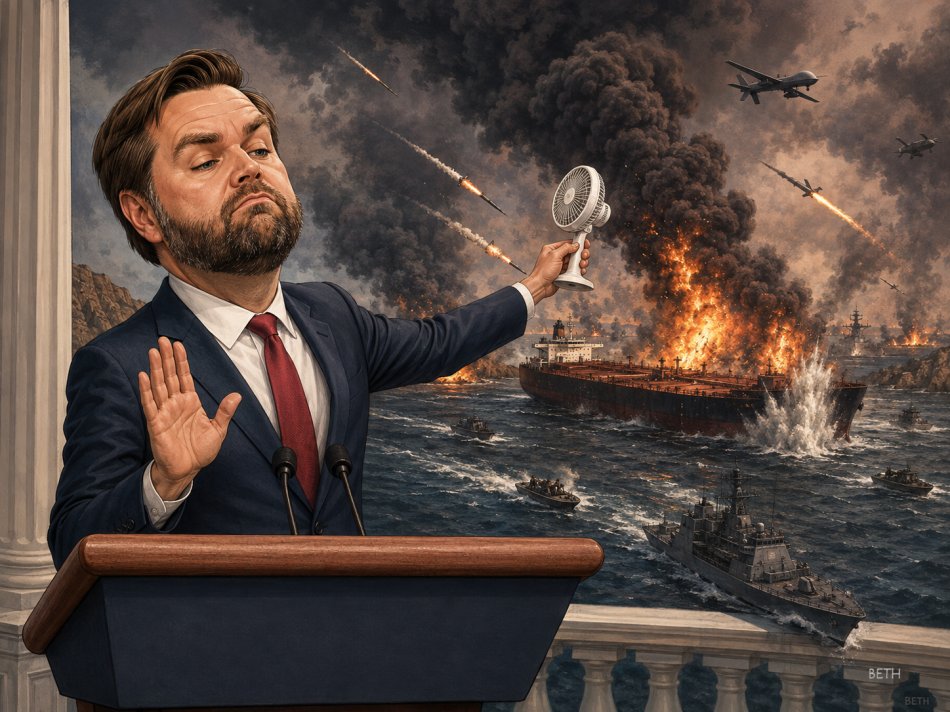
Vance refuses to call the confrontation with Iran a war and rules out talks until attacks in Hormuz stop; Tehran threatens a “multi-layered” response as protecting the Strait gradually becomes an international front
September 4, 2026
Prepared and analyzed by | Strategic Media Department – BETH Agency
After six months of fighting, Washington is trying to change the name, not the reality.
U.S. Vice President JD Vance rejected describing the confrontation with Iran as a “war,” saying there is currently no active exchange of fire between the two sides. He also declined to predict whether the conflict would end before the November 3 midterm elections.
Yet the current lull comes only days after a violent round of fighting that included U.S. strikes inside Iran and an Iranian response involving missiles and drones targeting American bases in the region.
Hormuz First
Vance made Washington’s condition clear:
There will be no talks with Iran as long as commercial vessels are being attacked in the Strait of Hormuz.
He said economic, military and diplomatic pressure — including covert options — would remain on the table, while stressing that Iran “does not control” the strait.
On the other side, Iran’s First Vice President Mohammad Reza Aref said U.S. strikes had changed Tehran’s calculations and threatened an “asymmetric and multi-layered” response.
This suggests that the current calm is not a settlement.
It is a pause between two possible rounds of confrontation.
Oil Returns.. Ships Do Not
Vance said around 15 million barrels passed through the strait in a single day, arguing that oil and gas flows had nearly returned to pre-war levels.
But the picture is more complicated.
Before the war, flows were close to 20 million barrels per day, while independent data indicate that overall vessel traffic remains well below previous levels, despite larger volumes of oil passing through on some days under U.S. naval protection.
Oil prices also remain under pressure from the confrontation, with Brent crude trading around the mid-$90s as fears persist over renewed fighting and possible supply disruptions.
Hormuz Goes International
One of today’s notable developments came from Seoul.
South Korea announced that it is considering practical measures to support freedom of navigation through the Strait of Hormuz, including options of a military nature, although no final decision has yet been made.
This adds a new dimension to the conflict:
Washington wants to transform Hormuz from a U.S.-Iran confrontation into an issue of international maritime security.
Every country that joins efforts to protect shipping reduces Tehran’s ability to present the strait as a bilateral bargaining card with Washington.
China.. The Bigger Question
Perhaps the most sensitive of Vance’s statements was his claim that China is “prepared to cooperate” in economically isolating Iran.
That statement, however, requires caution.
For now, it represents an American assertion rather than a confirmed shift in Chinese policy.
Beijing had publicly objected only days earlier to Washington’s new sanctions campaign against Iran and threatened to respond to measures targeting its trade with Tehran.
If Vance’s statement does translate into actual Chinese cooperation, it would represent the most dangerous economic development for Iran since the war began, because China remains Iran’s most important outlet for oil exports and trade.
The Economic Squeeze
According to Iranian sources speaking to Reuters, U.S. sanctions and the oil blockade are beginning to impose mounting pressure that Iran’s economy is finding increasingly difficult to absorb.
This may explain Washington’s shift away from seeking a rapid military conclusion toward trying to exhaust Tehran’s ability to endure.
Inside the United States, however, there is another dimension.
Higher fuel prices and inflation are turning the prolonged confrontation into a political burden for President Donald Trump ahead of the congressional elections. Reports suggest that some White House officials would prefer to keep the conflict at a lower intensity until November, with the possibility of reassessing escalation afterward.
That helps explain Vance’s phrase:
“It is not a war.”
The White House does not want an open war that drives oil prices higher before the elections.
Nor does it want a peace that gives Iran a way out without concessions.
It wants something in between:
Pressure without invasion, blockade without settlement, and strikes when necessary — without calling it war.
But changing the name does not change the reality.
After 184 days, the question is no longer whether this confrontation is a war.
The question is: which side can endure it longer?