



Two Wars Searching for an End
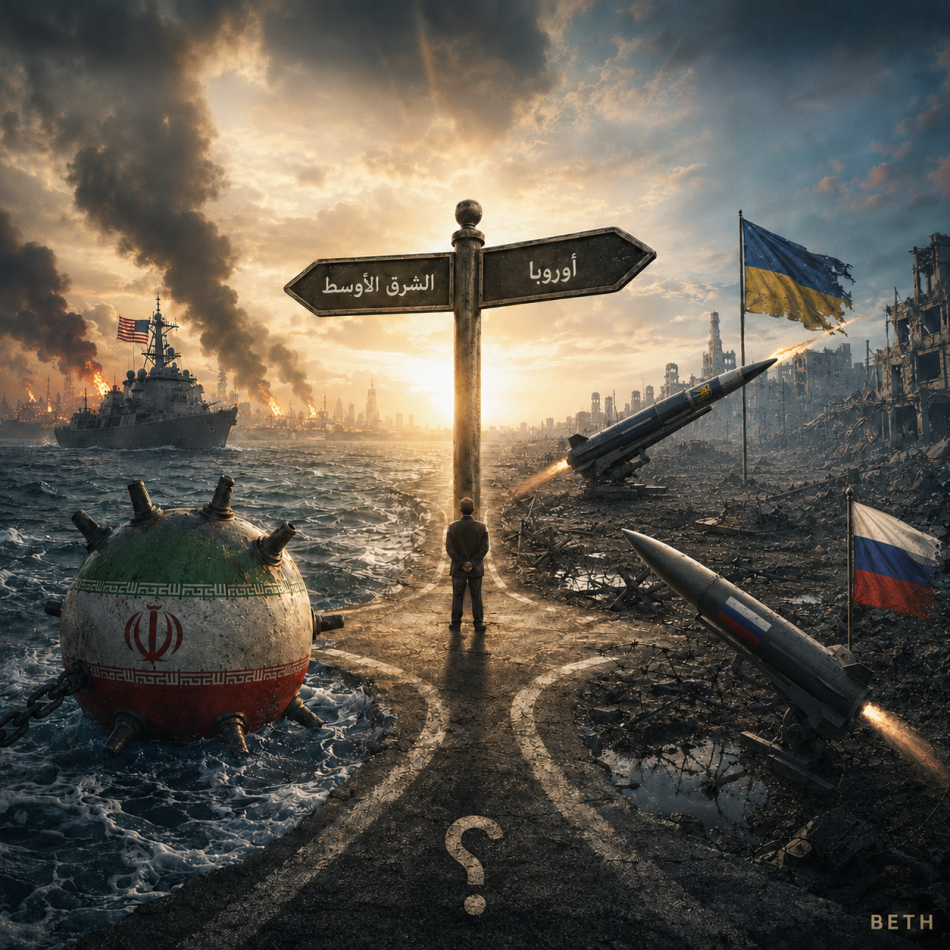
In the Middle East, Washington is pressuring the Iranian regime; in Europe, Moscow is betting on time and the battlefield. Two wars differ in tools and objectives, yet converge on one question: when and how will they end?
Prepared and analyzed by | Strategic Media Department – BETH Agency
Supervision: Abdullah Al-Amirah
The world is living through two major wars today. They differ in the nature of the conflict, the balance of power, and their ultimate objectives, yet they meet at the same dilemma:
How does a war end?
In the U.S.-Iran confrontation, the picture appears relatively clearer: Washington is applying military, economic, and political pressure on the Iranian regime, while Tehran is trying to endure and raise the cost of confrontation through Hormuz and its military capabilities.
In the Russia-Ukraine war, the problem is more complex. Russia cannot eliminate Ukraine as a state, and Ukraine cannot, by force alone, expel Russia from all the territories it controls, while NATO’s presence and Western support prevent the war from turning into a complete Russian victory.
We therefore find ourselves facing two very different wars:
The first is searching for an end after escalating pressure on a regime.
The second is still searching for a definition of what an acceptable end would look like.
War One | America and Iran
After 182 days, the question is no longer who wins the round, but who has a vision for the day after: Washington is pressuring the regime, Tehran is fighting to survive, and Hormuz is shifting from a maritime passage into a tool of coercive bargaining
After 182 days of the U.S.-Iran confrontation, the biggest problem is no longer only military, but political as well: how does the war end?
Washington has raised the pressure to a new level: wide-ranging strikes, targeting radar systems, naval capabilities and mine-laying facilities, economic sanctions, and increasing internal pressure on the Iranian regime.
At the same time, there are signs within the U.S. administration of a desire to keep the war within limits that prevent it from turning into an open-ended war of attrition, particularly with oil prices rising and congressional elections approaching.
Here lies the first American contradiction: escalation is needed to increase pressure, but a wider war could raise the political and economic cost for Washington itself.
Iran, meanwhile, does not appear capable of restoring military superiority, but it still retains enough capability to threaten shipping and raise the cost of the confrontation.
The latest U.S. strikes on radar systems and capabilities linked to detecting and targeting vessels point to a clear attempt to reduce Tehran’s ability to use Hormuz as an arena of pressure, but that capability has not been completely eliminated.
This is where the central dilemma of the war becomes clear:
America can destroy a large part of Iran’s ability to control Hormuz, but missiles alone cannot create a new political system in Tehran.
And in return:
Iran can make Hormuz more dangerous, but it cannot turn that into a lasting strategic victory.
The American Dilemma
If the U.S. objective is to return Iran to negotiations, broad escalation may make a return to the table more difficult.
But if the actual objective has become regime change, then a bigger problem begins: who governs Iran the day after?
So far, no unified political force has emerged within the Iranian opposition that is clearly capable of managing a stable transition, while opposition groups abroad suffer from division and weak organization inside the country.
This means Washington could succeed in weakening the regime before knowing what to do if it collapses.
The Iranian Dilemma
Tehran is betting on an old equation:
If you cannot win, raise the cost for your opponent.
That is why the Strait of Hormuz becomes more important to Iran as its conventional military capabilities decline.
Threatening shipping, pushing oil prices higher, and disrupting energy markets give Tehran leverage it cannot obtain from the battlefield alone.
But this strategy carries a major risk.
Every attack on shipping, or every expansion of the confrontation in the Gulf, could push more countries away from Iran and could turn even states trying to remain outside the war into parties taking a harder line against Tehran.
Most importantly, major energy-importing powers, led by China, cannot accept Hormuz becoming a permanent source of instability.
A War Without a Clear Winner
The current equation does not give either side a complete victory.
Washington possesses overwhelming military and economic superiority, but it needs a viable political endgame.
Tehran can prolong the confrontation and raise its cost, but in return it is paying an increasing economic and military price.
The war has therefore become closer to a race between America’s ability to sustain pressure and the Iranian regime’s ability to survive under that pressure.
Forecast
The most likely scenario in the coming weeks is for the war to continue in short waves: precise U.S. strikes, measured Iranian responses, and continued blockade and sanctions.
This scenario allows both sides to escalate without sliding directly into a full-scale war.
The more dangerous scenario is a major incident in Hormuz, or a strike causing large numbers of American or Gulf casualties. In that case, Washington could move from targeting military capabilities to striking senior command-and-control centers.
The least likely scenario at present is a rapid return to comprehensive negotiations, because the political rhetoric on both sides has become more confrontational, even as mediation channels remain partly open.
After the War
This is not merely a war searching for victory.
It is a war searching for an end that neither side yet knows how to create.
The more dangerous question is no longer:
Can Iran endure?
But:
What happens if it cannot?
War Two | Russia and Ukraine
After more than four years of war, the Russia-Ukraine question is no longer only about who advances a few kilometers, but whether either side can actually turn military progress into a sustainable political end.
Russia continues to apply military pressure and launch missile and drone attacks, but its territorial gains have remained relatively limited and have not produced a breakthrough capable of ending the war. Ukraine, meanwhile, continues to strike deep inside Russia, including oil infrastructure and areas near the border, seeking to transfer part of the war’s cost into Russian territory.
This is where the Russian problem becomes clear:
Moscow can continue the war, but it has not yet demonstrated that it can end it militarily.
What Does Russia Want?
This is the most ambiguous dilemma.
Moscow is demanding political, security, and territorial guarantees, most notably the consolidation of its gains in the east, preventing Ukraine from joining NATO, and limiting the Western military presence inside Ukraine. These demands have remained central to Russia’s position across various negotiating tracks.
But the question is:
Does Russia want these objectives as the outcome of the war, or does it want the war itself to remain a permanent means of imposing them?
Accepting a settlement would require Moscow to settle for part of what it has gained, while continuing to fight means paying a higher price for slow additional gains.
The Ukrainian Dilemma
Ukraine faces a difficult equation of its own.
It cannot accept a settlement that appears to be surrender or permanent recognition of the loss of large territories, because that would trigger a domestic political crisis and hand Russia a major strategic gain.
At the same time, regaining all occupied territories by force appears extremely difficult without a major shift in the balance of Western support or more direct involvement by NATO states.
That is why Kyiv continues to insist on security guarantees as an essential part of any possible end to the war. President Volodymyr Zelensky has recently spoken of a U.S. mediation window extending until the summer of 2027, as well as ideas involving a ceasefire and special arrangements in Donbas.
NATO | The Presence That Prevents a Decisive Outcome
NATO’s presence in the background of the war is the factor that makes a complete Russian victory almost impossible, yet this does not mean the alliance wants to enter into direct confrontation with Moscow.
That is why the delicate equation continues:
NATO prevents Ukraine from falling, but tries not to enter the war itself.
However, the continued cyber incidents, drone activity, and acts of sabotage inside Europe gradually increase the possibility that the confrontation could spill beyond Ukraine’s borders — the one scenario capable of radically changing the balance of the war.
Russia Negotiates With Time
So far, Moscow appears to be betting that time works in its favor:
Exhausting Ukraine, draining Western support, and increasing domestic pressure on European and American governments.
But this strategy is not without cost.
The Russian economy continues to face restrictions and sanctions, while Moscow is attempting to open economic channels with Washington. Russia’s finance minister has spoken of the possibility of building shared financial interests between the two countries, while Washington has maintained that there will be no economic relief before the war ends.
The paradox therefore becomes clear:
Russia wants economic gains from peace, but it has not yet decided the political price of peace.
Forecast
The most likely scenario is not a complete military victory for either side, but continued fighting alongside intermittent negotiations until the cost of war becomes greater than the value of additional gains.
At that point, the likely outcome may be a prolonged ceasefire or a phased settlement rather than a final peace agreement resolving every issue.
The most dangerous scenario is the direct expansion of the war beyond Ukrainian territory, prompting a larger NATO military response. In that case, the entire nature of the war — not merely the front lines — would change.
The Two Wars
The difference between the two wars is significant.
In Iran, one can imagine an end resulting from the regime losing its ability to continue or accepting new terms.
In Ukraine, however, no party can simply be removed from the equation.
Russia will remain.
Ukraine will remain.
And NATO will remain behind it.
That is why the Russia-Ukraine war may prove more difficult to end, even if it is less explosive during some phases.
In the end, both wars return to the same question:
The U.S.-Iran war: what happens if Iran can no longer endure?
The Russia-Ukraine war: what happens if both sides can continue enduring for a long time?
And this brings us to the strongest conclusion:
Two wars searching for an end;
one may end when one side can no longer continue,
while the other may end only when both sides conclude that continuing will no longer change the outcome.
In the end, force alone does not appear capable of closing these two wars, and wisdom alone is not enough without power to define the limits of what is possible.
The U.S.-Iran war is closer to a faster end if Tehran loses its ability to continue or accepts new terms; the Russia-Ukraine war, however, is more likely to last longer, because it needs a moment when both sides become convinced that what force has failed to settle will not be settled by more force.
The true end of every war comes when power recognizes its limits, and wisdom begins its work.