



Makkah Defence Alliance Begins
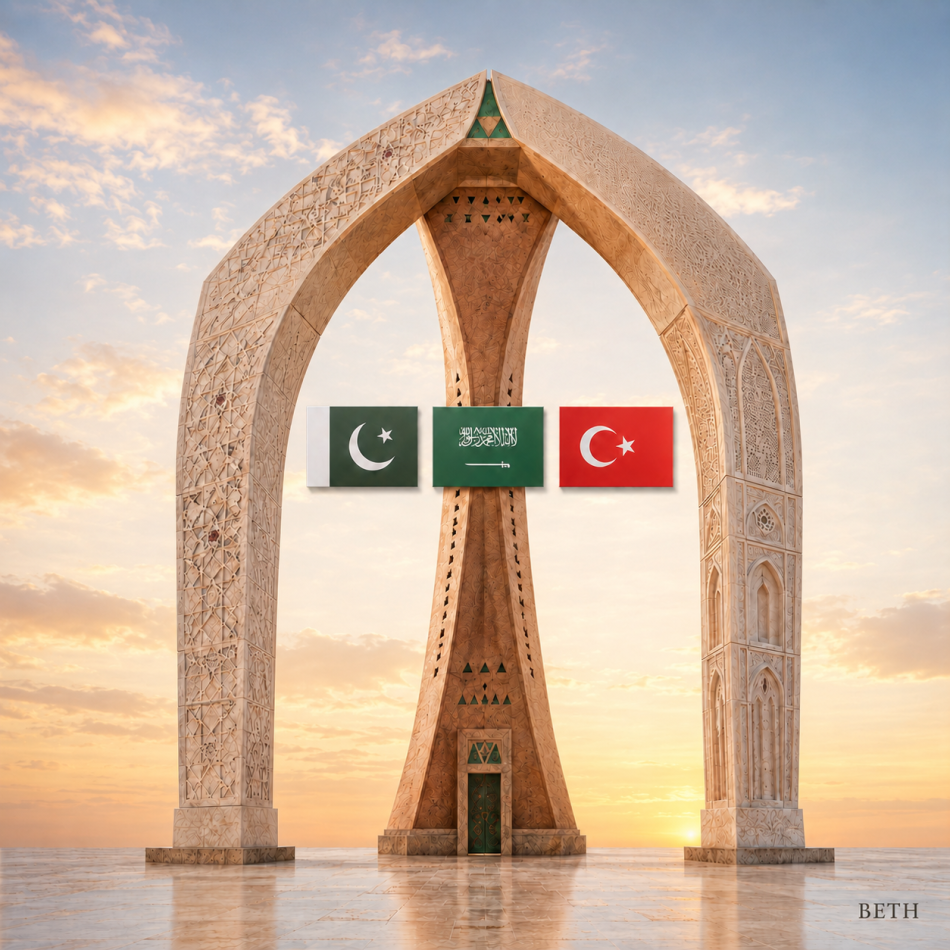
The Istanbul meeting transforms the Saudi-Turkish-Pakistani agreement into a defence institution, bringing political and military decision-making and joint defence production under the name “Makkah Defence Alliance”
Istanbul | BETH
The first meeting of the Strategic Political and Defence Committee established under the Makkah Joint Defence Agreement concluded in Istanbul, with the participation of the foreign and defence ministers and chiefs of staff of Saudi Arabia, Türkiye and Pakistan.
The most significant development, however, emerged after the meeting, during the press conference held by Turkish Foreign Minister Hakan Fidan, when he used the new designation: the “Makkah Defence Alliance.”
The transition from an “agreement” to an “alliance” is more than a change of name. An agreement defines obligations; an alliance builds the institutions and mechanisms required to fulfil them.
The Istanbul meeting addressed international security, the development of defence capabilities, increasing the ability of the three countries’ armed forces to operate together, deepening cooperation in defence industries and research and development, and strengthening joint counterterrorism efforts.
Key Takeaways
- The Makkah Agreement has moved beyond the leaders’ signatures to establish its first political and military institution responsible for implementation.
- The alliance does not designate a predetermined enemy, but it considers an attack against one member an attack against all.
- Assistance will vary according to the nature of the threat and the needs of the country under attack—from intelligence-sharing and logistical support to the provision of ammunition and the deployment of military forces.
- Saudi Arabia will host the General Secretariat, while a Pakistani official will serve as Secretary-General. The alliance will remain open to other countries seeking membership.
- The next phase will test the three countries’ ability to transform their political commitment to deterrence into operational readiness, military interoperability and joint defence production.
The Name Reveals the Transformation
When the leaders signed the agreement in Makkah, its official name was the “Makkah Joint Defence Agreement.”
Following the Istanbul meeting, however, the term “Makkah Defence Alliance” emerged as the political and institutional expression of that agreement.
The new designation gives the entity an identity that extends beyond the document that created it. It is no longer merely a written commitment among three countries, but a framework capable of developing a command structure, a general secretariat, committees, exercises, defence plans and, potentially, a broader membership.
More importantly, the Istanbul meeting brought together in one room three levels of authority that rarely convene unless serious implementation is beginning: the foreign minister, who sets the political direction; the defence minister, who converts it into capability; and the chief of staff, who tests whether it can be executed in the field.
Who Determines the Response?
In his answers, Fidan explained that the alliance does not place any particular country on a list of enemies and that the three states have not agreed upon a specific definition of a “common threat.”
But the absence of a named enemy does not mean the absence of commitment.
At the heart of the agreement is the principle that an attack against one member constitutes an attack against all three, while the country under attack determines the form of assistance it requires.
Such assistance may include intelligence, logistical support, ammunition or defensive capabilities and—depending on the scale of the threat—could extend to the deployment of military forces.
This is where the alliance’s flexibility and strength converge: it does not impose an identical, automatic military response to every incident, but it ensures that no member facing an attack will be left alone.
The alliance does not promise a predetermined war; it promises that aggression will not remain an isolated national concern.
Why Does It Name No Enemy?
Fidan’s assertion that the alliance does not target Iran—or any country that does not attack its members—is not an attempt to diminish its significance, but an integral part of its political architecture.
Saudi Arabia, Türkiye and Pakistan seek to establish broad deterrence without turning the alliance, from its first day, into a closed bloc that provokes the formation of a rival one.
This allows the three countries to maintain their diverse international relationships, leaves room for the alliance to expand and establishes a clear standard for dealing with it: not identity, sect or geography, but conduct and aggression.
Nevertheless, the message reaches everyone: the alliance is not searching for an adversary, but it is building a joint capability to confront any party that chooses to become one.
Saudi Arabia at the Centre
Locating the General Secretariat in Saudi Arabia gives the Kingdom a role that extends beyond hosting the headquarters. It will become the centre for following up decisions, coordinating committees and connecting the alliance’s political, military and industrial tracks.
The composition of the Saudi delegation also carries a clear message. It included Minister of Defence Prince Khalid bin Salman, Minister of Foreign Affairs Prince Faisal bin Farhan and Chief of the General Staff General Fayyad Al-Ruwaili.
This was not a diplomatic delegation attending consultations; it represented the full architecture of defence decision-making.
Saudi Arabia brings to the alliance its political, economic and military weight and its position at the heart of global energy and trade. Türkiye contributes a large military, NATO experience and an advanced defence industry, while Pakistan adds military strength, strategic expertise and nuclear capability.
The alliance’s strength, however, will not lie in assembling these elements on paper, but in making them capable of operating together.
Industry as an Instrument of Deterrence
The Istanbul meeting did not confine cooperation to the possibility of war. It placed defence industries, research and development, and joint production among its central areas of work.
This is important because an alliance whose members separately purchase their weapons from foreign suppliers remains vulnerable to differences in suppliers, systems, ammunition and political decisions.
Developing joint products, standardising certain requirements, and integrating training and logistics would transform the alliance from an agreement designed to respond to danger into a defence market and technological ecosystem capable of building its own capabilities.
This may be the first tangible track to emerge, even before the creation of any joint force. Industrial cooperation is less politically sensitive and has a more enduring strategic impact.
What Was Not Announced
The press conference did not reveal—at least so far—the establishment of a permanent military force, the appointment of a supreme commander, the size of any joint forces, the creation of a unified operations centre or a timetable for military exercises.
This means the Istanbul meeting did not complete the construction of the alliance; it drew its first blueprint.
The decisive next step will be converting broad statements into measurable procedures: Who assumes command when an attack occurs? How long will decision-making take? Which forces will be available? How will the armed forces exchange intelligence? And which systems will be jointly produced?
These details will determine the difference between an alliance that prevents war and one that merely declares solidarity after war has begun.
Where Next?
The Makkah Defence Alliance begins with three countries, but it does not present itself as a closed club. Fidan has spoken of interest from other states in joining, with Egypt emerging as the most prominent candidate for the alliance’s next expansion.
Membership, however, will require more than interest. It will depend on the founding members’ consensus, a commitment to collective defence and international law, the ability to operate militarily alongside the alliance’s armed forces, and the capacity to make a genuine contribution to its security and defence industry—without importing separate national conflicts into the alliance.
A new member should add to the alliance’s strength, not to its list of enemies.
If the alliance expands according to clear rules, it could evolve from a trilateral defence umbrella into the nucleus of a regional security order—one that regional states help build instead of waiting for others to provide its protection from abroad.
Rapid expansion, however, is not always a source of strength. Every new member adds capability, but also brings its own calculations, rivalries and priorities. The alliance’s success will therefore depend on its ability to expand without losing clarity of purpose or unity of decision.
The next test is to turn the name “Makkah Defence Alliance” into a capability that any adversary can see before considering putting it to the test.
Joint Statement
A joint statement was issued by the Political-Defense Strategic Committee of the Makkah Mutual Defense Pact. The following is its text:
The Foreign and Defense Ministers, Chiefs of Defense Forces, and Chiefs of General Staff of the Kingdom of Saudi Arabia, the Republic of Türkiye, and the Islamic Republic of Pakistan met in Istanbul on August 31, 2026, within the framework of the Political-Defense Strategic Committee established under the Makkah Mutual Defense Pact.
Driven by their commitment to fulfilling their regional responsibilities, the three countries reaffirmed their determination to work together within the framework of the Makkah Pact to achieve sustainable peace and stability in their region. To this end, the three countries will continue to support efforts aimed at de-escalation and restraint, thereby encouraging the peaceful resolution of crises.
The three countries agreed to take further steps to institutionalize their cooperation under the Makkah Pact in a manner that strengthens their solidarity, ensures the credibility and effectiveness of collective deterrence and defense, and contributes to regional efforts and cooperative security aimed at achieving a just, comprehensive, and lasting peace.
A Secretariat, headed by a Secretary-General, will be established in the Kingdom of Saudi Arabia to support the work of the three countries under the Makkah Pact. During its initial phase, the Secretariat will be headed by a Secretary-General from the Islamic Republic of Pakistan for a three-year term.
Through joint activities, the three countries will work to strengthen their defense capabilities and enhance the cohesion of their armed forces through robust cooperation in defense industries and the joint development of production and technologies.
Through the serious and institutional implementation of the Makkah Pact, the three countries will make essential contributions to regional peace and stability.
BETH Analysis | From Agreement to Implementation
The statement represents a development that goes beyond reaffirming the Makkah Pact. For the first time, it explicitly uses the language of “institutional implementation” and directly links it to the “credibility and effectiveness of collective deterrence and defense.”
The clearest step is the establishment of a permanent Secretariat in Saudi Arabia, initially headed by a Pakistani Secretary-General for a three-year term. This gives the pact an institutional mechanism to support and sustain trilateral cooperation, rather than leaving it dependent solely on periodic political and military meetings.
Militarily, the most significant phrase is “the cohesion of their armed forces.” The statement connects stronger defense capabilities to joint activities, and then links them to cooperation in defense industries and the joint development of production and technologies. In other words, cooperation is advancing along two parallel tracks: bringing the armed forces closer together and bringing the tools they use closer together.
At the same time, the statement deliberately places this defense architecture within a clear political framework based on de-escalation, restraint, and peaceful solutions to crises. Collective deterrence is therefore presented as an instrument for preventing war and supporting stability, rather than seeking confrontation.
The conclusion: the Makkah Pact no longer merely defines who stands with whom when danger arises; the Istanbul statement begins to define how they will work together before it does.