


Day 180: Fire Returns
A U.S. strike on Larak Island resumes direct military confrontation after a month of calm; Iran retaliates towards Jordan and the UAE as the war enters a phase combining military force, sanctions and digital deception
31 August 2026
Prepared and Analysed by the Strategic Media Department – BETH Agency
On Day 180, the U.S.-Iran war shifted from economic pressure back to a direct exchange of fire. U.S. forces struck two Iranian rocket launchers on Larak Island near the Strait of Hormuz, while Tehran retaliated by firing missiles towards bases hosting U.S. forces in Jordan and launching a drone intercepted by the UAE over its territorial waters.
Although the U.S. strike was limited, its significance lies in ending nearly a month of military calm and drawing neighbouring countries back into the confrontation, while shipping through Hormuz remains disrupted and oil prices remain vulnerable to every new exchange of fire.
In Brief
- The United States resumed military strikes, saying it was acting to prevent Iran from laying new mines in the Strait of Hormuz.
- Iran retaliated beyond its borders; Jordan intercepted eight missiles, while the UAE denied that Al Minhad Air Base had been hit.
- The war is now unfolding along three simultaneous fronts: firepower, sanctions and the battle of narratives.
A Strike and a Message
U.S. Central Command said the strike targeted members of Iran’s Revolutionary Guards who were preparing to launch rockets carrying naval mines into the Strait of Hormuz. It described the operation as a limited and precise action against an imminent threat to shipping.
The choice of Larak Island, however, is more than a geographic detail. The island lies at the centre of the dispute over who has the authority to regulate passage through the strait. The strike therefore targeted more than two launchers; in practical terms, it challenged Iran’s attempt to turn threats against shipping into permanent control over the waterway.
The Revolutionary Guards responded by launching ballistic missiles towards two sites hosting U.S. forces in Jordan. The Jordanian military said it intercepted eight missiles that entered the kingdom’s airspace.
The UAE also said it intercepted an Iranian drone over its territorial waters, describing the incident as a dangerous escalation and a violation of its sovereignty. It rejected Iran’s claim that Al Minhad Air Base had been struck.
Iran has thus repeated one of the war’s most dangerous equations: when struck on its own territory, it transfers its response to the territory of its neighbours.
Three Wars at Once
The military escalation has not halted the economic campaign. Washington is preparing to continue imposing weekly secondary sanctions, beginning with networks and banks linked to Iran, in an effort to restrict its ability to sell oil and move money.
At the same time, the war has entered a third arena: the battle over images.
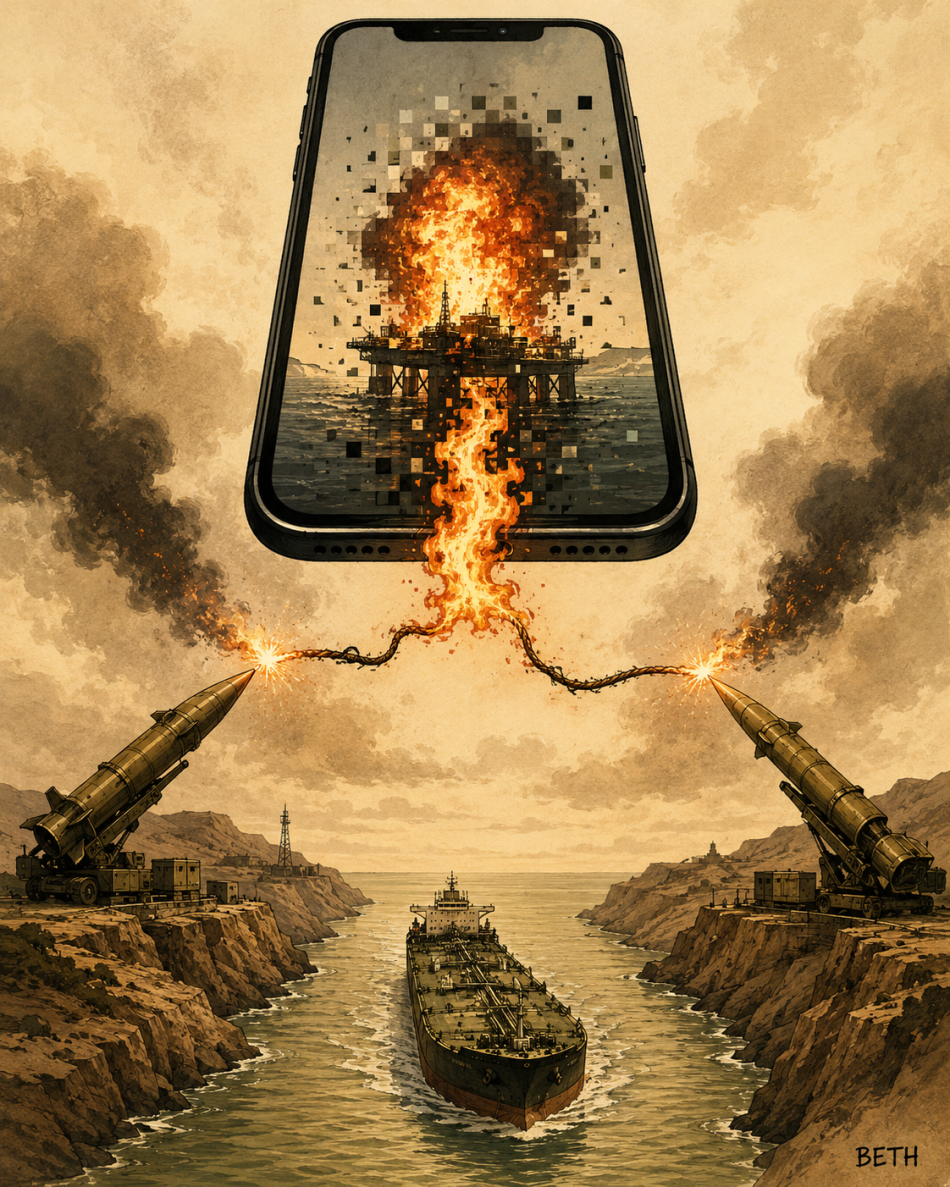
President Donald Trump posted an AI-generated video that he claimed showed the destruction of Kharg Island, Iran’s most important oil export hub. No U.S. government agency, however, confirmed that such an attack had taken place. Tehran denied that the island had been struck and said oil operations were continuing.
The video was not evidence of an attack, but it demonstrated how a fabricated image can raise tensions before a real aircraft even takes off.
Pressure Returns to Oil
The renewed strikes pushed oil prices more than 3.5% higher, with Brent crude rising above $91 a barrel and U.S. crude surpassing $86.
The market is not concerned solely by the scale of the latest strike. It fears that the limited exchange could develop into a new cycle: a U.S. strike, an Iranian response, and then retaliation for the retaliation, while Hormuz remains hostage to every round.
So far, both sides appear to be selecting targets that allow them to demonstrate strength without immediately sliding into a full-scale war. But the trajectory of missiles and drones over Jordan and the UAE increases the risk of miscalculation. One projectile landing in the wrong place, or a strike causing significant casualties, could be enough to alter the rules of response.
On Day 180, the war is no longer only military or economic; it is also a war over what the world sees and believes.
The danger is not merely that fire has returned to Hormuz, but that a fabricated image may become faster than a missile—and more capable of igniting one.