



Makkah Agreement Enters Implementation
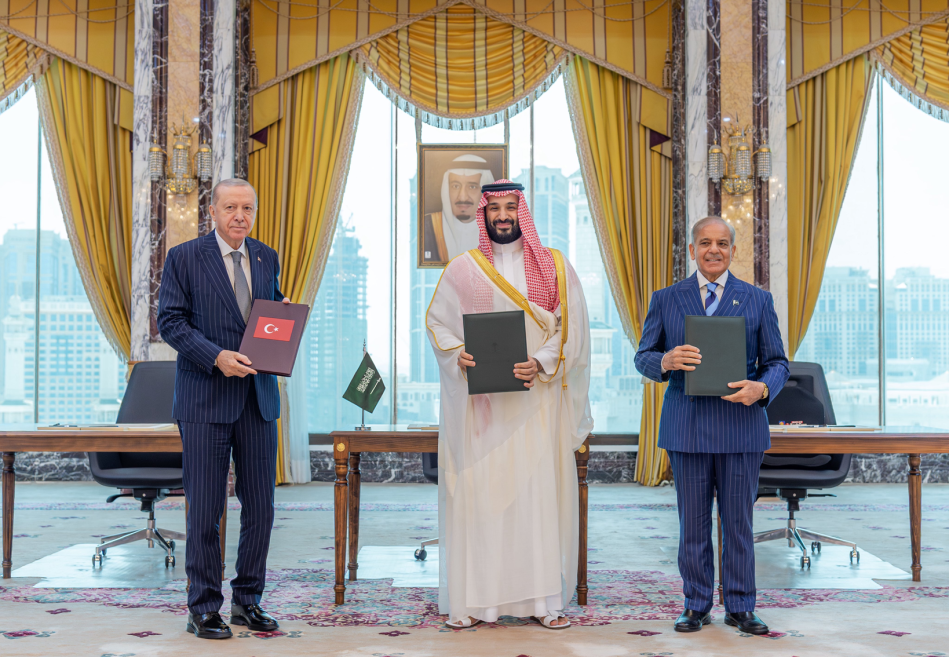
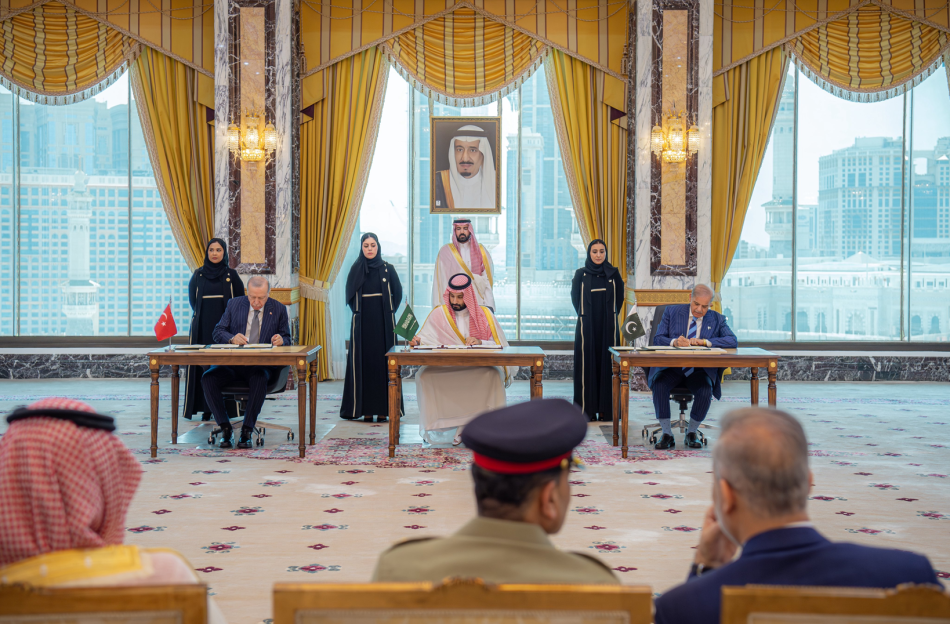
The inaugural meeting of the Strategic Political and Defence Committee in Istanbul moves the Makkah Agreement between Saudi Arabia, Türkiye and Pakistan from a political commitment towards building mechanisms for deterrence and military coordination
Istanbul | Special Report
Prepared and Analysed by the Strategic Media Department – BETH Agency
Supervised by Abdullah Al-Omairah
Saudi Arabia, Türkiye and Pakistan are moving the Makkah Joint Defence Agreement from political signature to its first operational test today, Monday, 31 August 2026, as the Strategic Political and Defence Committee holds its inaugural meeting in Istanbul with the participation of senior political and military officials from the three countries.
The significance of the meeting lies not only in the fact that it is the first since the agreement was signed in Makkah on 7 August, but also in its potential to begin answering the question that has remained open since the agreement was announced:
How can the principle that “an attack on one state is an attack on all three” be transformed from a major political commitment into a defence capability that can be activated when a threat materialises?
Beyond the Signing
The Makkah Agreement clearly established the principle of collective defence, stipulating that any armed attack against one of the three countries would be considered an attack against them all.
Defence agreements, however, are not measured by the strength of their language alone, but by the structures built behind it: communication systems, response plans, intelligence sharing, compatible command arrangements and the ability to make timely decisions.
The Istanbul meeting therefore carries significance beyond its declared agenda. It represents the first step towards transforming political will into an operational framework.
The meeting is expected to address military coordination, interoperability among the three countries’ armed forces, the development of defence capabilities, and cooperation in defence technology and industry, as well as the establishment of communication channels among their political and defence institutions.
Deterrence is not achieved merely by declaring that countries will stand together. It requires convincing a potential adversary that they already know how they will stand together, when they will act and which capabilities they will employ.
Three Complementary Powers
The agreement brings together three countries whose capabilities are not identical, but complementary.
Saudi Arabia gives the agreement its political, economic and military weight, its Arab and Islamic standing, and its ability to direct investment towards domestic defence industries and long-term technological partnerships.
Türkiye contributes a large military with experience in operating within multinational defence structures, alongside an advanced defence industry encompassing unmanned aircraft, missiles, naval systems and military electronics.
Pakistan brings considerable military weight, operational experience, and extensive personnel and training capabilities, in addition to its status as a nuclear power—although the publicly announced agreement does not automatically extend Pakistan’s nuclear umbrella to its two partners.
These elements do not mean that each country will provide one fixed capability. Their real strength lies in the possibility of integrating financing, manufacturing, expertise, training and geographic reach within a single strategic architecture.
What the three countries can build together may substantially exceed the combined value of what each possesses individually.
The Real Test
The most important test remains in the details that have yet to be announced.
Will the agreement lead to the creation of a joint military command, or will it remain under the direction of a high-level coordination committee?
Will pre-arranged plans be developed to address potential threats, or will the nature of the response be determined only after an attack occurs?
And what, in practical terms, constitutes an armed attack? Does it include only missiles, drones and maritime attacks, or does it extend to cyberattacks and strikes against energy infrastructure, ports and supply lines?
Who determines whether an attack warrants the activation of collective defence, and what form of assistance is each country obliged to provide?
These are not minor legal details. They will determine whether the Makkah Agreement becomes an operational deterrence umbrella or remains a powerful declaration of political solidarity that requires considerable time to develop into an executable force.
An Alliance That Does Not Seek War
The agreement was concluded during a period of profound instability, as the region confronts open conflicts, missile threats, disruptions to shipping and energy flows, and declining confidence in the ability of traditional security arrangements to prevent aggression or bring it to a swift end.
Nevertheless, the participating countries have stressed that the agreement is defensive, is not directed against any particular state, and is not intended to establish a closed religious or military bloc.
This is more than a routine diplomatic formulation.
Successful deterrence does not begin when missiles are launched, but when anyone contemplating their use becomes convinced that the cost will outweigh the gain.
Autonomy Without Estrangement
Building this framework does not mean that Saudi Arabia, Türkiye and Pakistan are moving towards severing their existing alliances and international partnerships.
Türkiye is a member of the North Atlantic Treaty Organization, while all three countries maintain varying military and security relationships with the United States and other powers, as well as extensive political and economic partnerships.
The Makkah Agreement, however, reflects an important shift in security thinking.
Regional states no longer want the protection of their security to remain entirely dependent on decisions made in distant capitals or on calculations that may change with successive governments and crises.
They are not replacing one international partnership with another. Rather, they are adding a regionally owned capability to their existing networks—one that controls its own decisions, understands its geography and recognises the nature of the threats surrounding it.
Strategic autonomy does not mean isolation from the world. It means ensuring that national security is not entirely borrowed from it.
From Makkah to the World
The agreement’s impact is unlikely to stop with its three founding members.
The agreement has become increasingly attractive to potential new partners, some of whom are not merely expressing interest but actively pressing to join. The question, however, is not who wants to enter, but under what mechanism they would operate, what capabilities they would contribute, and what strategic thinking they would bring to the collective security framework.
Discussions have already begun in other countries over the possibility of joining it, making the success of the inaugural meeting important not only for the founding states, but also in determining whether the agreement remains trilateral or gradually develops into the nucleus of a broader defence framework.
Early expansion, however, carries risks of its own.
Every new member would bring additional capabilities and strategic geography, but might also bring its disputes, calculations and adversaries. Establishing firm rules among the founding countries is therefore more important than increasing the number of flags around the table.
A Meeting to Set the Rules
The Istanbul meeting is not expected to produce a unified army in a single day, nor to answer immediately every political and military question raised by the agreement.
What it can do, however, is establish the first rules:
Who contacts whom when a threat emerges?
How will intelligence be exchanged?
How will threats be assessed?
And which capabilities must be developed before they are needed?
In this sense, implementing the Makkah Agreement does not begin with the deployment of forces. It begins with building the institutional mind that will determine when those forces move and how they operate together.
The meeting’s value will not be measured by the number of issues it discusses, but by how much it transforms the agreement into procedures, intentions into capabilities, and solidarity into deterrence.
The Makkah Agreement was born at a moment of regional instability, but it should not remain solely a product of that crisis.
If the three countries succeed in transforming it into institutional cooperation, defence industrial integration, intelligence sharing and rapid-response capability, they will not merely have created an agreement to confront a passing threat. They will have laid the foundation for a new security order led by the countries of the region, which assume responsibility for building it.
In Makkah, it was declared that an attack on one is an attack on all.
In Istanbul today, the harder question begins: How will all defend the one?
The agreement’s success will ultimately depend on its partners entering it with the capabilities of the present—not the maps of the past.