

Khamenei Summons the Gulf | Analytical Article
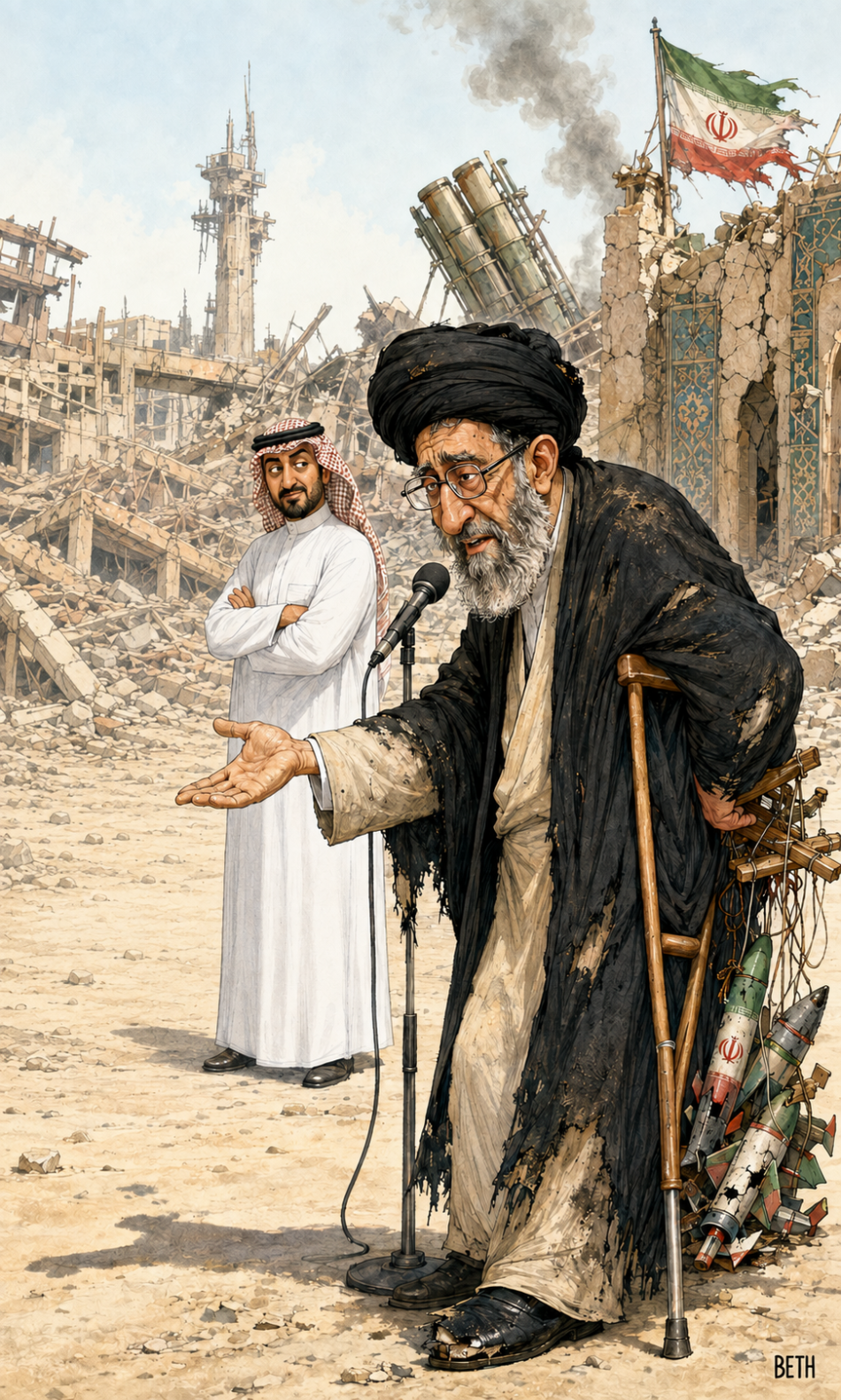
When the Iranian regime asks the Gulf states to search for their “real enemy,” it is not offering reconciliation so much as attempting to erase the memory of its threats and rename the source of danger at the very moment it has become most dependent on its neighbors.
By Abdullah Al-Amirah
The message sent by Iran’s Supreme Leader, Mojtaba Khamenei, to the rulers of the Gulf states was not an ordinary call for Islamic unity, as it might appear on the surface.
Political messages are not read through their wording alone, but through their timing, the needs of their author, what he says before and after them, and what he avoids acknowledging.
Khamenei called on the Gulf states to identify their “real enemy,” understand its plans, and confront it. He also called for Muslim unity, cooperation, and mutual defense against enemies.
But the question the message avoids is:
Who compelled the Gulf states in the first place to seek defense umbrellas, purchase missile-interception systems, protect their oil facilities, and monitor their waters and borders throughout the past decades?
Who built armed militias in Arab countries, financed and trained them, supplied them with missiles and drones, and then used them as cards in its confrontation with the world?
And who treated Gulf security as a bargaining chip and the Strait of Hormuz as a valve it could close whenever the blockade tightened around it?
The problem is not that Khamenei is calling for unity.
Unity is a value no rational person would oppose.
The problem is that he is demanding unity without first conducting a review, mutual defense without first ending the threats, and trust for which he offers nothing except a new discourse produced by the same old behavior.
Iran is not asking the Gulf to forget a political disagreement; it is asking it to forget an entire security experience.
A Command, Not an Apology
The first striking feature of the message is that it came neither as an apology nor as a reconciliation initiative, nor did it offer any specific proposal for building trust.
Khamenei did not say that Iran was prepared to end its support for armed groups, respect the sovereignty of states, guarantee the security of navigation, or enter into a clear agreement prohibiting the use of missiles and drones against its neighbors.
What he effectively told them was: You do not know who your real enemy is.
This formulation reveals an important aspect of the Iranian regime’s way of thinking: it is not content with identifying its own enemies; it also wants to identify everyone else’s enemies for them.
It does not ask the Gulf states: What sources of danger do you perceive?
Instead, it tells them that their reading of the danger is wrong and that they must replace it with the Iranian reading.
Here, Tehran does not address independent states as partners in shaping the region’s security. It addresses them from the position of one who believes he possesses a higher definition of the truth and that others are either deceived or under the influence of a “plot” they have failed to understand.
It is an ideological language that grants its speaker a monopoly over awareness:
We know the enemy.
We understand the conspiracy.
And whoever disagrees with us has not yet seen the truth.
This is the essence of the problem in the regime’s thinking, not merely in the wording itself. It does not consider that Gulf fears may result from its own actions; instead, it assumes they are the product of foreign deception.
Thus, in Iran’s narrative, it is absolved of the fear it created, while the victims of its threats are required to correct their understanding instead of Iran correcting its behavior.
A Memory Meant to Be Erased
The message asks the Gulf to look toward the future without reviewing the past.
But states do not build their policies on the memory of a single day.
Since the establishment of the current Iranian regime in 1979, Tehran has not treated the Gulf as an equal neighbor, but as an open arena for exporting the revolution, expanding its influence, and building terrorist groups parallel to the state.
In Iraq, it helped build armed forces, some of which are more closely tied to Iran politically and militarily than they are to the decisions of the Iraqi state.
In Lebanon, it transformed Hezbollah into a force that surpasses state institutions and possesses the power to decide matters of war and peace outside them.
In Yemen, the Houthi group was transformed from a local armed movement into an Iranian arm possessing missiles and drones and threatening cities, facilities, and navigation.
In Bahrain, Kuwait, and other countries, the name of the Islamic Revolutionary Guard Corps has been associated with armed networks and cells, as well as attempts to smuggle and use weapons to destabilize those states.
When Saudi energy facilities were attacked, the Gulf states were not facing an intellectual disagreement or a political debate. They were facing missiles, drones, economic costs, and a direct threat to the security of their populations and global energy supplies.
During the current war, Tehran struck military installations and infrastructure in Gulf states, threatened oil-export routes, and linked the safety of navigation through Hormuz to the concessions it could obtain.
Then came the message telling these states: Search for your real enemy.
What is astonishing is that such a call should come from a regime that has been among the most harmful to Muslims and its neighbors. Through its militias and armed proxies, it has spread corruption across Arab lands. It has never ceased its destructive operations or the dispatch of missiles and drones to destroy and terrorize, targeting states greater than its fantasies of expansion and stronger than its ability to subjugate them.
How, then, does Mojtaba Khamenei expect the Gulf states to trust a regime in whose political and security doctrine a culture of sabotage is deeply rooted, and which asks its neighbors to feel reassured by it while the instruments used to threaten them remain in its hands?
The proposition appears naïve if read as a sincere call for unity, because a victim cannot be asked to trust the source of the danger without acknowledgment, review, or guarantees. Yet it becomes a political proposition when read as an exposure of the regime’s way of thinking: it threatens its neighbors when it is strong, summons them when it grows weak, and asks them to forget what it has done without pledging not to repeat it.
As though a missile loses its nationality merely because the language of its launcher has changed.
And as though a militia becomes a charitable association when the state that financed it needs to break its isolation.
Politics can open a new page, but it cannot tear out the preceding pages and then demand that others deny ever having read them.
Why Now?
The timing is the clearest part of the message.
It came at a moment when Iran is facing simultaneous pressure from several directions:
Its economy is suffocating under the blockade and sanctions.
Its foreign trade is declining.
Its oil exports face severe restrictions.
Its currency is losing value.
Fuel and commodity prices are placing pressure on the domestic front.
And its foreign financial and commercial networks are threatened by US secondary sanctions.
At the same time, some countries in the region have begun reducing their dealings with Iran and are being required to make a clearer choice between access to the global financial system and continuing to provide outlets for the Iranian economy.
Only days before the discourse of “unity,” Tehran warned the Gulf states against cooperating with US sanctions and threatened that economic escalation against it could halt oil exports through the Gulf and target other energy routes.
Here, the full contradiction emerges:
One hand threatens the Gulf if it cooperates with the sanctions, while the other invites it to participate in mutual defense.
But both hands belong to the same political body.
Khamenei’s message, therefore, cannot be separated from an attempt to prevent the Gulf states from participating in the strangulation of the Iranian economy or providing military, logistical, and financial facilities for exerting pressure on Iran.
Iran most likely does not expect the Gulf suddenly to become its strategic ally against the United States and Israel.
At a minimum, what it wants is less than an alliance, but more urgent:
It wants to neutralize the Gulf.
It wants the Gulf not to become a platform for military pressure.
Not to close its financial and commercial outlets to Iran.
Not to participate actively in the sanctions.
Not to advance too far in building a regional defense system that excludes Iran.
And not to provide the United States with regional cover for continuing the blockade.
The message does not necessarily seek to move the Gulf into the Iranian camp. It is enough for Tehran to prevent it from becoming fully established in the opposing camp.
Unity as a Way Out
Khamenei chose a religious occasion and invoked the language of Islamic unity, Palestine, and mutual defense because religious language provides his message with moral cover broader than its immediate political purpose.
But the question this discourse avoids is: Does the Iranian regime’s behavior embody the spirit of Islam and the ethics of a true Muslim? And what precedents does it have in serving Arabs and Muslims?
Islam is not represented by slogans, but by justice, the preservation of life, respect for neighbors, and the protection of nations from sedition and destruction. A regime that has torn societies apart through its militias, contributed to weakening Arab states, and threatened its neighbors with missiles cannot simply invoke the name of Islam whenever it needs moral cover for a political predicament.
If Iran were described as asking the Gulf to help it confront the sanctions, it would appear as a besieged state searching for an outlet.
But if it is described as calling on Muslims to confront the “real enemy,” its need is transformed into the cause of an entire nation, supporting Iran becomes a duty, and distancing oneself from it becomes a division that serves the enemy.
The discourse thus works to move Iran from the position of the accused party threatening regional security to that of a leader defining the region’s danger for it.
It is an exchange of seats:
Iran, whose behavior requires explanation, becomes the interpreter.
Iran, which is required to provide guarantees, becomes the party demanding that others correct their positions.
Iran, which used militias to tear states apart, speaks of the danger of division.
And Iran, which threatened energy routes, offers mutual defense.
This is not reconciliation, but an attempt to rewrite the narrative without changing the facts.
Palestine in the Message
Khamenei invoked the Palestinian cause and asked, in effect, whether the Palestinians would have been left in such a state of weakness had Muslims been united.
The question appears affecting on the surface, but it performs a clear political and ideological function consistent with the project of the mullahs and the Revolutionary Guard and their fantasies of expansion: to embarrass Gulf governments before their people and portray rejection of the Iranian project as though it were abandonment of Palestine.
But the Palestinian cause does not grant any state the right to dominate other states, nor does it make everyone who rejects Tehran’s policies an enemy of Palestine.
More importantly, Iran has long used Palestine to build its regional legitimacy, while directing a significant portion of its capabilities and proxies into conflicts within Arab states. It has contributed to weakening their institutions and draining their societies, transforming the Palestinian cause from a national right into an instrument serving its project of regional influence.
Since its establishment, the Iranian regime has done nothing to bring the Palestinians closer to their state or the region closer to peace. Instead, it has used their suffering to prolong the conflict and grant legitimacy to its proxies—a legitimacy that gives the Palestinians no land, protects no life, and builds no state.
If the unity Khamenei speaks of were a genuine objective, Tehran would begin by restoring decision-making authority to the states from which the militias seized it, rather than demanding that intact states open their doors to the same model.
The Mullahs’ Mindset
The message reveals a deeply rooted way of thinking within the regime of the mullahs.
It is a way of thinking based on several constants:
The first is that the Iranian revolution is not merely a state within the region, but an authority entitled to define the region’s interests and enemies.
The second is that security is not built between equal states, but under an ideological umbrella whose direction is determined by Tehran.
The third is that what Iran does is called resistance, while what its opponents do is called aggression, even when both sides use the same instruments.
The fourth is that the political memory of others is short and that a religious discourse or a call for brotherhood can separate the missile from its source, the militia from its financier, and the threat from the party that made it.
The most dangerous assumption in the thinking of the regime of the mullahs, however, is that the Gulf states may cooperate with Iran under pressure without obtaining any corresponding change in its behavior.
In clearer terms, Tehran is demanding free security for itself while leaving others to pay the cost of the insecurity it created.
It wants the Gulf to protect Iran from its enemy before Iran stops behaving as an enemy of the Gulf.
Will the Gulf Believe Him?
It is unlikely that the Iranian leadership believes a single message will persuade the Gulf states to overlook forty years of bitter experience.
But the success of political messages is not always measured by their complete acceptance.
The message may be intended to sow doubt within Gulf alliances, influence public opinion, embarrass governments, or provide Iran’s allies with material enabling them to claim that Tehran extended its hand but the other side rejected it.
This is part of the way a regime that has long shown what it does not conceal thinks: it extends its hand before the public while keeping the instruments of threat hidden behind its back.
It may also be preparation for an initiative through an intermediary, or a message to Washington that Iran possesses the ability to address its allies from within the American regional sphere.
The message may also target the Iranian domestic audience.
Khamenei, who has not appeared publicly since his injury, needs to reaffirm his presence and authority. The regime, which calls on its people to preserve cohesion, needs to demonstrate that it is not isolated and that it possesses a regional project larger than its fuel crisis and sanctions.
The message therefore addresses more than one audience:
It tells the Gulf: Do not join in strangling us.
It tells the United States: Your allies are not guaranteed forever.
It tells the Iranians: We are still leading a project greater than our crisis.
It tells Tehran’s proxies: The leadership has not retreated from the narrative that grants you legitimacy.
And it tells the mediators: We have language that can be built upon if we receive something in return.
An Umbrella Built Without Iran
Khamenei’s message also comes as Saudi Arabia, Turkey, and Pakistan move to transform the Mecca Defense Agreement from a political declaration into an institutional and operational structure.
This development concerns Tehran because it presents a regional security model in which Iran is not at the center, which it cannot disrupt from within, and which combines significant military, industrial, and political capabilities.
Iran has long spoken of the need for foreign powers to leave the Gulf and for the countries of the region to build a regional security system.
But it has often assumed that any new regional order would recognize its dominant position, grant it the right to object, or treat its missile power and armed proxies as a reality that must be accepted.
The prospect of the region’s states building a defense arrangement independent of Iran exposes the predicament Tehran has created for itself:
It sought to weaken its opponents while they were divided, so it drove them to seek strength together.
It sought to drive foreign powers out of the Gulf, but gave its neighbors additional reasons to summon them.
It sought to lead the regional security order, but its behavior became one of the main reasons for building a system designed to deter it.
Iran calls for a single umbrella after raining missiles down on its neighbors, only to discover that those neighbors have begun building their umbrella without it.
How Can the Gulf Respond?
The Gulf states have no interest in rejecting the principle of dialogue with Iran or turning hostility into a permanent destiny. Geography does not change, and regional stability is better for everyone than continued exhaustion.
But dialogue is one thing, and surrendering the definition of security to Iran is another.
The Gulf can say to Tehran:
Yes, we want regional security.
But security begins with respecting the sovereignty of states, not penetrating them.
We want mutual defense.
But mutual defense cannot be built with a state that arms groups operating outside national armies.
We want the Gulf to remain removed from international wars.
But that requires Iran not to use its waters, straits, and facilities as a means of raising the cost of its conflict with others.
We want normal relations.
But normal relations are not built with a missile in one hand and a call for brotherhood in the other.
For Khamenei’s message to be transformed from a maneuver into a different beginning, Iran must take measurable steps:
End the arming of militias.
Respect the sovereign decisions of Arab states.
Guarantee the security of navigation and refrain from using Hormuz for blackmail.
End its threats involving missiles and drones.
Accept a clear regional mechanism for de-escalation.
And transform its relationship with the Gulf from a project of influence into a relationship between states.
Without that, unity will remain a beautiful word used to cover an ugly policy.
What Can Be Expected?
The Gulf states will most likely not respond to the message through a direct verbal confrontation. They understand that media escalation would give Tehran an opportunity to escape its crisis and shift the debate away from its behavior and toward the rhetoric of its opponents.
They may keep the doors of mediation and communication open, particularly on matters involving Hormuz, ending the war, and energy security.
But they will not rebuild their security on an Iranian written promise, abandon their defense partnerships, or separate the message from the threats that preceded it.
Iran, meanwhile, may pursue two parallel paths:
It will continue speaking of brotherhood and unity when it needs calm, while retaining threats and pressure through its proxies and the strait when it needs to raise the cost.
If it receives a Gulf response, it will present that as recognition of the validity of its position.
If it does not, it will accuse the Gulf of choosing the “real enemy” over “Islamic brotherhood.”
This is one of the characteristics of Iranian ideological discourse: it formulates the question in a way that allows it to emerge victorious from every answer.
But the Gulf’s standard will not be the eloquence of the message, but what happens after it.
Will the threats stop?
Will the role of the militias recede?
Will Hormuz be opened without extortionate conditions?
Will Tehran accept being a state in the region rather than its guardian?
Only then will it be possible to know whether the message marks the beginning of a genuine review or merely a linguistic pause between two threats.
Who Drafted the Message?
It does not matter who held the pen inside the Supreme Leader’s office or what committee reviewed the wording before publication. The question is not who wrote the words, but what dictated them.
What truly drafted the message was Iran’s predicament.
The blockade wrote it when it narrowed the economy’s outlets. The sanctions dictated it when they threatened what remained of Tehran’s trade. Fear of the Gulf joining the campaign to isolate Iran edited it. The Revolutionary Guard added the concept of the “real enemy.” The Supreme Leader’s office then wrapped it in the language of Islam, Palestine, unity, and mutual defense.
The message did not arise from a new review of relations with Iran’s neighbors, nor was it preceded by any indication that the regime had decided to abandon its proxies or change its behavior. It arose from the realization that Iran cannot simultaneously withstand American pressure, the naval blockade, economic strangulation, and regional isolation while the Gulf states proceed with building defense capabilities and alliances of which Tehran is not a part.
That is why the words were carefully distributed:
“Islamic unity” to address the peoples.
“Palestine” to embarrass governments.
The “real enemy” to redirect the source of danger.
And “mutual defense” to obtain security Iran needs without providing guarantees to its neighbors in return.
The regime’s institutions contributed the distilled essence of their crises to the message: the security establishment supplied the fears, the Revolutionary Guard identified the enemy, diplomacy softened the language, and the Supreme Leader’s office dressed political necessity in religious garments. Khamenei’s name was then placed above it to grant it an authority exceeding that of any passing government statement.
The message therefore does not mean that Iran has discovered the value of the Gulf; it means that it has discovered the cost of having the Gulf on the opposing front.
Nor does it reveal that the regime has changed its view of its neighbors; rather, it has become necessary for the regime to change how its neighbors view it.
The message was not written by a desire for unity, but by a fear of isolation.
It was not drafted by reassurance toward the neighborhood, but by anxiety that this neighborhood might unite against the source of danger that had threatened it for so long.
The signature bore the name of Mojtaba Khamenei.
But the true author was Iran’s predicament.