



Wildfires and Floods Besiege the World
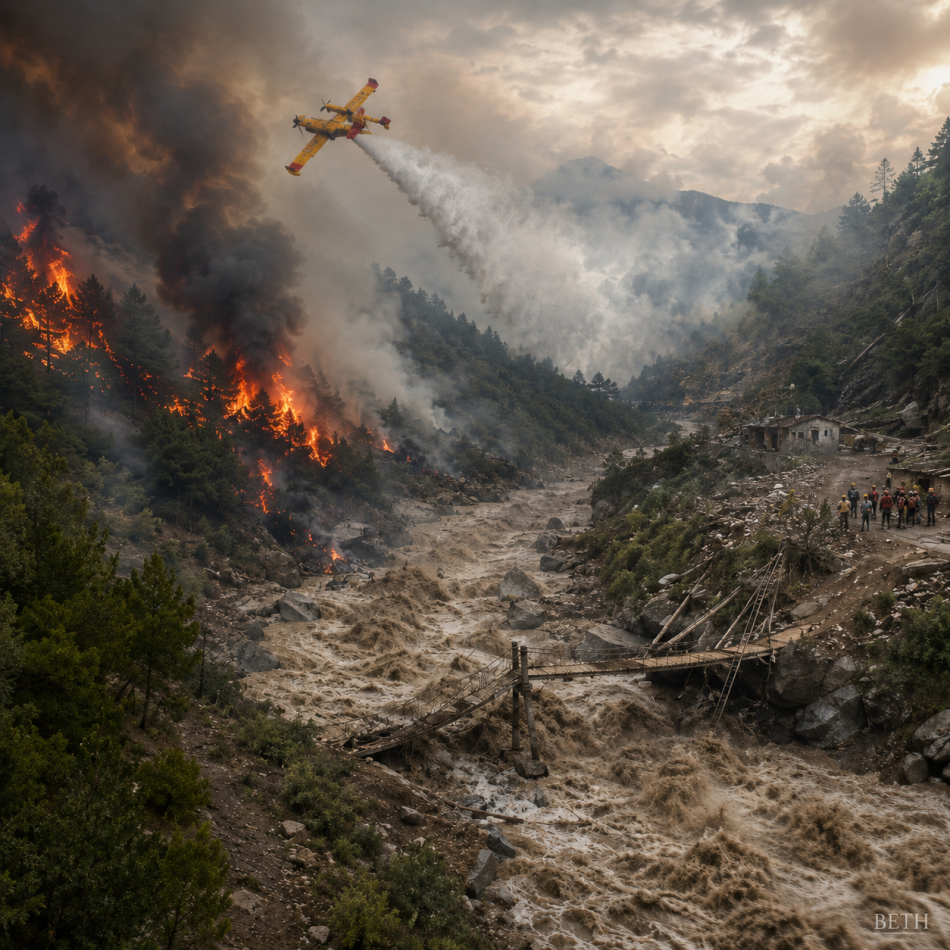
When the Balance Breaks
From a glacial collapse that turned Himalayan rivers into deadly torrents and rains that inundated Japan, to wildfires across Europe and California and a landfill collapse onto the homes of the poor in Guinea, disasters are unfolding simultaneously—revealing a climate growing more extreme, while weak planning, fragile infrastructure and inadequate preparedness determine who survives and who pays the price
Riyadh | Special Report
Prepared and analyzed by the Strategic Media Department – BETH Agency
In recent days, the world map has appeared less like a record of isolated natural events and more like a display of simultaneous scenes from a war without armies.
In the Himalayas, ice, rock and mud collapsed at once, transforming rivers between Tibet and Nepal into destructive torrents. Temporary lakes formed behind dams of debris, turning the first disaster into the source of a second threat.
In Japan, exceptional amounts of rain fell within a single day. Rivers overflowed, roads were severed and weather warnings were raised to their highest levels.
Across Europe, wildfires have burned more than 634,000 hectares since the beginning of the year. California, meanwhile, is battling two fires along the Big Sur coast, one of them spreading through rugged terrain inaccessible to firefighting vehicles.
In Conakry, the capital of Guinea, it was not a natural mountain that collapsed. A mountain of waste gave way after heavy rain, burying homes and tents erected by impoverished families along the edge of the landfill and killing dozens.
The countries and hazards differ, but the question is the same:
Have disasters grown beyond the capacity of states, or are they exposing the fact that humanity has entered an age of climate extremes with ageing infrastructure, poorly planned cities and a culture that prepares for danger only after it strikes?
When Ice Becomes a Deluge
The disaster stretching across Nepal and Tibet offers the starkest illustration of what can happen when seemingly stable elements of nature become a chain of cascading hazards.
The tragedy began with a massive glacial collapse in the Himalayan highlands. Ice, rocks, mud and debris surged into river channels, sending torrents through villages, roads, bridges and facilities near the Nepal–China border.
By August 28, the confirmed death toll had exceeded 540, while about 1,500 people remained missing. Complex search-and-rescue operations involved residents, tourists and workers, some of whom were trapped inside hydropower facilities and tunnels.
Yet the danger did not end when the first torrent passed.
Rocks, ice and mud accumulated in parts of the river system, forming natural dams that trapped millions of cubic metres of water. When one of the newly formed lakes began to overflow, rescue operations were temporarily suspended, helicopters were withdrawn and residents and emergency teams were ordered to move to higher ground.
Here, the cascading nature of modern disasters became clear:
A glacial collapse creates a torrent. The torrent carries rocks. The rocks block a river. The temporary dam forms a lake. And the lake, now at risk of bursting, prepares to release another flood.
In such circumstances, the question is no longer whether the mountain’s collapse could have been prevented; that is often beyond human power. The question becomes what could have been done beforehand: monitoring glacial movement, identifying villages and facilities located along potential flow paths, and connecting early-warning systems between two countries that share the mountain, the river and the danger.
Political borders can regulate the movement of people, but they cannot stop water at passport control.
Japan Under Water
In Japan—one of the world’s most experienced countries in managing earthquakes, typhoons and torrential rain—the latest floods demonstrated that technological advancement does not eliminate the limits of human capacity.
The city of Himi in Toyama Prefecture recorded approximately 361.5 millimetres of rain in 24 hours—nearly half the annual rainfall received by some major European cities.
Around 20 rivers overflowed in Toyama and Ishikawa prefectures. Water swept through roads and homes, trapping people inside vehicles and buildings, while the Japan Meteorological Agency issued its highest-level warnings for heavy rain and landslides.
Japan does not lack monitoring technology, building regulations or evacuation experience. Even so, exceptional rainfall within a short period placed immense pressure on rivers, drainage systems and roads. It showed that infrastructure designed around historical records may no longer be sufficient for events that exceed those records.
This is one of the defining realities of the present moment:
Much of the world’s infrastructure was built for yesterday’s climate, while the threats it now faces are arriving from tomorrow’s.
A bridge may remain sound according to the river levels recorded 50 years ago. A drainage system may be adequate for the rainfall it was designed to accommodate. A dam may be strong under the assumptions of a water cycle that once appeared stable.
But changes in the intensity and frequency of rainfall do not necessarily make old infrastructure defective. They make the assumptions on which it was built obsolete.
Europe in Flames
On the other side of the world, fire has become water’s opposite face.
Data from the European Forest Fire Information System show that, by August 27, wildfires had burned more than 634,000 hectares across the European Union since the beginning of 2026, compared with a 20-year average of approximately 313,000 hectares.
Although the affected area remains below the devastation of 2025—the worst wildfire season recorded in the European Union—it is still more than double the long-term average.
Large fires have been concentrated in southwestern Europe, particularly Spain and France, amid heatwaves, drought and exceptionally low flows in some rivers.
Not every wildfire begins because of climate change. Ignition may result from lightning, human error, negligence or deliberate action. But heat, drought and declining moisture in vegetation determine whether a spark dies out or becomes a fire front that is difficult to contain.
Climate change does not personally ignite every fire, but it prepares the landscape to burn, lengthens the season, accelerates the spread and reduces the safe hours available to firefighters.
The abandonment of villages and agricultural land in parts of Europe has also allowed dry vegetation and combustible material to accumulate. At the same time, residential development has moved closer to forests, turning fires once regarded primarily as environmental events into direct threats to cities and communities.
Losses are therefore determined not only by temperature, but also by forest management, defensible space around homes, the speed at which fires are detected, the availability of multiple evacuation routes and the ability of neighbouring cities to operate under a unified command.
California Encircled
Along the California coast, the Plaskett and Timber fires are testing the limits of control in one of the world’s most experienced and well-equipped regions.
The Plaskett Fire spread rapidly near the Big Sur coast, prompting evacuation orders and the closure of sections of Highway 1. The Timber Fire, burning since August 8, had consumed nearly 20,000 acres, with containment remaining at about 21 per cent.
The challenge lies not only in the size of the fires, but also in steep terrain, canyons inaccessible to firefighting vehicles, scattered homes and a coastal highway whose closure may obstruct evacuation and the arrival of assistance at the same time.
The risk of dry lightning and erratic winds—associated with moisture whose rain sometimes evaporates before reaching the ground—has increased the possibility of new ignitions and unpredictable fire movement.
California demonstrates that a wealthy state may possess satellites, aircraft and specialised teams, yet still be unable to place a fire engine behind every home or prevent the wind from changing a fire’s direction.
It also shows that extensive capabilities do not eliminate questions of planning: Why does construction continue along the boundary between forests and homes? Are evacuation routes sufficient? Who should bear the cost of protecting isolated properties? And should rebuilding in the same manner be permitted after every fire?
A Mountain Made by Man
In Conakry, the scene was different—and even more revealing.
After heavy rain, part of a massive landfill collapsed onto homes and tents built beside it, killing at least 30 people.
Rain was the immediate trigger, but it was not the whole story.
The disaster resulted from accumulated waste that had not been safely managed, housing permitted in a known danger zone, poverty that drove families to live at the foot of a mountain of refuse, and failures in planning, services and oversight.
This was not a purely natural collapse. It was the convergence of rain, negligence and poverty.
Such disasters expose an ethical inequality before they reveal an engineering failure. The wealthy can move away from danger zones, buy insurance, leave the city when warnings are issued and begin again after a loss.
The poor may live inside a flood channel, on an unstable slope or beside a landfill—not necessarily because they are unaware of the danger, but because they have nowhere else to go.
The hazard may be the same, but the ability to survive it is not equally distributed.
Disasters Are Not Natural
The United Nations Office for Disaster Risk Reduction uses a clear equation:
Hazard + exposure + vulnerability = disaster.
Earthquakes, rain, storms and droughts are natural phenomena. They become human disasters when they strike exposed and unprotected communities.
The same amount of rain can fall on wetlands and healthy forests, where water is dispersed and absorbed into the soil. It can also fall on a city covered in asphalt, its natural waterways obstructed and its drains clogged with waste, turning its streets into rivers within minutes.
A fire may ignite in a forest where combustible vegetation is properly managed, homes are surrounded by defensible space and multiple access routes are available, allowing it to be contained. The same spark in an area filled with dry fuel, where trees and homes intermingle, may become a catastrophe.
There is therefore no simple answer to the question of responsibility.
Not every disaster proves that the state has failed, and the extraordinary force of an event does not erase every instance of negligence.
Beyond the Capacity of States?
Yes, some phenomena may reach a scale that exceeds the capacity of any single country.
When millions of tonnes of glacial ice collapse, months’ worth of rain falls within hours, or extensive fires ignite simultaneously under powerful winds, preventing every loss becomes impossible.
Even advanced countries sometimes require international assistance, aircraft and emergency teams from other states. They may be forced to set priorities and allow some areas to burn in order to protect the most exposed cities.
Preparedness, however, is not measured by whether a country can prevent the event itself, but by what it does before and after it:
- Were risk maps current and publicly available?
- Was construction prohibited in flood channels and on unstable slopes?
- Were bridges, drains and dams upgraded?
- Did warnings arrive in time?
- Did residents understand what those warnings meant and how to respond?
- Were alternative evacuation routes available?
- Did hospitals, communications and electricity remain operational?
- Did the country learn from the previous disaster, or did it rebuild the same risk?
An exceptional event may overwhelm even the strongest protective systems. The difference between a prepared state and an unprepared one is revealed in how many people survive, how quickly they are reached, how long essential life is disrupted and how effectively society recovers from the shock.
Preparedness Is a Culture
Firefighting aircraft and dams alone do not create a society capable of confronting disasters.
A country may possess the most advanced monitoring systems, but a warning that does not reach people, reaches them but is not understood, or is understood but not believed, is not a complete warning.
A culture of preparedness begins with simple questions:
Does each family know its nearest evacuation route? Does it have a communication plan if networks fail? Do schools, hospitals and institutions conduct evacuation drills? Do citizens understand the difference between a warning, an instruction to prepare and an immediate order to leave?
At the same time, do media organisations avoid exaggeration that exhausts the public and weakens trust in warnings? Do authorities communicate clearly, or conceal the scale of the threat for fear of causing panic?
A society subjected to repeated exaggerated alerts may ignore the warning that matters. A citizen who does not trust an institution may lose the time that could have saved a life.
Survival is not merely instinct. It is knowledge, training, trust and behaviour.
Cascading Disasters
The greater danger is that wildfires, floods and collapses are no longer separate events.
Heat prolongs drought. Drought turns vegetation into fuel. Fire removes the cover that holds the soil in place. Rain then falls over scorched ground, sending water, ash and rocks downhill in destructive mudflows.
A flood may destroy the roads needed by rescue teams, cut power to water-pumping stations, disrupt communications and inundate industrial facilities—transforming a natural event into a health, technological or economic crisis.
Fire, water and earth thus exchange roles within a single chain, while the failure of one small facility can disrupt an entire city.
It is no longer enough for a state to have one plan for wildfires, another for floods and a third for landslides. Planning must consider how one disaster produces another and how essential services can remain operational when several systems fail at once.
The Limits of Man
We should not claim that a particular fire or flood is a divine punishment. Such a judgment belongs to the unseen and is not ours to make. It may also turn victims who deserve compassion and rescue into people accused of causing what befell them.
We are entitled, however, to question human civilisation about its relationship with the Earth over which it was entrusted with stewardship.
At many stages, humanity has understood progress as the ability to subdue nature: cutting forests, draining wetlands, diverting rivers, excavating mountains, building along coastlines and inside flood channels—then asking technology to provide protection from the consequences.
Humanity has behaved as though everything on Earth belonged to the present generation alone, rather than being a trust to be carried and passed on to those who follow.
Allah Almighty says:
“Indeed, We offered the Trust to the heavens and the earth and the mountains, but they declined to bear it and feared it; yet humanity assumed it. Indeed, humankind has been unjust and ignorant.”
Surah Al-Ahzab, 33:72
And Allah Almighty says:
“They have not appraised Allah with true appraisal. Indeed, Allah is All-Powerful, Almighty.”
Surah Al-Hajj, 22:74
These two verses open a wide field for reflection on the meaning of the Trust and the limits of man: a creature granted power but not absolute ownership, and charged with cultivating the Earth rather than oppressing or corrupting it.
Stewardship is not a licence to cause destruction. Developing the Earth does not mean exhausting it. Progress that destroys the conditions of life does not become virtuous simply because it increases production and profits.
Humanity exceeded its limits when it assumed that possessing the power to act also granted the right to act, and that everything it was capable of changing could be changed without consequence. It forgot that human power, however far it expands, is as nothing before the power of the Creator—and does not release humanity from responsibility for the Trust it accepted.
BETH Analysis
The map of disasters does not tell us that nature has declared war on humanity. It tells us that the relationship between the two has fallen out of balance.
The climate has become more extreme across many regions, but climate change is not the only factor. Alongside it stand land-use decisions, deforestation, poor construction, ageing infrastructure, unplanned urban expansion, poverty, weak warning systems and delayed maintenance.
In some cases, the event is genuinely beyond the capacity of the state, however extensive its resources. In others, the disaster reveals that the danger was known, the warning had arrived and reform was delayed because prevention attracts less attention than dramatic rescue scenes after tragedy strikes.
Governments spend heavily on extinguishing fires after they ignite, but less on managing forests beforehand. They rebuild roads after floodwaters wash them away, yet hesitate to prohibit construction in flood channels. They purchase advanced monitoring systems without building the public culture needed to understand and respond to what those systems detect.
The difference is decisive:
Rescue begins after disaster strikes. Protection begins years before it.
Conclusion
What is unfolding around the world is not one isolated event, not a conspiracy and not the result of a single factor.
It is the convergence of a changing climate with crowded cities, infrastructure designed for conditions that have passed, poverty that drives people into danger zones and a culture that postpones preparedness until warning sirens sound.
States cannot prevent every mountain from collapsing, stop every storm or extinguish every spark. But they can prohibit construction inside flood channels, prevent bridges from ageing without maintenance, keep cities from choking on blocked drainage systems and refuse to leave the poor living beneath mountains of waste.
Humanity may not be able to control nature, but it is responsible for how much danger it adds to nature’s hazards, for protecting those whom poverty and vulnerability have placed in their path, and for fulfilling its responsibilities before disaster strikes rather than merely managing the consequences afterwards.
This is not a war between humanity and nature, because humanity cannot defeat the Earth from which it lives and upon which it depends.
It is a confrontation between a mind that persists in violating the balance and one that realises—before it is too late—that protecting humanity begins with respecting the limits of the Earth and honouring the Trust it has undertaken.