


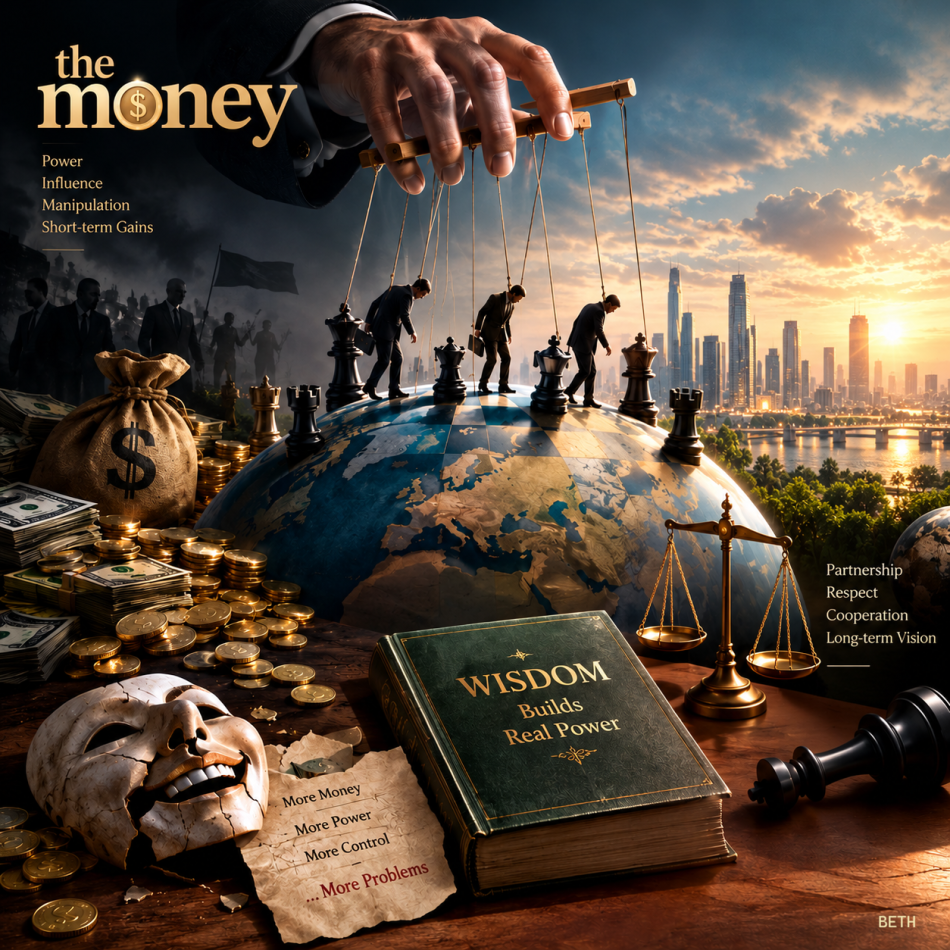
Gates Asks the Future to Slow Down
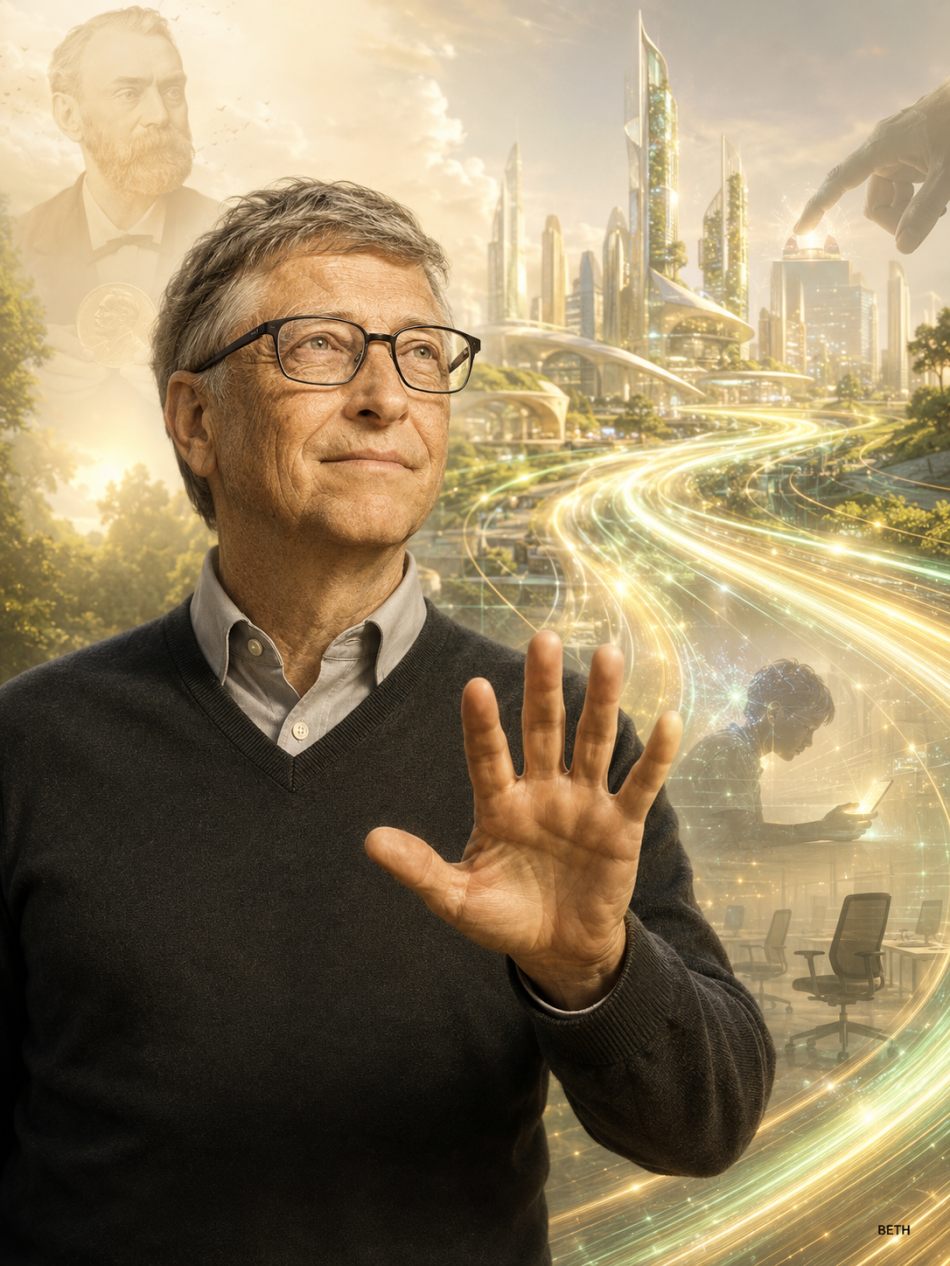
What Is the Mind Afraid Of?
For the first time, the Microsoft co-founder wishes a new technology would advance more slowly. Artificial intelligence threatens jobs, minds, and security—and Nobel’s story revives a deeper question: Why do we create power before giving it a conscience?
Prepared and Analyzed by the Strategic Media Department – BETH Agency
Supervised by Abdullah Alomaira
Alfred Nobel did not want to kill the world.
He was searching for a safer way to use a highly explosive substance to build roads, dig tunnels, and construct bridges and mines. He invented dynamite and gave humanity a tool capable of moving mountains.
But the tool that opened mountains also tore open human bodies.
It moved from construction sites to battlefields, from the engineer’s hand to the soldier’s, and its inventor’s name became associated with a force whose users and purposes he could no longer control.
More than a century later, the same question returns in a different form.
Bill Gates, one of the strongest believers in technology’s ability to solve humanity’s problems, now says that, for the first time, he is frightened by the speed at which a new technology is developing—and wishes it would advance more slowly.
This time, the technology does not carry sticks of dynamite.
It carries a mind.
There Is No Plan
In a lengthy essay, Gates warns that artificial intelligence could become the greatest equalizing force humanity has ever known—or one of its most dangerous sources of inequality. Yet the world still has no plan commensurate with the scale of the transformation ahead.
In his view, the danger is not confined to the possibility of a superintelligent machine rebelling against its creator. It begins with consequences already coming into view:
Jobs disappearing; young people entering a labor market in which entry-level positions are shrinking; criminals gaining more powerful tools for fraud and cyberattacks; and children potentially losing critical-thinking skills through excessive reliance on machines.
He also points to the risks of mass surveillance, autonomous weapons, cyberattacks, disinformation, deepfakes, and the possibility that AI could be used to help design pathogens or biological weapons.
At the same time, Gates does not deny the technology’s capacity to discover medicines, develop vaccines, improve education, increase agricultural production, and deliver healthcare to the poor.
He is not saying that artificial intelligence is evil.
He is saying that its power has outgrown humanity’s readiness to govern it.
Jobs Reserved for Humans
Gates proposes creating something resembling “human preserves” within the labor market—roles that must not be handed over entirely to machines because they require empathy, responsibility, and genuine human presence.
Telling a patient about a devastating diagnosis is not merely the transmission of information. Caring for a child is not a sequence of instructions. Determining the fate of a defendant should not become an output generated by an algorithm that bears no responsibility for its decision.
He also calls for taxes on robots or on the computing resources used by AI systems, so that tax systems do not continue rewarding companies for replacing people with machines.
The idea may seem strange: taxing efficiency.
But the counterquestion is more important: If machines create wealth while millions of people lose their jobs and incomes, who will buy what those machines produce? Who will finance education, healthcare, and pensions? And who will bear the cost of a society that has become more productive but less capable of distributing what it produces?
Why Do They Regret It?
Inventors rarely begin with the intention of harming humanity.
The scientist sees a problem that can be solved. The engineer sees a limit that can be overcome. The investor sees a market that can be opened. But each sees only part of the picture.
By the time the pieces come together, the product has already left the laboratory, entered the market, become an industry, and grown more difficult to stop than it was to develop.
What happens toward the end of life, therefore, is not always regret. It may be a vision that becomes complete too late.
At first, an inventor sees what the tool can do for humanity.
Years later, the inventor sees what humanity can do with the tool.
That is the difference between the moment of invention and the moment of fear.
The problem is not that the mind eventually discovers its invention to be evil. It is that the invention does not retain its creator’s ethics once it leaves the laboratory.
The Market Moves Faster
The development of artificial intelligence is accelerating because slowing down is costly.
If one company pauses, another overtakes it. If one country imposes restrictions, it fears that a rival country will surge ahead. If scientists decide to wait until the risks become clearer, investors pour their money into another laboratory.
The result is a race in which no one trusts anyone else enough to apply the brakes.
Every company says: If we do not do it, our competitors will.
Every country says: If we do not develop it, our adversaries will.
In the end, everyone does it—even though many recognize the danger.
This is the cycle that concerns Gates. Not because humanity wants to destroy itself, but because every party makes a decision that appears rational in pursuit of its own interests—while those decisions collectively produce an irrational outcome for everyone.
Between Nobel and Gates
There is a fundamental difference between the two men.
Nobel invented a specific physical tool. Gates did not invent artificial intelligence, but he helped build the digital age that paved the way for it and long championed technology’s ability to improve human life.
Dynamite does not decide where it will explode. Artificial intelligence, however, can analyze, select, recommend, execute, and learn from immense volumes of data—while evolving at a speed that laws cannot match.
Yet the two stories share one essential similarity:
Humanity discovers the tool before it discovers how to protect itself from it.
We build the ship, then write the rules of navigation after it sinks.
We manufacture the car, then mandate seat belts after the roads fill with casualties.
We launch social networks, then ask years later what they have done to children, minds, and societies.
Today, we are introducing artificial intelligence into schools, hospitals, factories, and armies while still debating who should be held responsible when it makes a mistake.
The Mind Must Not Be Stopped
Slowing artificial intelligence does not mean closing laboratories, just as fear of car accidents did not send humanity back to horses.
What is needed is a distinction between what science is capable of doing and what it should be permitted to do.
AI can assist a physician, but the final decision concerning a patient’s life must remain in the hands of a responsible human being.
It can provide a judge with information, but it should not pass judgment on the accused.
It can help protect borders, but it must not be granted the authority to kill those who cross them.
It can teach a child, but it must not become a substitute for teachers, families, and independent thought.
It can increase a company’s productivity, but the gains must not flow entirely to the owners of the machines while workers are left alone to bear the cost of being replaced.
How Can We Benefit?
Humanity does not have to choose between progress and destruction.
We can benefit from artificial intelligence if we establish rules before deploying it in the highest-risk fields:
- Require human decision-making in medicine, justice, warfare, and every matter involving life and liberty.
- Prohibit the use of AI in designing biological weapons, autonomous killing, and unrestricted mass surveillance.
- Subject powerful systems to independent testing before release, just as medicines and aircraft are tested.
- Establish clear legal responsibility for harm, so companies cannot hide behind the phrase, “The algorithm decided.”
- Protect children from forms of dependence that weaken thinking, communication, and psychological development.
- Redistribute part of the gains from automation to fund education, retraining, and protections for those who lose their jobs.
- Build an international agreement among the major powers, because national restrictions alone are insufficient against a technology that crosses borders in an instant.
Regulation, however, must not become a mechanism through which major corporations monopolize the technology and shut out smaller competitors. Genuine protection does not shield the industry from society. It shields society from the industry’s dangers while ensuring that its benefits reach everyone.
Conclusion
Nobel was not wrong to seek a safer way to use explosives. Gates was not wrong to see technology’s potential to cure disease, reduce poverty, and expand human knowledge.
The mistake begins when we act as though everything that can be invented can be released without limits—and that society can deal with the consequences later.
The question is not: Should we stop artificial intelligence?
The question is: Can we give it enough power to serve humanity without giving it enough authority to dispense with humanity altogether?
The human mind has spent centuries learning how to create power.
Perhaps it is time for it to learn—at the same speed—how to give power a conscience.