



Washington Internationalizes Drone Warfare
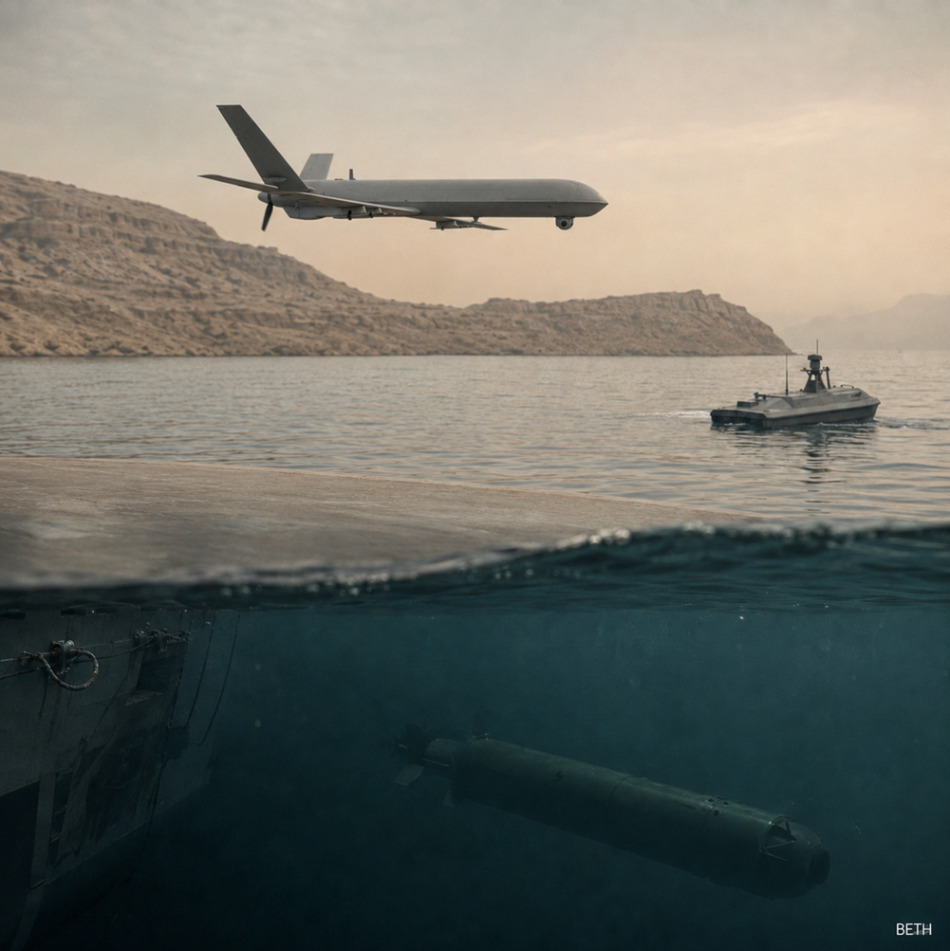
CENTCOM begins establishing the first multinational offensive drone force, seeking to transform what it tested against Iran from a limited U.S. unit into a regional system operating in the air, on the sea, and beneath it
Prepared and analyzed by | Strategic Media Department – BETH Agency
U.S. Central Command has begun the process of establishing the first multinational, multi-domain attack-drone task force in the Middle East. The move goes beyond adding another squadron to U.S. forces: it seeks to operate unmanned systems jointly with countries in the region rather than retain them as a solely American capability.
CENTCOM has named the project “Task Force Falcon Strike” and said it will employ one-way attack drones and unmanned systems operating in the air, on the surface of the sea, and beneath it, with a staff expected to include U.S. military personnel and representatives of regional partners.
The force, however, remains a project under development. The countries that have decided to join have not been named, nor have the location of its operational command or its rules of engagement been announced. CENTCOM is still consulting partners and extending formal invitations.
The news, therefore, is not about a force that has already become combat-ready, but about a U.S. attempt to establish one. The response of regional states will determine whether it develops from an announcement into an operational system.
From Scorpion to Falcon
Falcon Strike comes nine months after the establishment of Task Force Scorpion Strike, the first U.S. squadron in the Middle East dedicated to one-way attack drones.
The earlier unit underwent operational trials: it launched an attack drone from a U.S. warship and used such systems during the war with Iran. Unmanned attack vessels also took part in strikes on facilities at Iranian ports in July.
CENTCOM describes these operations as a success on which it intends to build. The information released publicly, however, is insufficient for a comprehensive independent assessment of the strikes’ accuracy, cost, and results, or to determine whether success achieved under specific conditions can be replicated by a force combining multiple countries and systems.
This is where the deeper story lies:
Washington is not merely announcing a new unit; it is attempting to move an experience tested in war from limited U.S. operation to joint regional employment. Between the attempt and its success stand questions about the partners, the command structure, and the objective.
From Strategy to Doctrine
The phrase “turning the experience of the war with Iran into a permanent regional military doctrine” does not mean that the United States has issued an official document bearing that name, nor that such a doctrine is complete. Rather, it describes the direction revealed by U.S. military decisions if the project succeeds and endures.
A military experiment remains temporary when a weapon is used to address a specific circumstance and its role ends with the battle. Military doctrine begins to take shape when lessons proven effective are transformed into enduring principles that guide thinking, planning, armament, training, and combat.
This is where the distinction between strategy and doctrine becomes important.
Strategy defines the objective a state seeks to achieve, the means it will use, and the cost it is prepared to bear. In other words, it answers the questions: Why do we fight? What outcome do we seek? And how does the confrontation end?
Doctrine defines how forces operate to achieve that objective. It answers: How do we fight? How do forces integrate? And which weapons and methods have proven effective?
Strategy sets the destination and the end state; doctrine organizes movement and combat along the way.
The United States has an extensive body of military strategies and doctrines, ranging from nuclear and integrated deterrence to joint and multi-domain operations, forward deployment, and cooperation with allies. It also maintains doctrinal publications governing planning, training, and the conduct of operations across its military services.
What Washington is doing with drones may represent the beginning of a similar transition:
It began with a limited U.S. squadron.
It tested drones in actual operations against Iran.
It says it assessed their effectiveness and cost.
It expanded the experiment from the air to the surface of the sea and beneath it.
It began inviting regional states to participate.
It is seeking to integrate capabilities within a shared command-and-deterrence structure.
If these stages are completed, what occurred during the war will no longer remain an episode in the operational record. It will become a model on which forces train, for which units are built and weapons procured, and which continues after the fighting stops.
Possessing an advanced doctrine, however, does not guarantee the desired political outcome.
In more than one war, the United States has demonstrated its ability to enter quickly, destroy targets, and weaken an opposing force. Yet outcomes became more complicated after the strikes stopped. Battlefield superiority may be clear while the questions of the next day remain unanswered: Who fills the vacuum? Who manages the settlement? And how is force converted into stability?
This challenge is evident in the war with Iran. Washington has conducted extensive strikes, imposed a blockade, and weakened Iranian capabilities, but it has not yet converted those measures into a stable political end state, the permanent reopening of Hormuz, or an agreement preventing the confrontation from resuming.
The United States knows how to initiate military pressure; its previous experiences, however, lead regional states to ask whether it knows how to end it this time.
Falcon Strike’s appeal will therefore be measured not only by the performance of its drones, but also by the clarity of the political project behind it. Regional states may welcome lower-cost technology that supports the protection of their facilities and sea lanes, but they will hesitate if they fear the force could become an offensive arm that provokes Iranian retaliation and then leaves them facing consequences they had no role in determining.
To earn the confidence of potential partners, the project must provide clear answers: Who selects the target? Does a participating state have the right to reject an operation? Is the mission confined to deterrence and protecting navigation, or does it include striking the territory of other states? And what happens if a strike starts a wider war?
The world may be persuaded by the effectiveness of a U.S. weapon, but it will not be persuaded by a regional project unless it sees, alongside the attack plan, a strategy for the day after.
Doctrine may thus become a ready military answer for future battles. Yet its ability to hit the target does not absolve strategy from answering the harder question: What happens after the target is hit?
The Idea Returns to Iran
For decades, Iran has built part of its power around low-cost drones, which can be produced and launched in large numbers to confuse defenses and deplete their munitions without requiring conventional air superiority.
The United States has adopted the same logic and begun deploying low-cost attack drones that can be launched by various means. CENTCOM says the LUCAS platform costs about $35,000—far less than the precision missiles and combat aircraft used for some missions.
Similarity in concept, however, does not mean equivalence in capability or guarantee the outcome. The potential U.S. advantage lies not in the drone alone, but in connecting it to reconnaissance, space, intelligence, and command-and-control systems. Iran, in turn, can develop countermeasures involving jamming, interception, deception, and altered deployment methods.
The paradox is that the United States is not negating the Iranian concept; it is adopting it and placing it within a broader network. But the network’s scale does not establish its effectiveness until its ability to coordinate and operate under wartime pressure has been tested.
Why Might the Region Join?
The United States wants more from the project than additional aircraft.
Participation by regional states could provide the force with closer operating locations, knowledge of local terrain and waters, varied industrial and technological capabilities, shared operating costs, and a wider surveillance and response area.
In return, participating states could gain training, technology, data sharing, and experience in operating unmanned systems, rather than each state merely purchasing platforms that function separately from the wider network.
These potential benefits do not make participation automatic. Some states may prefer to take part in training or information sharing without permitting their territory to be used for attacks. They may restrict target selection or refuse association with a force that could make them a direct party to the war.
CENTCOM describes Falcon Strike as a deterrent, but its armament is offensive and includes one-way drones that do not return after carrying out their strike. Calling it a deterrent is therefore insufficient to define the mission; its true nature will be determined by its rules of engagement, its targets, and who holds launch authority.
Its Connection to Maritime Security
Falcon Strike is not confined to the sky. The inclusion of unmanned systems operating on and beneath the surface of the sea gives it a potential role in protecting ships, ports, and straits, and in monitoring mines, hostile boats, and coastal platforms.
This may make it part of a broader transformation in regional security: more interconnected air defense above, collective maritime capabilities along the sea lanes, and an unmanned arm capable of monitoring or attacking the source of a threat.
Its missions may eventually intersect with those of the multinational defensive maritime coalition launched by Saudi Arabia. The Kingdom, however, cannot be regarded as a member of the new U.S. force: Washington has not disclosed which states have received invitations or decided to participate.
The distinction is important. The declared maritime coalition is led by Saudi Arabia and tasked with collective security and the protection of navigation. U.S. special operations forces, by contrast, are leading the establishment of Falcon Strike as a multi-domain offensive capability. The two missions may complement one another under certain circumstances, but their differing leadership and mandates preclude any assumption that they will merge before clear arrangements are announced.
Cost Changes Warfare
The issue is not only technological; it also concerns the economics of warfare.
The war with Iran has consumed costly U.S. munitions and brought an old question back with greater urgency: Does it always make sense to counter a cheap drone with a missile costing many times more, or to employ an expensive platform against a target that a cheaper weapon could reach?
Attack drones offer one possible answer. They may enable lower-cost strikes, disperse and burden defenses, and reduce reliance on some more expensive missiles and aircraft without replacing them.
The platform’s price, however, is not the full cost. Operation requires reconnaissance, communications, protection, maintenance, training, munitions, and command networks. A lower price also guarantees neither accuracy nor the ability to penetrate defenses, and it does not make war easy or low in casualties.
A cheaper strike may also produce the opposite political effect: making the decision to use force easier, increasing the number of attacks, and lowering the threshold between deterrence and escalation.
A cheaper weapon may reduce the cost of a single strike; it may also increase the number of strikes and make the war’s ultimate cost higher.
Between the Lines
Coverage has focused on the announcement of the first multinational force of its kind, but the project’s timing is more important.
The war has not ended, Hormuz has not returned to normal operation, Iran is talking about shifting to an offensive posture, and regional states are building new arrangements for maritime and collective defense.
Washington is therefore not waiting for a settlement before determining the form of its postwar presence. It is using the conflict to test the weapon and attempting to turn the test results into a military institution that endures after the war. The success of that transition, however, depends on the willingness of partners to participate, not on a U.S. decision alone.
The failure to announce their names may reflect the sensitivity of the negotiations. Each state must balance its need for protection and technology against the risk of appearing as a direct participant in U.S. strikes.
This raises a forward-looking question: Will Falcon Strike complement the region’s new alliances, or compete with them?
Military complementarity is possible. The maritime coalition led by Saudi Arabia protects navigation and sea lanes; the Makkah Agreement builds political deterrence and collective defense; and Falcon Strike is intended to add an unmanned offensive capability in the air, on the sea, and beneath it. If information is exchanged and missions are allocated without command overlap, these arrangements could become cooperating components of regional security.
The possibility of conflict emerges politically, however, over leadership and the authority to use force. The new alliances reflect the region’s desire to expand its ability to own its security decisions and shape its peace from within. The new force, meanwhile, places its command center in the hands of U.S. special operations personnel under CENTCOM.
The question, therefore, is not whether the weapons are compatible, but who defines the threat, selects the target, and decides when an attack begins and when it ends.
The project may align with the broader contours of the Middle East that Trump is attempting to build, although Washington has issued no document formally linking Falcon Strike to a plan bearing that name. The apparent concept is to reduce the direct U.S. burden, increase allied contributions, and connect their capabilities to U.S. technology and command, thereby protecting interests and sea lanes at the lowest possible human and financial cost to Washington.
Regional states, however, are building arrangements of their own based on mutual defense and greater independence in decision-making. Cooperation with the United States does not automatically mean accepting external management of their security.
The two visions may therefore converge on deterring Iran and protecting navigation, then diverge over who leads the region after the war and who bears the consequences of its decisions.
Trump wants a Middle East that bears a greater share of its own security costs within a system in which Washington retains command influence; regional states want to build their security in partnership with the United States, not hand Washington the key.
Falcon Strike’s future will consequently be a test extending beyond drones: it may become a technical capability that supports regional alliances and respects their decisions, or an American framework that attempts to absorb and reorder them under U.S. leadership.
The projects may complement one another in confronting the threat, but the new Middle East will ultimately be defined by who holds the authority to pull the trigger.
The question remains: Will the states forming these new alliances accept the United States entering through the drone door as a technical partner, only to settle in through the back door as the leader of their security decisions?
Assessment
If Washington secures sufficient consent, Falcon Strike is likely to begin with a limited number of states and systems, then attempt to expand through training, data sharing, and the integration of different platforms within a single command.
The first indicators will be the names of the participating states, the location of the operational command, and the basing arrangements. The more important test will be who holds the authority to select targets and launch the drones.
Regional states may accept cooperation in training, technology, and information sharing without delegating attack authority to Washington. The project’s success will therefore depend not on the number of drones or participating states alone, but on the United States demonstrating that the force supports regional alliances rather than absorbing them, and strengthens regional security without appropriating its decisions.
If the force’s missions remain limited to training, deterrence, and confronting mutually agreed threats, it may add a new capability to the region’s security architecture. If it is assigned plans for cross-border strikes under unilateral U.S. command, it may shift from an instrument of collective protection into a source of disagreement over sovereignty, leadership, and the right to use force.
The decisive test will come in the first crisis: Will Falcon Strike move by joint decision, or will participating states discover that their partnership consisted of supplying capabilities and assuming risks while launch authority remained American?
Iran has begun to lose its near-exclusive claim to the concept of using inexpensive drones to disrupt its adversaries. The United States is adopting the same logic and wants to employ it through partners and across multiple domains. What has been announced so far, however, is a proposed force, not a completed one. Its value will be determined not by its platforms alone, but by their performance in the field, the identity of the participants, who controls their launch, and the strategy for halting their use once the mission ends.
Washington is adept at seizing opportunities and promoting them, but it does not always succeed in turning them into sustainable gains. Its hardest test remains using those opportunities to strengthen its allies’ trust—not leaving them to foot the bill.