


Council of Ministers Session Chaired by King Salman: The Kingdom Activates Maritime Security
The Council of Ministers welcomes the start of the institutional and operational phase of the maritime coalition launched by Saudi Arabia, renews its rejection of Iranian attacks on vessels, and approves the regulation of the National Curriculum Center
Jeddah | BETH
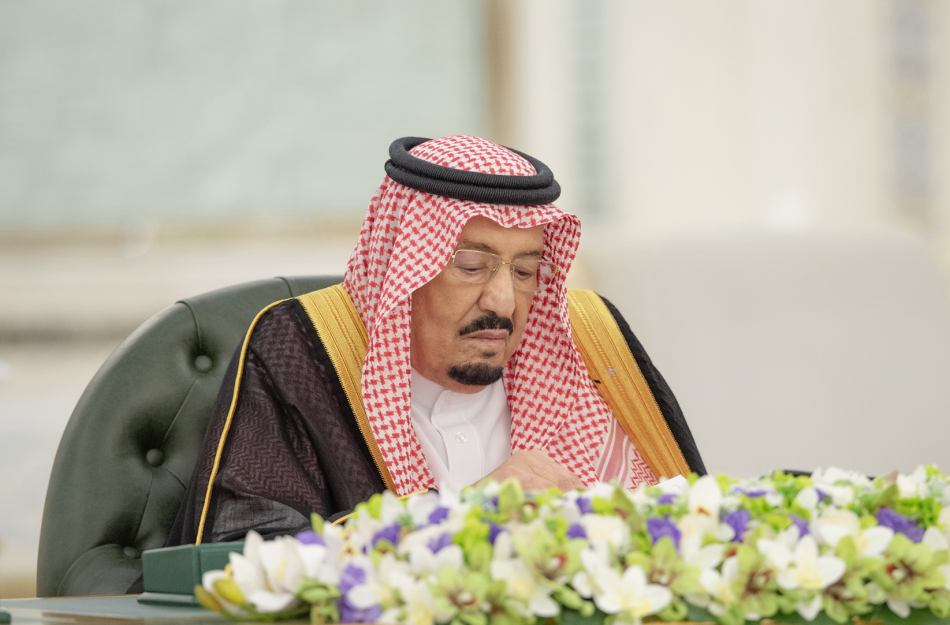
The Custodian of the Two Holy Mosques, King Salman bin Abdulaziz Al Saud—may God protect him—chaired the Council of Ministers session held in Jeddah on Tuesday, August 18, 2026.
The Council welcomed the beginning of the institutional and operational activation of the multinational defensive maritime coalition launched by the Kingdom, following the completion of arrangements for its bodies and its organizational and planning frameworks.
The transition to this phase marks the beginning of organized work toward achieving operational readiness and carrying out the tasks related to strengthening collective maritime security, protecting freedom of navigation and maritime passages and straits, and supporting the continuity of international trade and global supply chains.
The Council of Ministers’ welcome for the new activation gives the coalition Saudi political weight, following its transition from an idea and international contacts to a leadership structure, operational and intelligence centers, and plans to integrate the maritime capabilities of participating countries.
Rejection of Iranian Attacks
The Council of Ministers renewed its categorical rejection of repeated Iranian attacks on commercial vessels and tankers, describing them as a dangerous escalation, a direct threat to the security and safety of maritime navigation, and a grave violation of international laws and norms.
The Council affirmed that the attacks constitute a challenge to the United Nations Security Council resolution that stresses respect for the rights and freedom of commercial vessels to transit the Strait of Hormuz and condemns threats and measures that obstruct navigation.
The Saudi position places the attacks within their international context, rather than viewing them merely as a political dispute among regional countries. Targeting vessels does not affect only the owning or importing country; its consequences extend to markets, insurance, energy, food and supply chains.
This position coincides with the continued decline in vessel traffic through Hormuz and rising risks in Bab el-Mandeb and the Red Sea, making the new coalition a practical response to a threat moving across more than one maritime passage.
From Condemnation to Protection
The session reveals a transition in Saudi Arabia’s management of the maritime threat.
Condemnation identifies the aggressor and protects the legal position, while the coalition builds the operational capability required for deterrence, surveillance, vessel protection and information exchange.
Operational readiness does not mean that the coalition has become an offensive party in the war. Its declared mission is defensive and consists of securing navigation and maintaining trade. However, the existence of unified leadership and operational and intelligence centers raises the cost of an attack and reduces the time between detecting a threat and responding to it.
The Saudi message is clear: freedom of navigation is not a privilege granted by a country overlooking the strait, but an international right protected by an organized collective force.
Saudi-Sudanese Coordination Council
The Council of Ministers considered the establishment of the Saudi-Sudanese Coordination Council an extension of the two countries’ commitment to supporting joint cooperation within an institutional framework that produces measurable initiatives, projects and targets.
The Council’s significance extends beyond managing political relations. It allows economic, investment, development and humanitarian cooperation to be organized and transformed from separate initiatives into structured tracks monitored by designated committees and entities.
It also provides Sudan, amid its need to rebuild its institutions and economy, with a stable channel for working with the Kingdom on projects that serve the interests of both countries and support the stability of the Sudanese state.
Regulating Curricula Through the National Center
The Council of Ministers approved the regulation of the National Curriculum Center, a step that gives curriculum development a specialized institutional framework instead of treating curricula merely as books reviewed separately.
The decision comes as the new school year approaches and after the Council reviewed the achievements of the education sector in developing its organizational and operational system, constructing educational facilities, improving school environments, developing the capabilities of male and female teachers, and expanding scientific experiences for male and female students.
The regulation is expected to help unify the authority responsible for building, developing and evaluating curricula, while linking educational content to skills, knowledge, innovation and future needs.
Curricula do not merely determine what a student learns during one academic year; they shape the type of person and skills that the economy and society will need years from now.
The Fund and the Economy
The Council commended the financial performance of the Public Investment Fund and the growth of its revenue and net profit during 2025, alongside the expansion of its domestic and international investments.
The Council linked the financial results to the Fund’s role in driving development and economic diversification and strengthening the artificial intelligence, technology, energy, infrastructure and advanced manufacturing sectors.
The commendation demonstrates that the Fund is not evaluated solely by the size of its assets or profits, but also by its ability to create new sectors, companies and economic opportunities within the Kingdom.
Progress in Digital Services
The Council of Ministers praised the progress achieved by government entities in the 2026 Digital Experience Maturity Index, reflecting the transition in government development from merely providing services electronically to improving the experience of using them.
A mature digital service is not measured only by the existence of an application or platform, but by the ease of the procedure, the reduction of steps, data integration among government entities, speed of completion, and the ability of citizens, residents and visitors to obtain services without complication.
Desertification and Humanitarian Work
The Council praised the Kingdom’s successful presidency of the 16th session of the Conference of the Parties to the United Nations Convention to Combat Desertification and the partnerships and initiatives it launched to address land degradation and drought, strengthen water and food security, support climate adaptation, and develop innovative solutions to protect the environment and achieve sustainable development.
On the occasion of World Humanitarian Day, the Council expressed pride in the Kingdom’s position among the world’s largest donor countries and its record of assisting disaster victims and extending support to countries and peoples in need.
Decisions of the Session
The Council of Ministers adopted several decisions, most notably:
- Authorizing the Chairman of the Board of Directors of the Nuclear and Radiological Regulatory Commission to hold discussions with Malaysia on cooperation in safety, security and safeguards related to the peaceful applications of nuclear technology.
- Approving a memorandum of understanding with Kuwait in the field of public-private partnerships.
- Authorizing the Minister of Commerce to hold discussions with Tunisia on cooperation in consumer protection.
- Authorizing the President of the Oversight and Anti-Corruption Authority to sign a model information-exchange agreement among members of the Global Operational Network of Anti-Corruption Law Enforcement Authorities, known as the GlobE Network.
- Approving customs cooperation and mutual administrative assistance with New Zealand.
- Approving the regulation of the National Curriculum Center.
- Appointing five private-sector representatives to the Board of Directors of the General Corporation of Saudi Arabian Airlines.
- Approving the final accounts of King Faisal University, Jouf University, Taibah University and Qassim University for previous fiscal years.
- Approving promotions to the 15th rank and to the diplomatic positions of ambassador and minister plenipotentiary.
Assessment
The Council of Ministers session brought together two complementary tracks: protecting the movement of the economy beyond the Kingdom’s borders and building its capabilities within them.
The maritime coalition protects the passages through which trade and energy flow; the National Curriculum Center builds the knowledge required for the future; the Public Investment Fund expands economic sectors; and digital transformation improves government efficiency.
These tracks reveal a broader Saudi transformation: moving from addressing each challenge separately to establishing a permanent institution capable of managing it.
When a threat recurs, a security system is built to confront it; when the future changes, curricula are built for it. In this way, decisions move from responding to the present to laying the foundations for what comes next.