


Trump Endorses Deterrence
The US president sees the Saudi-Turkish-Pakistani Makkah Agreement as a “big, bold first step” and acknowledges that the Middle East has begun building its capacity to protect itself from within the region
Prepared and analysed by | Strategic Media Department – BETH Agency
Supervised by: Abdullah Al-Omierah
Washington | BETH
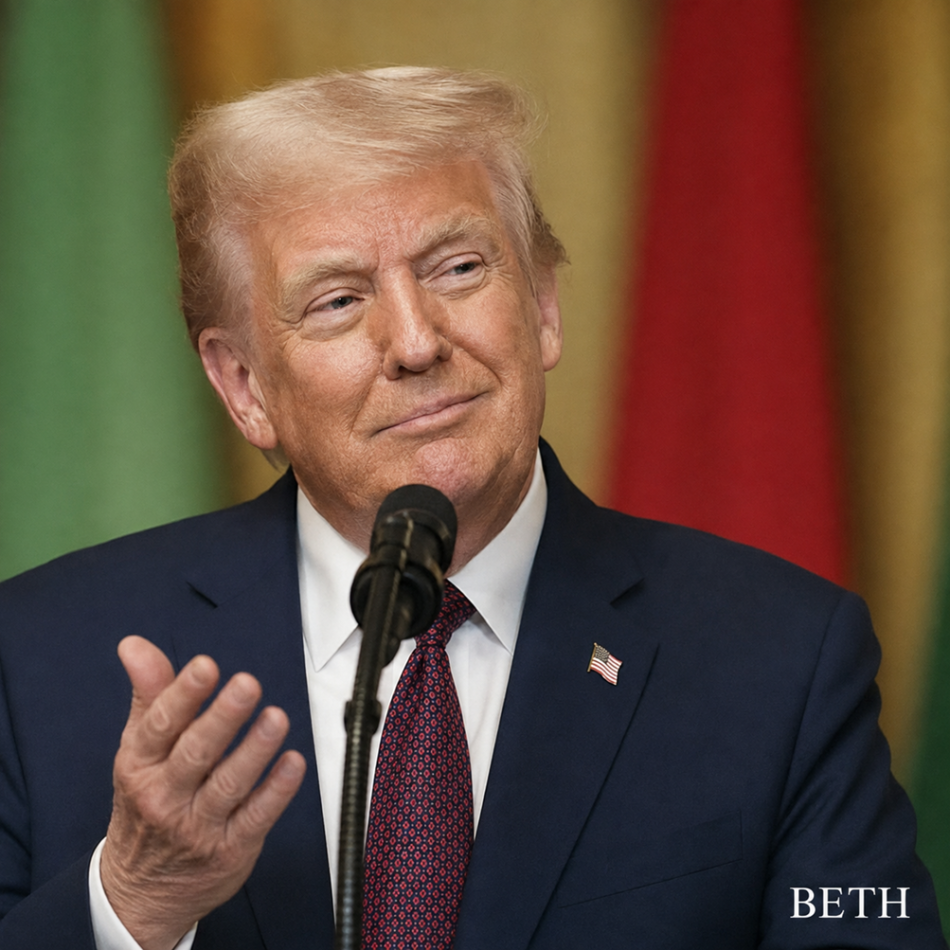
US President Donald Trump did more than welcome the Makkah Joint Defence Agreement between Saudi Arabia, Türkiye, and Pakistan. He placed it within a broader vision of a changing Middle East, describing it as evidence that the region’s countries are drawing closer and building a more effective capacity to defend themselves.
In a post on his Truth Social platform, Trump expressed his satisfaction that the three countries had “finally” signed the agreement, congratulated their leaders, and described the development as a big, bold, and important first step.
The most significant phrase in his message, however, was that the agreement demonstrated “how the Middle East is coming together,” and how its countries would become capable of defending themselves more effectively. Trump’s Truth Social post.
The US president’s remarks therefore go beyond congratulations. They offer the first clear presidential reading from Washington of the agreement as the nucleus of a new regional order, rather than merely military cooperation among three countries.
The Message
In his post, Trump said he was very pleased to see Saudi Arabia, Türkiye, and Pakistan “finally” sign the Makkah Joint Defence Agreement.
He added that the agreement showed how the Middle East was coming together and how countries would finally be able to defend themselves in a more meaningful and effective way.
He congratulated the leaders of the three signatory states before concluding by describing the agreement as a “big, bold, and important first step.”
A few words in the message reveal more than the direct expression of support:
Finally. Coming together. Defending themselves. A first step.
Each phrase opens a political door extending beyond the agreement in its current form.
Why “Finally”?
Trump’s use of the word “finally” does not appear to be an incidental linguistic detail.
It suggests that the creation of a collective defence structure by regional countries was either anticipated or overdue, and that Washington does not regard the agreement as an unwelcome surprise, but as a response to a longstanding need that had remained without an institutional framework.
For decades, the region’s security has depended, to varying degrees, on the American umbrella, naval fleets, military bases, and bilateral guarantees, while attempts to build a joint regional defence system remained limited or incomplete.
The Makkah Agreement brings together three elements that have not previously been combined in this form:
Saudi Arabia, with its political and economic weight and leadership position; Türkiye, with its military strength, defence industries, and experience within NATO; and Pakistan, with its large armed forces, missile capabilities, and nuclear weight.
When the US president says that this structure has arrived “finally,” he implicitly acknowledges that the region needed a capability that did not depend entirely on American intervention whenever a threat emerged.
Recognition, Not Objection
Washington could have viewed the emergence of a defence bloc bringing together three major regional powers with caution, particularly as two possess extensive military capabilities and the third is a nuclear-armed state.
Trump, however, chose to welcome it publicly and enthusiastically.
This indicates that the US administration does not currently view the agreement as a hostile competitor to the American presence or as an alternative intended to remove the United States from the region.
Instead, Washington may see it as an arrangement that eases its burden by distributing responsibility for regional security among countries with a direct interest in maintaining stability.
This is consistent with a longstanding American position that has become more pronounced in Trump’s rhetoric: allies must bear a greater share of the cost of defending themselves, and the United States should not remain the principal financier and leading military power in every confrontation.
The Makkah Agreement, however, does more than increase each country’s individual defence spending. It moves to a higher level by integrating power within a collective commitment under which an attack on one is treated as an attack on all.
This makes Trump’s endorsement even more significant. He is not merely welcoming the purchase of more American weapons, but the establishment of a regional deterrence equation that remains cooperative with Washington while retaining independent decision-making.
What Does Self-Defence Mean?
Trump said the countries would “finally” be able to defend themselves more effectively.
He did not say that the United States would defend them more effectively or provide them with additional American guarantees.
The actors in his statement are the countries of the region themselves.
This marks an important shift in American language. Middle Eastern security has often been presented as the result of US protection or a balance managed by Washington between its allies and adversaries.
Trump’s post acknowledges that regional states can become producers of security rather than merely consumers of it.
This does not imply an American withdrawal or the end of US alliances. It does, however, signify acceptance of a regional centre of power that possesses its own decision-making capacity and deterrent capability.
Such a model may be more comfortable for Washington than the continued need for direct intervention. The United States could support its allies politically, technologically, and through intelligence cooperation without bearing the full military burden of every crisis.
The Middle East Comes Together
Perhaps the most profound phrase in Trump’s post is his description of the agreement as evidence that the Middle East is “coming together.”
He did not view Saudi Arabia, Türkiye, and Pakistan simply as three countries concluding a separate arrangement, but placed them within a broader regional movement.
Notably, Pakistan does not geographically fall within the traditional definition of the Middle East. Trump nevertheless included it politically in his new conception of the region, based on its security and military role and its strategic connections with regional states.
Türkiye, meanwhile, stands at the intersection of Europe, Asia, and the Middle East, yet enters the agreement as a central force in regional security rather than an external party.
This means that the “Middle East” described by Trump is not defined by fixed geography alone, but by a network of interests, capabilities, and countries prepared to assume responsibility for deterrence and stability.
In this sense, the Makkah Agreement may mark the beginning of a security-based redefinition of the region:
Not a collection of states waiting to be protected, but a system combining economic strength, military power, technology, and deterrence.
Why Did He Call It a First Step?
Trump described the agreement as a “first step,” indicating that he does not view it as a completed structure or one permanently confined to the three countries.
The phrase may point to anticipated subsequent stages, including activating command and coordination mechanisms, holding military exercises, integrating capabilities, developing defence industries, or admitting additional countries.
The signatory states have confirmed that the agreement is defensive in nature, intended to strengthen collective deterrence, and stipulates that any armed attack against one of the three states shall be regarded as an attack against them all.
Pakistan has also clarified that the agreement is not directed against any particular country and is based on the right of individual and collective self-defence enshrined in the United Nations Charter.
This leaves the door open to expansion, because the agreement was not constructed around a declared enemy, but around the principle of protecting the member states and their sovereignty.
In Trump’s reading, the “first step” may therefore indicate that the bloc is capable of becoming broader than its three members or deeper than the collective-defence clause alone.
What Trump Did Not Say
The omissions from Trump’s post are no less important than its explicit language.
He did not link the agreement to confronting Iran, despite the continuing war and tensions surrounding the Strait of Hormuz.
He did not describe it as an extension of NATO, an American instrument, or part of an international confrontation with China or Russia.
Nor did he place Israel within the arrangement that he said demonstrated the Middle East “coming together.”
This omission does not represent a reversal in US-Israeli relations or an abandonment of Washington’s commitment to Israel’s security.
It does, however, mean that the US president was able to envision regional convergence and a collective defence system without Israel being a member or occupying its centre.
This is highly significant. Earlier visions for reshaping the region began by integrating Israel into its political and security structure and linking stability to the expansion of relations with it.
The Makkah Agreement, by contrast, originates within three Muslim-majority states. It first builds deterrence among them, then leaves the form of their relations with other powers to the rules and interests they determine themselves.
Trump’s endorsement of this path opens the possibility that there may be more than one route to rebuilding the Middle East, rather than a single path drawn by Washington or Tel Aviv.
Deterrence Precedes Peace
The Makkah Agreement raises the cost of any direct Iranian or non-Iranian attack against one of the three states, because it could transform a confrontation with a single country into a collective one. Attempts to test the agreement may therefore move into the grey zone through armed proxies, cyberattacks, or operations whose source is difficult to prove.
Iran or an Iran-linked group may conduct an operation it considers limited, while the three states regard it as a deliberate test of the credibility of their collective defence. Defining an “attack,” establishing responsibility, and determining the appropriate response will therefore be among the most important factors governing the agreement’s effectiveness.
The agreement may also mark the beginning of a broader path combining deterrence with peace. The framework could expand through the accession of additional states or the establishment of security partnerships, while the United States assumes the role of an external supporter without remaining the sole power responsible for protecting the region.
The most important transformation is that a new regional order may not be built around Israel as the gateway to the Middle East. Instead, it could be built around power created by regional states themselves, enabling them to negotiate with Iran, Israel, and the United States from a more balanced position.
The Makkah Agreement may therefore be less a preparation for the next war than a guarantee that the next peace will not be written without the region’s countries or at their expense.
Peace Through Strength, Not Protection
The three countries have affirmed that the agreement is intended to advance peace, security, and stability in the region and beyond, and that it is an instrument of defence and deterrence rather than confrontation.
Peace here does not appear as the result of weakness or waiting for external guarantees, but as the consequence of possessing sufficient power to raise the cost of aggression.
Deterrence does not begin by launching a war. It begins by preventing an adversary from believing that war can be launched without consequence.
From this perspective, a defence agreement does not contradict peace. It seeks to provide the balance of power necessary to protect it.
Trump’s welcome reflects acceptance of this concept: countries more capable of protecting themselves may be less dependent on American intervention, less vulnerable to pressure, and better able to negotiate from a balanced position.
What Does Washington Gain?
The United States can benefit from the agreement in several ways.
All three states maintain different forms of strategic relations with Washington. Türkiye is a NATO member, Saudi Arabia is a principal partner in regional energy and economic stability, and Pakistan possesses a military and diplomatic role extending beyond South Asia.
If the three countries can deter attacks and protect transport corridors, airspace, and critical facilities, the need for extensive direct American intervention will decline.
The agreement may also reduce security vacuums that Iran, armed groups, or competing international powers could exploit.
At the same time, Washington is likely to monitor the limits of the bloc’s independence, the nature of military and technological cooperation among its members, and its future relationships with additional states.
An endorsement does not mean abandoning strategic calculations. It does, however, suggest that Washington’s initial assessment sees greater benefits than risks.
Assessment
Trump’s post represents the first acknowledgment at the US presidential level that the Makkah Agreement is not merely a trilateral defence accord, but the beginning of a shift in how security is produced within the Middle East.
His words reveal four interconnected meanings:
Regional deterrence was overdue; Washington does not oppose its creation; the region’s countries are expected and able to protect themselves; and the agreement is not the end of the process, but its “first step.”
Most importantly, Trump did not present the agreement as a barrier dividing countries or a bloc preparing for attack. He described it as evidence that the Middle East is “coming together.”
This places a new equation before the region:
Convergence does not begin only with trade, shared interests, and diplomatic statements, but with countries being prepared to protect one another when threatened.
The Makkah Agreement does not mean the end of the American role. It may, however, mark the end of a period in which the security of regional states depended entirely on when American power would arrive and whether Washington would decide to use it.
Trump’s welcome is not merely a compliment to the agreement. It is an acknowledgment that the Middle East has begun moving from seeking protection to creating deterrence—and from waiting for a regional order to building one.
This leads to the broader question:
If the region’s countries can build their own security, can they also write their own vision of peace and of the Middle East they want?