
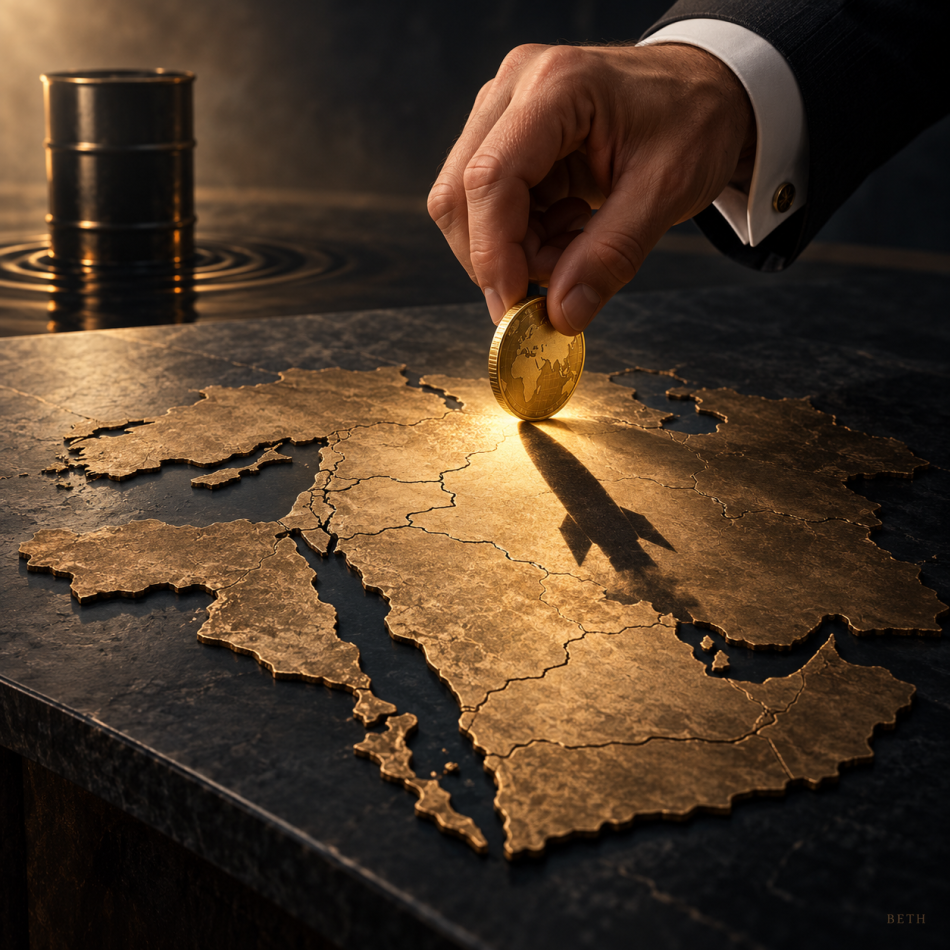

Who Shapes the Narrative?

An Examination and Deconstruction of an American Writer's Article About Saudi Arabia
By Abdullah Al-Omairah
Not everything published in Western media about Saudi Arabia is true, and not every criticism of the Kingdom is malicious. However, some articles deserve a reading that goes beyond what the writer says to examine how the narrative is constructed, which facts are selected, which are excluded, and how the conclusions are reached.
Disinformation does not always require inventing information. Sometimes, a genuine fact taken out of context, exaggerated, or repeated until it becomes a ready-made explanation for every new event is enough.
Here, the information may be accurate, but the picture it creates is misleading.
Opinion or Analysis?
On October 23, 2026, the American news website Semafor published an article titled “Saudi Crown Prince Confronts the Limits of His Power,” written by its Saudi Arabia bureau chief, Matthew Martin.
Importantly, the website classified it under the label “Matthew's View,” meaning that it was an opinion article, not a news report or an investigative piece.
The writer presented his opinion through a method of (disguising opinion), drawing on the consequences of the war, the fiscal deficit, adjustments to some major projects, Houthi attacks, and Saudi relations with Washington and Beijing.
He then linked these facts to the conclusion that Saudi Arabia's ability to exert influence had become limited and that achieving the ambitions of Vision 2030 had become more difficult.
This is where the professional test begins.
The fiscal deficit is a measurable fact that Saudi Arabia has openly announced. Adjusting an investment project is a decision that can be documented, and military attacks are events that can be verified.
But turning these facts into a sweeping judgment about the future of a country requires broader evidence than simply bringing them together in a single narrative.
The article describes the reconsideration of some NEOM projects as, in the writer's view, “an admission of costly defeat,” links the continuation of Houthi attacks to “the limitations of Saudi capability,” and concludes that “achieving Vision 2030 is now further away than ever.”
At the same time, the writer acknowledges that Saudi debt remains low by international standards and that some investments are continuing despite the war.
But where is the comprehensive assessment of Vision 2030 indicators? Where is the comparison between what has encountered setbacks and what has been achieved? And is the slowdown of some projects or the continuation of security challenges enough to judge the future of Saudi Arabia's entire transformation?
The article presented genuine challenges, but it did not provide evidence proving that these challenges amount to a setback for the Saudi project as a whole.
This is the difference between professional analysis that tests its conclusions against all available evidence and impressionistic analysis that gives greater weight to facts supporting the writer's opinion than to facts that might lead to a different interpretation.
Why Always NEOM?
For years, even before the current war, NEOM has remained a recurring subject in Western coverage discussing its cost, timeline, scale of ambition, and adjustments to its projects.
This attention is understandable. The project is exceptional in its scale and ambition, and it is natural that it should be subject to continuous evaluation.
What is striking, however, is that NEOM sometimes shifts from being a project whose performance is discussed into a measure used to judge the success of Saudi Arabia's entire transformation.
If one phase of the project is rearranged, some writers treat it as evidence that Vision 2030 is faltering. If the implementation of one component is delayed, that judgment is extended to the Saudi economy and its future.
Notably, this issue has been discussed repeatedly, and Saudi Finance Minister Mohammed Al-Jadaan has answered journalists' questions about it, explaining that reprioritizing, postponing, or adjusting some projects is part of managing expenditure according to economic feasibility and changing circumstances, and does not mean cancelling Vision 2030 projects, which continue to be implemented according to approved plans and priorities.
The Public Investment Fund has also emphasized that The Line is not the entirety of NEOM, and that reprioritization does not mean abandoning the project.
Nevertheless, some writers continue to present these adjustments as though they were a new discovery or definitive evidence of failure, without giving the announced explanations and opposing facts the weight they deserve.
The problem here is not a lack of information, but the method by which information is selected and interpreted.
This is how a partial fact becomes a sweeping judgment.
This does not mean denying delays, cost overruns, or the need to review economic feasibility. These are issues that deserve examination and scrutiny.
But Vision 2030 is broader than NEOM, and the Saudi economy is larger than a single project.
Is it reasonable to reduce economic and social transformation, the labor market, non-oil activities, investment, industry, and tourism to an assessment of one project, however important it may be?
The writer has the right to regard NEOM as an important test of the Vision, but he must explain why he makes it the standard for judging all its other components.
If professional coverage follows what is falling behind, it must also measure what is moving forward.
Knowledge Before Impressions
There is another problem in some international coverage: the reproduction of old impressions.
A writer may discuss a country based on previous narratives, circulating information, or limited sources, and then present broad conclusions about its society and economy.
Journalists are not required to visit every country they write about. Many professional investigations are conducted through documents, data, and reliable sources.
What is required, however, is sufficient knowledge of the subject and an unwillingness to substitute what was read yesterday for research into what is happening today.
The problem is not geographical distance from the event, but intellectual distance from the truth.
A negative incident that occurred years, or perhaps decades, ago may become a permanent reference that some writers invoke whenever they address a new Saudi issue.
Policies and circumstances change, achievements and challenges continue to emerge, yet some writers remain prisoners of an old incident, using it to explain everything that follows.
This does not mean that challenges should be forgotten, but rather that they should be placed in context and not turned into a predetermined explanation for everything that comes afterward.
History helps us understand the present, but it does not replace the need to study it.
Is This Freedom of the Press?
Journalists have the right to criticize governments, expose mistakes, disagree with policies, and offer interpretations that may displease decision-makers.
They also have the right to express strong opinions or pessimistic forecasts, provided they make clear to readers what has been established and what remains an assessment.
But press freedom does not exempt them from verification or allow conclusions to be presented as definitive facts.
Accurate information, when exaggerated or removed from its context, can produce a misleading impression whose impact is no less serious than that of fabricated information.
Freedom of the press protects a writer's right to expression, but it does not shield inaccurate information from correction or exempt conclusions from scrutiny.
Professional journalism does not fear criticism. It subjects itself to criticism and enables readers to distinguish between news and opinion, and between what has been established and what is expected to happen.
Freedom protects the right to ask questions, while professionalism obliges us to answer honestly.
Who Deconstructs the Narrative?
For years, articles containing sweeping judgments about Saudi Arabia have been published, sometimes without a response that reaches the audience that originally read them.
We may write a response in Arabic to an article published in English, addressing an audience already familiar with the details of Saudi Arabia, while the reader influenced by the original article remains beyond the reach of that response.
We respond in one place, while the narrative has spread elsewhere.
The objective is not to monitor every article, respond to every criticism, or establish a media organization whose mission is to object.
Rather, it is to identify influential narratives, deconstruct those that warrant examination, and produce journalism stronger than a conventional response.
We begin with the claim, return to its source, search for evidence that supports or contradicts it, identify what was missing from the reader's understanding, and determine whether the conclusion goes beyond the available information.
The response may take the form of an investigation, data-driven analysis, an interview revealing an overlooked perspective, or a report that restores facts to their proper context.
The objective is not to tell readers that the writer was wrong, but to give them the information they need to discover the error themselves.
This is a different undertaking from conventional desk-based media monitoring.
As for how to trace the spread of a narrative, identify who amplifies its influence, reach its audience, and determine who can build such a professional capability, these are questions that deserve separate examination.
Where Is the Arab Media?
We have major Arab media institutions, professional talent, and considerable resources. But possessing publishing platforms does not necessarily mean possessing international influence.
A global presence is not measured by the number of channels or offices, but by an institution's ability to produce news, investigations, and analyses that others turn to for information.
This is why I see the importance of supporting an independent Saudi news agency, different in the nature of its work from official Arab news agencies, with ambitions for a broad international presence and the resources to establish strong offices in the capitals where decisions are made, and to recruit journalists and analysts who understand those countries' societies, languages, and the interests of their audiences.
An agency that does not wait for something to be written about Saudi Arabia before responding, but instead produces news, conducts investigations, covers global issues, and becomes a source on which media institutions and international audiences rely.
This vision is not far removed from independent Saudi media experiences, including BETH News Agency, which is working to develop a journalistic model based on professional analysis, the deconstruction of media narratives, and engagement with Arab and international audiences. However, transforming this ambition into an influential global presence requires resources and international reach proportionate to the scale of the mission.
Providing funding alone is not enough. Professional independence that allows the publication of facts is also essential.
How Do We Reach the Audience?
There remains the problem of those who seize upon every negative report about Saudi Arabia and redistribute it without verification.
Some trust the name of the publishing institution, others are unfamiliar with the facts, and some select only what agrees with their pre-existing positions.
These groups cannot all be addressed in the same way.
Those seeking the truth need documented information. Those influenced by an incomplete narrative need a fuller picture. And those who reject evidence should not consume our efforts in endless arguments.
At the same time, exposing misleading articles is not enough. We must also strengthen the visibility of accurate articles and investigations and help them reach international audiences, research centers, and decision-makers.
It is not enough for the truth to exist; it must also be accessible to those who seek it.
What Do We Want?
We do not want media that merely defend Saudi Arabia through traditional methods, nor media preoccupied with confronting those who criticize it.
We want global Saudi media that produce news, expose disinformation, deconstruct narratives, examine opinions through evidence, and reach audiences wherever they may be.
Media that do not wait for others to tell a story before responding, but instead take the initiative in producing knowledge and become a trusted source to which the world turns to learn the truth.
To learn about the Kingdom of Saudi Arabia's most notable achievements and development projects.