


BETH Eyes in Capitals of Decision
August 16, 2026
The U.S.-Israeli war with Iran remains the most prominent story in the global press, but every capital views it through the lens of its own interests: Washington calculates the cost of gasoline and the strain on its navy; Europe connects it to energy and the economy; Asia fears disruptions to supplies; Israel watches the multiplication of fronts; while the Arab press focuses on ports, sovereignty and mediation efforts.
Prepared and Analyzed by | Strategic Media Department – BETH News Agency
Supervised by: Abdullah Al-Omairah
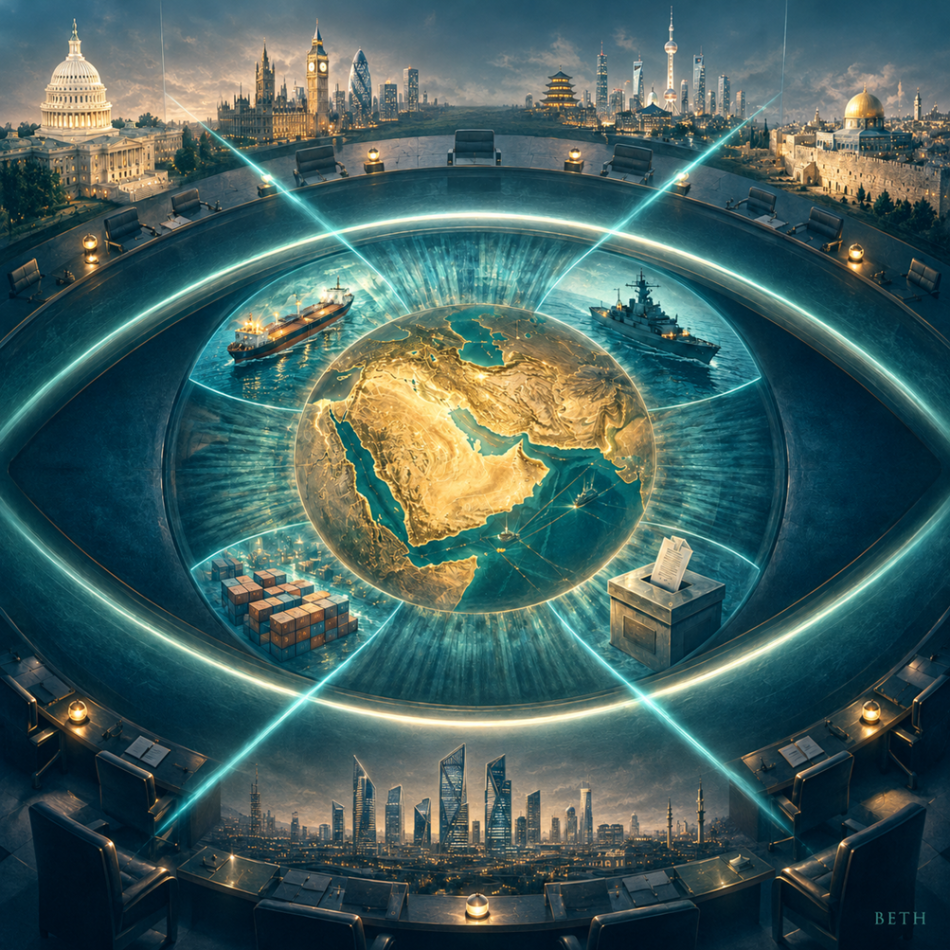
The global press does not view the same event in the same way.
The war that appears in Washington as a test of the effectiveness of sanctions and the blockade is portrayed in London and Paris as an energy and economic crisis. In Beijing, Tokyo and New Delhi, it is viewed as a threat to supply chains, while the Israeli press sees it as a battle for survival unfolding across multiple fronts.
The Arab press, meanwhile, views the conflict from much closer to the fire. The issue is not limited to oil prices, but extends to ships, ports, cities, borders and the mediators trying to prevent the next explosion.
Washington | The War Comes Home
The U.S. press is increasingly focused on the war’s transition from a question of military power to one of endurance.
The confrontation is being portrayed as a test of which side will blink first under economic pressure. President Donald Trump’s administration is intensifying sanctions and the naval blockade, while Tehran is betting that rising oil prices and the cost of the war will eventually force Washington to retreat.
The visit by U.S. Central Command chief Admiral Brad Cooper to the aircraft carrier USS Abraham Lincoln also received widespread attention—not only for its military significance, but because of reports of crew fatigue and deteriorating living conditions after more than 240 days at sea.
The carrier has thus shifted from being merely a symbol of American power to a measure of the cost of a prolonged war. A force capable of remaining at sea also needs crews that can endure, replenished ammunition, a sustainable budget and continued public acceptance.
The press also covered preparations to deploy the USS George Washington to replace the Lincoln, indicating that the Pentagon is treating the war as an extended deployment rather than a mission nearing completion.
Domestic Focus
Three issues are gaining prominence inside the United States:
- Rising fuel prices and their impact on households and rural states.
- Declining consumer confidence, particularly among Republicans.
- The war’s effect on the midterm elections and Trump’s ability to persuade voters that today’s costs are preventing a greater danger.
The treatment of military personnel has also entered the debate, as sailor fatigue and conditions aboard the carrier become part of a broader discussion about the limits of American power.
The U.S. press is therefore no longer asking only whether the United States can defeat Iran.
It is also asking:
How much will American families, the navy and the elections pay for the continued attempt to force Iran into submission?
London | War Measured by the Bill
The British press focuses on the connection between the Middle East and the global economy.
It follows the Strait of Hormuz crisis as a struggle over energy and trade, while viewing the escalation in Lebanon as a test of the fragility of the ceasefire and the durability of agreements sponsored by the United States.
The killing of 11 people in Israeli strikes on southern Lebanon also drew attention, with the renewed violence threatening an agreement intended to lead to Hezbollah’s disarmament and a phased Israeli withdrawal.
London’s broader perspective, however, remains economic. Global oil inventories are falling, fuel prices are pressuring consumers, and airlines, shipping companies and the tourism sector face additional costs. Every escalation in Hormuz or Bab el-Mandeb is quickly reflected in the British market.
Domestic Focus
At home, the British press followed the unexpected economic growth recorded in June, linking it partly to a temporary easing of energy pressures during the Gulf lull, as well as the World Cup and summer weather.
At the same time, welfare reform, migration across the English Channel, wildfires, heatwaves and the government’s ability to reconcile social spending with fiscal discipline remained prominent issues.
To the British reader, the war may appear geographically distant, but it becomes very close when it reaches:
The price of fuel, the energy bill, the cost of an airline ticket and the economy’s ability to grow.
Paris and Berlin | Two Wars over Energy and Climate
The European press views the war with Iran alongside an internal crisis that is no less pressing: the heatwave and widespread wildfires.
Economic estimates suggest that heatwaves could cost the European Union as much as €180 billion through declining productivity and disruptions to infrastructure, agriculture and tourism.
France is facing particular pressure after high river temperatures forced some nuclear plants to reduce output or shut down, while Germany is dealing with lower water levels in the Rhine and their effect on freight transport and supply chains.
When the climate crisis coincides with disruption to Gulf oil, Europe faces two simultaneous sources of pressure on energy: extreme heat that reduces production capacity, and a war that threatens external supplies.
Domestic Focus
Wildfires, evacuations and suspicions of deliberate arson dominate French coverage, while the German press focuses on industry, transportation and energy costs.
The European press is also following the inability of the continent’s capitals to build a unified and effective position on the war. Military decisions remain in Washington’s hands and developments on the ground are controlled by the region’s actors, while Europe bears a growing share of the economic and humanitarian costs.
Europe is not leading the war, but it is paying an increasing share of its bill.
Beijing | Memory Before the Gulf
The war with Iran did not dominate the Chinese press alone. The 81st anniversary of Japan’s surrender in World War II and visits by Japanese officials to the Yasukuni Shrine—viewed by Beijing as a symbol of Japan’s failure to fully acknowledge its wartime crimes—also featured prominently.
The Chinese press used the occasion to renew criticism of what it describes as Japanese militarism, connecting historical memory to present disputes over Taiwan, Japan’s military expansion and its alliance with the United States.
Disputes with the Philippines—particularly over the South China Sea, Chinese workers and marine environmental issues—also received attention, alongside the launch of new internet satellites and developments in industry and technology.
The war with Iran is viewed in China through three interests:
- The stability of energy imports.
- Preventing the United States from gaining unilateral control over maritime routes.
- Expanding opportunities for Chinese companies in transportation, technology and alternative energy as Western markets face disruption.
Domestic Focus
Space projects, floods, dam repairs, environmental progress and the entry of China’s C919 aircraft into international commercial routes all featured prominently.
This coverage seeks to reinforce a domestic narrative that China continues to produce and expand while the West remains preoccupied with wars that drain its military and economy.
Tokyo | Oil, the Yen and Memory
The Japanese press follows the war with Iran with particular sensitivity because Japan depends heavily on energy imports from the Middle East. Any disruption in Hormuz raises the cost of oil and transportation while adding further pressure on the yen.
In domestic economic affairs, coverage has focused on rising government bond yields, the possibility of higher interest rates, and pressures caused by the weak currency and import costs. At the same time, confidence among industrial companies has improved due to demand for semiconductors.
Politically, visits by Japanese officials to the Yasukuni Shrine reignited disputes with China and South Korea, turning the memory of World War II into both a domestic and foreign policy story.
The Japanese press is therefore balancing two fears:
The fear of a new war threatening energy supplies, and an old dispute over how to remember a war that ended 81 years ago.
New Delhi | The Road to Oil
The Indian press views the Hormuz crisis primarily through the lens of energy security.
India is one of the world’s largest oil consumers and depends heavily on supplies from the Middle East. Coverage has therefore focused on reserves, supplier diversification, ship protection and the search for alternative routes.
India had secured enough oil to cover approximately 60 days of demand, expanded its import sources and increased domestic cooking-gas production to mitigate supply disruptions.
The defense partnership among Saudi Arabia, Türkiye and Pakistan is receiving particular attention in India. Pakistan’s entry into a broader defense alliance is viewed in New Delhi through the balance of power—not only through the security of the Gulf.
Domestic Focus
Attention is centered on the effect of oil prices on inflation, transportation and government subsidies, as well as India’s ability to protect its ships without becoming involved in the war.
The press is also monitoring relations with Russia, the United States and the Gulf states to determine how much room India has to maneuver without losing any of its suppliers or partners.
Jerusalem | Fronts Before the Elections
Strikes on southern Lebanon dominate the Israeli press, with a clear focus on wounded Israeli soldiers and the targeting of Hezbollah commanders and military infrastructure in the south.
The press is also monitoring the speed at which Iran is restoring its military capabilities—particularly its ballistic missiles—amid questions over what the U.S.-Israeli strikes actually achieved and whether Iran is rebuilding what was destroyed faster than anticipated.
In Gaza, Prime Minister Benjamin Netanyahu’s rejection of key parts of the U.S. plan is prominent, alongside diplomatic activity in Cairo and expected visits by U.S. figures seeking to advance a ceasefire and new political arrangements.
Domestic Focus
The October elections are beginning to weigh heavily on every security issue.
The Israeli press is discussing:
- The government’s ability to manage the Iranian, Lebanese and Gaza fronts simultaneously.
- The crisis surrounding the conscription of the ultra-Orthodox.
- The distribution of the war’s burden among different sections of society.
- The leadership’s responsibility for the October 2023 attack.
- Netanyahu’s future if the war continues without a clear victory or an agreement that restores stability.
Every strike in Lebanon and every position toward Iran therefore becomes both a military and electoral issue.
In Israel, a security story does not remain merely a security story for long; it quickly becomes an electoral vote.
Arab Capitals | Closer to the Fire
The Arab press reflects a different map of priorities because it covers countries located within the war zone or directly along its borders.
Beirut
Israeli strikes, the possibility of displacement and fears that the truce could collapse dominate the news, alongside the domestic debate over Hezbollah’s weapons, an Israeli withdrawal and the state’s ability to impose its authority in the south.
Domestically, the general amnesty law has triggered broad political and sectarian controversy over justice, prisons and the limits of settlements among Lebanon’s political forces.
Cairo
The Egyptian press is focused on a visit by a Hamas delegation and its meeting with the head of Egyptian intelligence, coinciding with expected visits by U.S. figures seeking to salvage the Gaza ceasefire plan.
Domestically, industrial development, the localization of production and attracting investment remain prominent, alongside economic pressures connected to energy, trade and the Suez Canal.
Doha and Kuwait
The Gulf press is following the dispute with Iran over the fate of Iranian pilots who went missing during the war, as well as four Iranians who entered Kuwaiti waters.
Qatar denies detaining Iranian pilots, while Iran says the investigation remains incomplete. Kuwait and Tehran also provide different accounts of the mission of the Iranians who entered Kuwaiti waters.
The coverage reveals that Gulf states are confronting not only missiles and ships, but also detainee, missing-person and sovereignty investigations that could develop into diplomatic crises.
Abu Dhabi
Attacks on vessels linked to ADNOC and assertions of freedom of navigation dominate coverage, accompanied by rhetoric that combines the defense of sovereignty with keeping the door to diplomacy open.
Yemen
Coverage focuses on the suspension of operations at the Port of Mokha, attacks against vessels and facilities, and the response of government forces to Houthi attacks, amid fears of a broader return to ground warfare.
In the Arab press generally, Mokha is not portrayed merely as a small Yemeni port. It is a point on the Bab el-Mandeb map capable of affecting navigation, energy supplies and Red Sea security.
Saudi Arabia in the Global Press
The Kingdom appears in the global media today from three interconnected perspectives.
A Center for Building Alliances
The international press continues to analyze the Makkah Joint Defense Agreement among Saudi Arabia, Türkiye and Pakistan following the announcement of high-level political and military mechanisms.
These include joint exercises across land, sea, air and cyberspace, as well as cooperation in unmanned aircraft, electronic warfare and artificial intelligence.
The agreement is not being viewed as a temporary military partnership, but as an attempt to build regional deterrence by combining Saudi financial and political influence, Turkish industry and expertise, and Pakistani military capabilities.
A State Drawn into a War It Did Not Choose
Some international coverage portrays Saudi Arabia as a country that sought to reduce escalation, only to find its facilities, ships and surrounding maritime routes threatened by Iran and its regional proxies.
From this perspective, building alliances and establishing a naval coalition in the Red Sea represent a transition from containment to deterrence—without abandoning diplomacy.
Guardian of Energy Routes
Economic reports have focused on Saudi oil tankers in the Red Sea switching off their tracking systems during some voyages to reduce the risk of Houthi attacks, resulting in varying estimates of export volumes.
Saudi Arabia therefore appears not only as an oil producer, but as a country carrying a dual responsibility: protecting its own supplies and contributing to the security of the routes through which oil reaches global markets.
The most prominent image of Saudi Arabia in the global media is no longer merely that of a country that possesses energy, but of a country building a network to protect both energy supplies and the region.
Why Does the Press Focus on These Stories?
The global press does not select stories solely according to the scale of human suffering, but also according to their expected impact on audiences and national interests.
This is why Hormuz, Lebanon, Saudi Arabia and Mokha dominate coverage: they affect four things that capitals cannot ignore.
Energy
Any disruption in Hormuz or Bab el-Mandeb quickly reaches the prices of fuel, electricity, transportation and food.
Security
The expansion of the war through proxies means that the dividing line between a regional confrontation and an international war has become less clear.
The Economy
Stationary vessels, insurance premiums, longer routes and military exhaustion all become financial costs reflected in markets and government budgets.
Domestic Politics
Trump is thinking about the American voter. Netanyahu faces elections in October. European governments confront public anger over prices and wildfires, while Asian states fear their citizens will pay the price of a war in which they are not participating.
There is also a media-related reason.
The press is drawn to stories that combine recognizable personalities, a threat that can be visually captured, a figure that moves markets and the possibility of a larger explosion.
That is why a statement by Trump or an attack on a tanker can sometimes receive more attention than a slow-moving humanitarian consequence that does not produce an urgent image.
The Reading
Today’s press reveals that the world is not following one war, but several different versions of it.
Americans see a war over fuel and elections.
Europeans see pressure on energy and the economy.
Asians see a threat to supplies.
Israelis see multiple fronts that will determine the shape of the next government.
Arabs see a danger reaching their ports, borders and cities.
Saudi Arabia stands at the intersection of all these perspectives: an energy power, a center of deterrence, a potential target, a diplomatic actor, and a force working to prevent the waterways surrounding it from becoming instruments of strangulation.
The global press does not merely reveal what is happening in the world. Through what it chooses to cover, it also reveals what every capital fears—and what it seeks to protect first.