


Who Owns History?
Between those who made the event, those who wrote its first account, those who controlled the archives, and those who reopened them decades later—where does the truth hide when memories multiply?
An Inferential Investigation
Prepared and Analyzed by | Strategic Media Department – BETH News Agency
Supervised by: Abdullah Al-Omairah
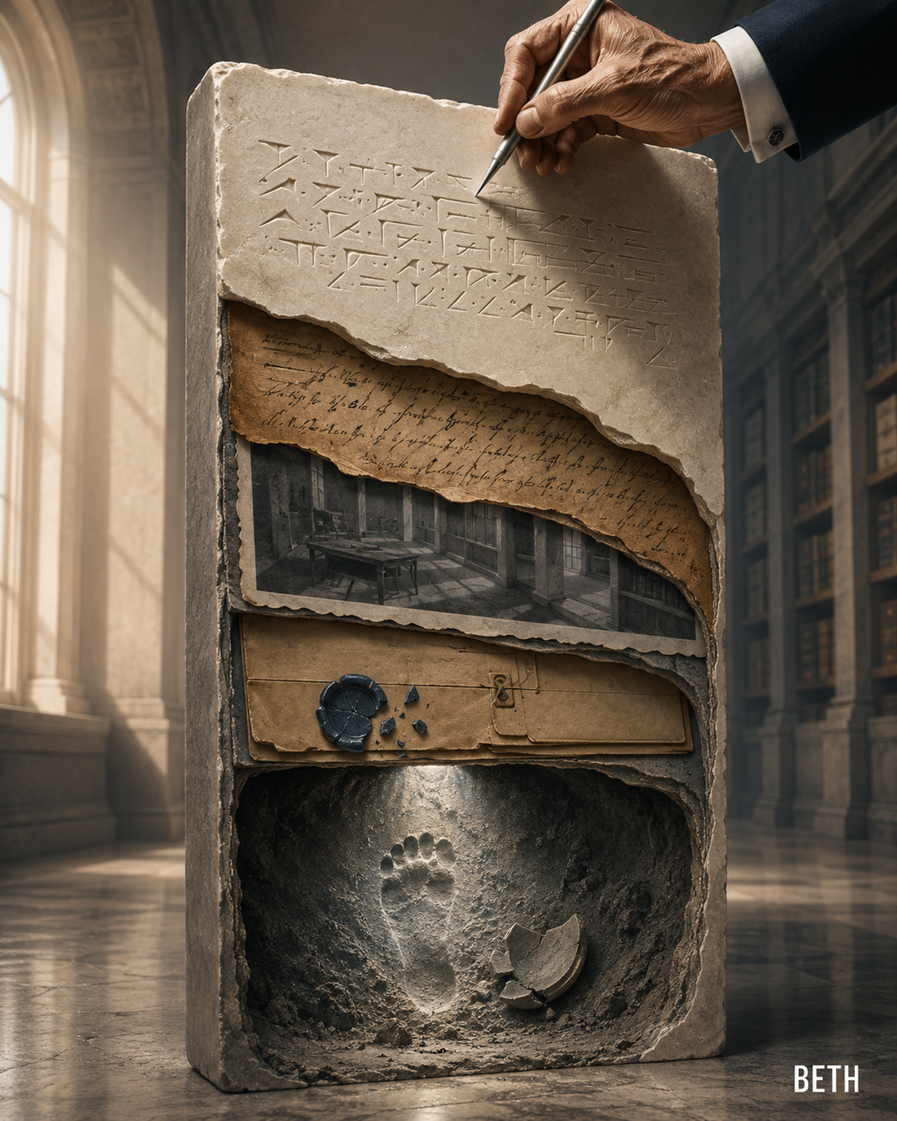
A hand stands at the top of the tablet, writing with confidence.
The words appear orderly, the story complete, and the surface polished—as though what has been inscribed upon it represents everything that happened.
But beneath the official narrative lie other layers.
A letter written by a witness but never published.
A photograph capturing an angle that never entered the history book.
A file sealed shut, then opened decades later.
And at the bottom, a footprint and a broken object left by the event before pens began interpreting it.
The hand may write whatever it wants on the surface, but it cannot prevent the past from leaving traces in the depths.
This is where the question begins:
Is history what happened, or what remained written of what happened?
The Past Is Not History
The past is everything that actually happened, including all the details that became known and those that were lost.
History, however, is humanity’s attempt to reconstruct that past through the documents, testimonies, photographs, artifacts, and narratives that survived.
The distance between the two is vast.
An event happens once, but its story may be written dozens of times. Each time, it absorbs something from the writer’s era, position, sources, fears, interests, and the questions they seek to answer.
The past does not return to us intact.
It arrives in an incomplete box: some of it preserved, some torn, some classified, some written years later, and some never recorded at all.
The historian, therefore, does not write the past exactly as it was, but reconstructs the closest possible image from what survived the passage of time.
The past is an event; history is the continuing work of understanding it.
Who Writes the First Narrative?
It is often said that the victor writes history.
There is an important element of truth in that statement, but it is not the whole truth.
After the battle, the victor controls the state, the platform, the school, the printing press, the archives, and the authority to name things. The victor can call an advance “liberation,” the opponent’s resistance “rebellion,” its own losses “sacrifices,” and the losses of others “collateral damage.”
The victor can also declare the war over, determine the date of victory, select the heroes whose portraits will be raised, choose the names given to streets, and decide which events enter school curricula.
But the victor does not own the past itself.
The defeated preserve their memories. Survivors recount what they witnessed. The land conceals traces. Letters pass through families. Decades later, a file may emerge and overturn the meaning of a decision once celebrated as heroic.
It is therefore more accurate to say:
The victor does not write all of history; the victor writes the fastest narrative and gives it the power to spread.
Who Documents the Event?
It is documented by whoever decides that something deserves to be preserved.
Here, a power deeper than the power of writing emerges: the power of selection.
The future historian will not reach everything that happened, but only what someone in the present decided to retain.
The state preserves certain communications and conceals others.
The military documents its operations from its own perspective.
The newspaper chooses what appears on its front page.
The photographer selects one moment from among thousands.
The institution preserves an official record and disposes of a draft.
A family safeguards a letter whose value may not be understood until two generations later.
The person who most profoundly influences history may not be the author of the book, but the person who stood earlier at the archive door and decided:
What enters?
What remains outside?
What is classified?
When will it be disclosed?
And who will be allowed to access it?
A document does not begin its life when a historian reads it, but when someone decides not to destroy it.
The Archive Does Not Speak Alone
An archive appears to be a neutral place: boxes, files, dates, and seals.
But it may carry the biases of the institution that created it.
Powerful authorities produce more documents, preserve them more effectively, and possess institutions capable of classifying and transmitting them across generations. The poor, displaced people, prisoners, or communities without a state may leave only oral memories and scattered materials that can easily disappear.
The voice of authority may therefore sound louder in history, not because it is more truthful, but because it had a greater ability to produce and preserve records.
An archive can also mislead without falsifying a single document.
It need only preserve what supports one narrative and neglect what contradicts it—or open certain files while keeping others closed—to guide researchers toward conclusions that appear scholarly but were built from materials selected in advance.
Every document in an archive may be authentic, while the archive itself remains incomplete in its truth.
The Witness Sees—and Does Not See
A witness’s testimony gives an event its human voice.
The witness describes the fear, the smell, the sound, and what official reports failed to record. A testimony may preserve the name of someone the documents ignored, or expose a crime omitted by the institution that committed it.
But memory is not a camera.
A person may forget, confuse two periods, or rearrange details after hearing the accounts of others. The passage of time may also give an event a meaning that was not present when it occurred.
This does not make the witness a liar.
It merely reminds us that sincerity is one thing, while complete accuracy is another.
A testimony may be emotionally truthful but chronologically incomplete, precise in one scene and confused in another.
Individual testimony should therefore be neither rejected because it is subjective nor accepted on its own because it is moving. It must be compared with supporting and contradictory testimonies, documents, and material evidence.
A Photograph Does Not Contain the Whole Scene
A photograph is often presented as a witness that does not lie.
But a photograph says: this is what stood before the lens at this particular moment.
It does not necessarily say: this was everything that existed there.
The photographer chooses the position, angle, moment, and frame. What lies outside the frame may alter the meaning of what appears within it.
A photograph may document a large crowd without revealing whether it represents the whole of society. It may show a soldier raising a flag without explaining what happened before that moment or what followed it.
An authentic photograph can serve a misleading narrative when separated from its time, location, and context.
It is therefore not enough to ask whether the photograph is authentic.
We must also ask:
What does it show?
What does it not show?
Who chose to publish it?
And in what context was it presented?
Do Narratives Differ?
Yes, because those who tell them stand in different places.
A battle one side calls “liberation” may be called “occupation” by the other. A person portrayed as a hero in state archives may appear responsible for a tragedy in victims’ testimonies.
Narratives differ because of language, identity, interest, fear, and affiliation—and because the questions themselves differ.
Military history asks: How did the army win the battle?
Economic history asks: Who financed it, and who profited from it?
Social history asks: What happened to ordinary people?
The history of victims asks: Who paid the price, and why was that person’s name never mentioned?
These narratives may all contain elements of truth without being equal in accuracy or integrity.
The existence of multiple narratives does not mean that truth does not exist, nor does it grant falsehood the status of opinion.
One narrative may rest upon multiple, intersecting documents, while another is built on repeated propaganda. There may be differences in interpretation, but there are also disputes over facts that can be proven or disproven.
Or Do Narratives Evolve?
They evolve as well.
Not because the past changes, but because our knowledge of it expands.
Previously classified archives are opened.
Personal memoirs emerge.
A witness who remained silent out of fear begins to speak.
An archaeological site is discovered.
Techniques for examining images and documents advance.
New generations ask questions their predecessors never raised.
A decision may be presented in its own time as a national necessity, only for documents to reveal that other options were available. A person may be condemned as a traitor, only for later evidence to show that they attempted to prevent a catastrophe. A society may celebrate a military victory before eventually beginning to calculate its human cost.
This is not a betrayal of history, but part of its nature.
A narrative that never changes, regardless of the evidence that emerges, is not history; it is a closed doctrine.
Serious history does not fear revision, because revision does not erase the past; it removes some of what has accumulated over it.
Who Gives Things Their Names?
Language is not a neutral covering for an event.
When killing is called “cleansing,” withdrawal is called “redeployment,” or defeat is called a “setback,” the term does not merely describe reality; it reshapes reality within memory.
Authority often possesses the initial power to name an event, then repeat that name through official statements, school curricula, and the media until it becomes part of public consciousness.
Over time, people may forget that the name was a political choice and begin treating it as a natural fact.
Revisiting history must therefore sometimes begin by revisiting its vocabulary:
Who chose the name?
What did it conceal?
And who became a criminal or a hero simply through its use?
Whoever possesses the power to name an event owns part of its meaning before its history is even written.
The History That Was Never Written
The most dangerous pages of history may be the pages that never existed.
People died without telling their stories.
Villages disappeared from maps.
Women lived through events without their voices entering the records.
Workers built cities, but the documents preserved only the names of their owners.
Victims whom institutions did not know how to classify vanished from the statistics.
Silence is not evidence that nothing happened.
It may be evidence that those who experienced it lacked the language, platform, safety, or institution needed to preserve their testimony.
The historian therefore does not merely ask documents what they say, but also asks who is absent from them.
Sometimes, the gap in the record is itself information, and the absence of a name becomes evidence of the nature of the system that produced the archive.
Does a Civilization Write Its History?
Ancient stone monuments and manuscripts demonstrate the ability of people in their time to document events, but they do not constitute a complete record of their age. What survives reached us because it was inscribed on materials that resisted time, or because authorities and institutions deemed it worthy of preservation. Artifacts therefore reveal what the past succeeded in securing, not everything it knew or experienced.
Our civilization, meanwhile, cannot guarantee the survival of its history through monumental buildings and advanced industries alone. Structures may endure as evidence of technological capacity, but they do not explain the people who built them, their ideas, or their conflicts. Paradoxically, the age that produces more information than any before it may be more vulnerable to losing that information, because its memory is digital, fragile, and dependent on technologies that may eventually become unreadable.
A civilization leaves its history not only through what it builds, but through what it preserves and makes comprehensible to those who come after it.
When Politics Enters the Past
States do not struggle only over territory and interests; they also struggle over the interpretation of what happened before.
History grants legitimacy and defines the victim, the victor, and the rightful claimant. The past is therefore summoned into the present to justify a war, establish borders, claim territory, or deny responsibility.
A long history may be reduced to a single incident that serves the political moment, or an event may be removed from its context and made to appear as though it were the beginning of everything.
When the past becomes a weapon, the objective is no longer to understand it, but to use it.
This is where the most dangerous forms of distortion occur—not necessarily through inventing an event, but through choosing a convenient starting point.
Someone who begins the story yesterday will reach one conclusion; someone who begins it fifty years earlier may reach another.
Controlling the beginning of the story may be more influential than controlling its end.
History in the Age of Platforms
In the past, history disappeared when a library burned, paper decayed, or a witness died.
Today, we produce more material than any person could ever read, yet we may be creating a more fragile memory.
A post is deleted.
An account is closed.
A link expires.
A photograph is separated from its source.
A clip is reposted thousands of times without its original context.
An algorithm determines what appears and what disappears from public awareness.
The future historian will no longer confront only a scarcity of information, but an enormous surplus of it—uneven in authenticity, easily altered, and owned by private companies that may change their policies or disappear.
What spreads most widely today may become what is most present in tomorrow’s memory, not because it is the most accurate, but because an algorithm granted it greater reach.
A new power has therefore entered the writing of history:
The state, the historian, and the newspaper are no longer the only ones deciding what is preserved; the platform also determines what millions see and what it buries beneath the surface.
Where Is the Truth?
Truth does not reside solely in a document, a survivor’s testimony, a photograph, or a material artifact.
It exists in the space where independent sources—created without the purpose of confirming one another—converge.
When a personal letter aligns with an administrative record, a photograph with a geographical location, a testimony with material evidence, and one side’s account with an admission from its opponent, the approach to truth becomes stronger.
This does not mean that truth is simply a compromise between two narratives.
If one narrative says that an event occurred while multiple forms of evidence prove that it did not, then claiming that it half-occurred does not become an equitable truth.
Neutrality is not standing midway between truth and falsehood, but subjecting both sides to the same standard.
Historical truth is measured not by how many people repeat it, but by its ability to withstand contrary evidence.
How Do We Approach the Truth?
No method can restore the past in its entirety, but certain rules can reduce the space available for deception.
Identify the Document’s Source
Who wrote it? For whom? Under what circumstances? Was it intended for internal use or public propaganda?
A classified document may reveal what public statements conceal, but it is not immune to deception or error.
Separate the Event From Its Interpretation
We may agree that a battle occurred on a specific date, while disagreeing about its causes, the responsibility of its participants, and its consequences.
Distinguishing between what can be established and what remains open to interpretation prevents opinion from wearing the clothes of fact.
Compare Adversaries
When two adversaries acknowledge the same event despite interpreting it differently, that point of convergence gains evidentiary value.
Details found only in one side’s narrative require additional evidence.
Search for the Original
A copied photograph, a truncated quotation, or a translated document may lose part of its meaning.
Whenever possible, we must return to the original version, its complete context, and the chain through which it was transmitted.
Pay Attention to Those Who Are Absent
Who was never asked? Who has no archive? Which groups appear in statistics but have no recorded voice?
Expanding the range of sources does not merely add voices; it may change the entire question.
Test the Chronology
A narrative that places an outcome before its cause, or relocates a statement to a time when it was never made, may construct an entire meaning upon an incorrect sequence.
Time is not a minor detail; it is the structure of causality.
State the Degree of Certainty
Some things are established, some probable, some disputed, and some unknown.
When historians state their degree of confidence, they do not weaken their work; they prevent possibility from turning into false certainty.
Solutions for Preserving a Fairer History
It is not enough to ask future historians to be more accurate; we must provide them today with materials that are more balanced and diverse.
This begins with opening public archives according to clearly defined timelines, protecting documents from selective destruction, digitizing records while preserving their originals and contexts, and recording oral testimonies before those who hold them pass away.
The world also needs to preserve digital content of public value beyond the decisions of commercial platforms, record the origin of images and videos along with their modification and publication history, and guarantee researchers access to the data that shapes public memory.
The right to document must not remain exclusive to states and major institutions. Local communities, families, victims, and minorities need tools that preserve their narratives according to verifiable standards.
Education, meanwhile, should not present history as a final list of names and dates. It should train students to examine sources, compare narratives, and understand the difference between an event and its interpretation.
Protecting the truth begins before the history book is written; it begins with protecting the materials from which it will be written.
The Historian’s Role
The historian is neither a judge who possesses the final word nor a copyist who merely places documents beside one another.
The historian’s task is to examine how a narrative emerged, what evidence supports it, what contradicts it, and which voices are absent.
Historians do not demonstrate independence by always standing in the middle, but by applying one standard to everyone and accepting the conclusion to which the evidence leads, even when it contradicts their previous beliefs.
They must also resist the temptation of the perfect story. Real history is less orderly than history books. A person may be a hero in one situation and wrong in another. A sound decision may produce harmful consequences, while a malicious motive may result in an outcome its author never intended.
Honest historical work does not give readers the comfort of a closed narrative; it gives them a more truthful understanding of human complexity.
When the Layers Speak
In the image, the narrative written at the top appears to be the strongest layer: polished stone, orderly inscriptions, and a hand that knows exactly what it wants to say.
But it is also the newest layer and the one closest to the light.
As we move downward, the materials lose their elegance and acquire a different kind of truthfulness: a worn sheet of paper, a faded photograph, a sealed file, and finally a footprint in the earth.
This does not mean that what lies below is always true, or that the official narrative is necessarily false.
But the image reveals a deeper paradox:
What was designed to endure may conceal the truth, while something never intended to become a document may emerge as its strongest witness.
The hand may carve into the stone, but it cannot make the foot step backward, repair the object that was broken, or erase the layers beneath its narrative.
Perhaps this is why history requires excavation, not reading alone.
The surface tells us what the writer wanted to remain. The depths tell us what survived despite the writer.
History is not written by one person, nor does the victor own it forever.
The victor writes a narrative. An employee preserves a document. A survivor recounts a memory. A photographer captures an angle. An official seals a file. Then time arrives and opens some of what was closed.
Narratives differ because they look from different positions, and they evolve because the evidence expands and the questions change.
But this does not mean that truth changes with every writer, or that every narrative deserves the same degree of trust.
Truth exists, even when it reaches us dispersed across layers.
Approaching it requires more than reading what was written. It requires knowing who wrote it, who was prevented from writing, what was preserved, what disappeared, and what the event left upon the earth before the battle over names began.
History is not the past; it is the continuing struggle over the meaning of the past.
Whoever holds the pen may write the surface, but the truth often waits in layers their hand could not reach.