


News from the Dust
When the truth lies inside the battle and the cameras remain outside it, the media does not convey everything that happened; it collects what the conflict has scattered, then gives the fragments the name of a narrative
An Inferential Investigation
Prepared and Analysed by | Strategic Media Department – BETH Agency
Supervised by: Abdullah Al-Omairah
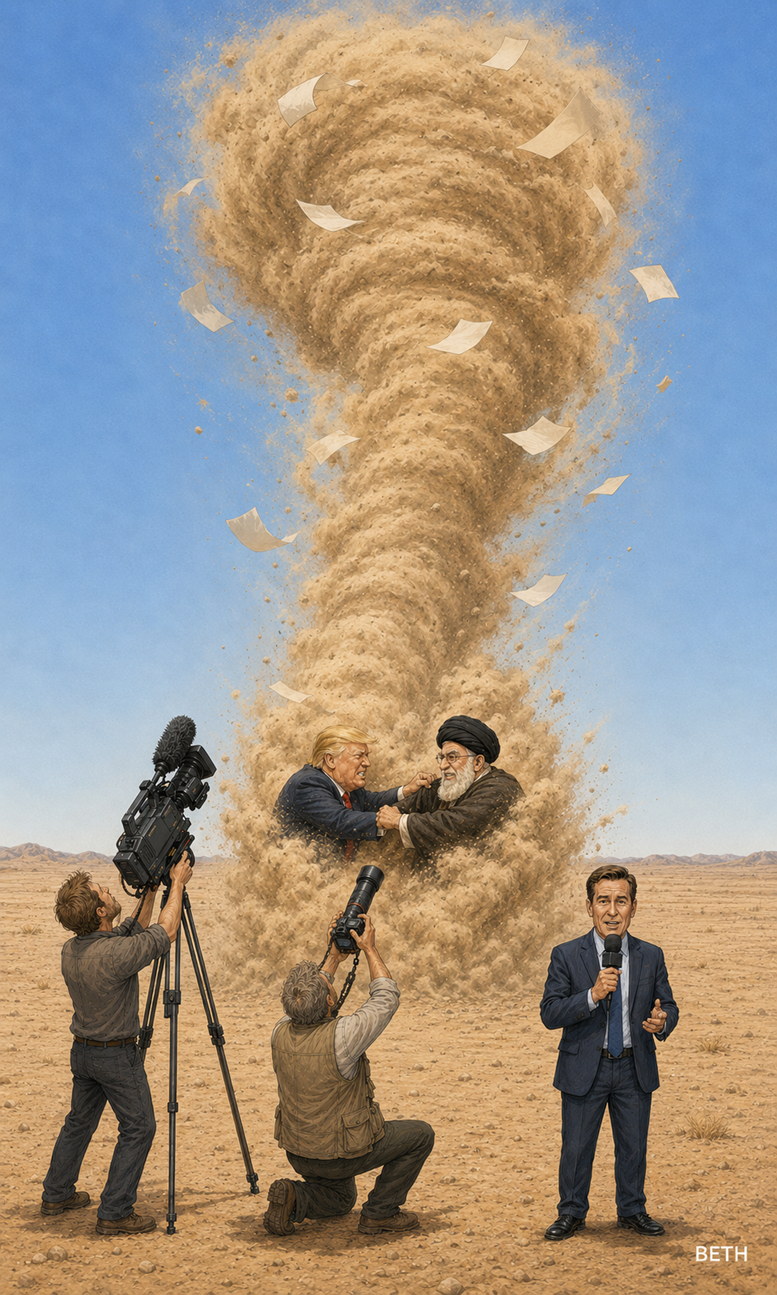
In the heart of the desert, two men are wrestling.
Hands become entangled, feet collide, and dust rises until it obscures the details of the confrontation.
No one sees the first blow, knows who started the fight, or can say with certainty who is advancing and who is retreating.
But the cameras are rolling.
Their lenses are raised toward the top of the whirlwind, following the flying papers and filming the dust as it climbs into the sky.
In the foreground, a reporter holds a microphone and confidently addresses the audience while the battle unfolds behind him.
He is not necessarily lying.
But he cannot see.
And here begins the problem of contemporary media:
When the camera cannot reach the truth, it may turn whatever obscures it into news about it.
The Battle Is Below
In wars and major crises, the truth often lies somewhere the media cannot reach.
It exists inside operations rooms, in secret conversations, among leaders who publicly declare one thing while privately negotiating another, and within military and economic calculations whose details are never published.
What reaches the press is usually whatever flies out of the battle:
A clipped statement.
A satellite image.
A stationary vessel.
The sound of an explosion.
A message carried by an intermediary.
A leak from an unnamed source.
Or a social media post written by a president in a moment of anger.
Each of these signals may be accurate within its limits, but none represents the whole truth.
The problem does not begin when a media outlet publishes incomplete information; that is part of the nature of breaking-news coverage. It begins when the small fragment is presented as the entire scene.
The Dust Is Not the Event
The dust may reveal that a battle is taking place, but it does not necessarily reveal what is happening inside it.
Nevertheless, the effect of an event quickly becomes the event itself in media coverage.
Oil prices rise, and Iran is said to have won.
Shipping traffic declines, and the United States is said to have lost control.
One tanker crosses, and the strait is declared open.
The strikes stop for one night, and peace is said to be approaching.
Trump issues a threat, and war is said to be returning.
An Iranian official refuses to describe exchanged messages as negotiations, and diplomacy is declared over.
Yet each of these conclusions may be based on a single sheet of paper caught by the camera as it spins through the air.
A sign may point to a direction, but it does not always reveal the entire course.
Every Lens Sees Different Dust
In the caricature, there are two cameras, each directed at a different part of the whirlwind.
This is also the condition of the global media.
The American press sees sanctions, the blockade, and the economy’s ability to force Iran into submission.
The Iranian press sees resilience, sovereignty, and the frustration of American power.
The Israeli press sees the erosion of Tehran’s capabilities and an opportunity to weaken its proxies.
The Chinese and Indian press sees energy, supply chains, and the cost of prolonged disruption.
The regional press sees targeted vessels, threatened installations, and danger approaching its shores.
This does not necessarily mean that one side is lying while another is telling the truth.
They may all be filming the same whirlwind from different angles. Each lens captures only what its position allows, then builds from it a narrative that appears complete to its audience.
At that point, bias becomes more complicated than deliberate deception.
Sometimes it is positional bias: believing that what you can see from where you stand is everything that exists in the scene.
The Reporter with His Back to the Event
The most satirical element in the image is not the dust or the two wrestlers, but the reporter who stands with his back to the battle and speaks confidently to the audience.
He symbolizes the moment when media performance became detached from knowledge.
The reporter is not always expected to know what happened. He is expected to be ready to appear immediately, fill airtime, answer questions before the information is complete, and give the audience the feeling that someone understands the chaos.
Competition for speed drives media outlets to summon analysts before the news is complete, announce scenarios before the facts have been verified, and search for a final outcome in an event that is still unfolding.
The reporter therefore ceases to be a bearer of certainty and becomes a manager of emptiness.
He speaks because the screen cannot tolerate silence, not because the truth has become clear.
In breaking news, the most visible speaker may be the person furthest from the event.
From News to Narrative
A short piece of information does not remain a piece of information for long.
It enters the newsroom and receives a headline. Background is added, an analyst is invited, and the information is connected to a previous event. Extracts are then published on social platforms, and within minutes it becomes a narrative with a beginning, an actor, a victim, and an expected outcome.
The dust becomes a story.
The problem is that once the narrative has been completed in the media, it begins resisting any new truth that contradicts it.
If a media outlet declares that one side is collapsing, it will interpret every subsequent move as another sign of collapse.
If it decides that one side has won, it will interpret that side’s concessions as intelligent tactics.
When the narrative takes shape first, facts no longer guide the coverage. They become material selectively used to confirm the narrative.
This is more dangerous than a passing error. An error can be corrected, but a coherent narrative defends itself.
The Media Does More Than Film the Dust
Media outlets do not always remain outside the whirlwind. At times, they help expand it.
A provocative headline raises tensions.
An incomplete report moves markets.
An anonymous leak prompts one side to respond.
An old image published as new generates a wave of anger.
A probability-based analysis becomes a confirmed fact through repetition.
With every republication, the dust thickens until it becomes difficult to distinguish between what the battle produced and what the coverage created.
In the age of digital platforms, information does not spread because it is the most accurate, but because it is the fastest, most provocative, and most capable of stirring emotion.
The algorithm does not ask: Is this true?
It asks: Will the user stop to look at it?
Two parties therefore cooperate, without any direct agreement, in concealing the scene:
The maker of the event, who releases a narrative, and the platform, which rewards the most incendiary version of it.
The Blank Papers
The papers swirling through the whirlwind in the caricature are not completed newspapers. They are blank pages.
That detail carries a deeper meaning.
Sometimes media outlets arrive at the event carrying the template before they carry the information.
They want a headline about victory or defeat.
They look for a hero and an adversary.
They expect a collapse or a settlement.
They then collect from the dust whatever fills the space they prepared in advance.
The narrative is not always written after the event is observed. It may already be ready, lacking only a statement, image, or figure to give it the appearance of truth.
The question then ceases to be: What happened?
It becomes: Which part of what happened fits the story we want to publish?
Between Speed and Accuracy
The media cannot be expected to wait until a war ends before reporting it, nor to stop analysing events whenever a piece of information is missing.
Professional responsibility, however, requires a clear distinction among four levels:
- What we know.
- What one of the parties claims.
- What the available evidence indicates.
- What we expect.
When these levels become confused, a possibility turns into news, an official narrative becomes fact, and an opinion becomes information.
Good journalism does not claim to see inside the whirlwind while standing outside it.
It tells the reader clearly: this is a partial picture, this source has an interest, this figure has not been independently verified, and this conclusion may change.
Acknowledging incomplete knowledge does not weaken journalism; it protects its credibility.
Sometimes the most professional sentence is: We do not know yet.
The Audience Shares in the Dust
The media is not solely responsible for this industry.
The audience itself wants a quick and decisive answer.
Who won?
When will the war end?
Who controls the strait?
Have the negotiations failed?
Has the deal been reached?
Audiences do not like answers beginning with “perhaps,” “so far,” or “according to the information available.”
This demand for certainty pushes some media outlets to offer answers larger than the evidence, because professional caution appears weak beside false confidence.
Every audience finds the outlet that gives it the narrative it wants to hear. Following the news then becomes an exercise in confirming a position rather than discovering reality.
The recipient no longer searches for a window overlooking the battle, but for a mirror reflecting their own conviction.
How Do We See Inside the Whirlwind?
No single lens can reveal the complete truth, but we can move closer to it by combining perspectives rather than treating one as sacred.
We read what a party says, then examine what it did rather than what it declared.
We monitor shipping movements without equating them with political control.
We follow energy prices without treating every increase as an Iranian victory or every decline as an American success.
We compare opposing narratives and search for the point on which they agree despite their hostility.
And we always ask:
Who possesses this information?
Why was it released now?
What was left unsaid?
Does it describe the event itself, or merely one of its effects?
And who benefits from turning this possibility into certainty?
These questions will not make the whirlwind disappear, but they reduce its ability to deceive the eye.
The Function of Media
The function of media is not to reach the dust before everyone else, but to help the audience see beyond it.
Its task is not to fill the void with words, but to identify where the void lies within the picture.
Its distinction is not measured by the number of stories it publishes, but by its ability to separate the event from its effects, truth from the narratives of the parties, and what appeared from what was inferred.
The news tells us that the dust has risen.
Real journalism asks:
Who raised it?
What does it conceal?
And why are the cameras directed toward its summit instead of searching at its base?
Another Perspective
The media professionals in the caricature do not stand far from the battle because they are cowards, but because distance gives them a safe and clear angle from which to film.
Yet safety itself may become a veil.
The further the lens moves from danger, the wider the scene becomes, but the more it loses the details that determine its meaning. The closer it moves to the wrestlers, the more it sees, but the more it becomes part of the dust.
This is the dilemma the camera alone cannot resolve:
To be close enough to know, and far enough away to understand.
In the image, the photographers look upward toward the light papers carried by the wind, while the wrestlers’ feet remain below, inside the origin of the confrontation.
Perhaps this is the condition of much news coverage:
It captures what rises because it is visible, and loses what remains below because it is heavy with truth.
Conclusion
Not every news report is false, but many are incomplete.
Not every narrative is manufactured, but some are built from the effects of an event rather than from within it.
In an age of speed, leaks, and algorithms, the media may appear able to see everything, while at times seeing nothing more than the dust that passes before its lens.
The reader should therefore not ask only: What did the media say?
They should also ask:
Where was the camera?
Which part of the scene was it pointed toward?
And what was happening outside its frame?
The battle may create the dust, but the dust does not tell the truth of the battle.