



Crown Prince Calls Zelenskyy
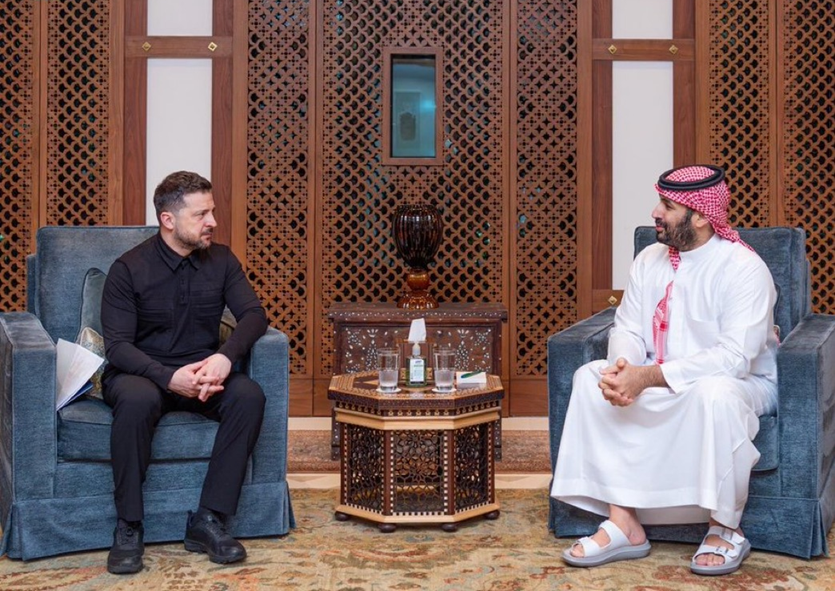
Ukrainian president congratulates him on the Mecca Agreement as the two leaders discuss international developments and expanding defense and food-security cooperation
Jeddah | BETH
His Royal Highness Prince Mohammed bin Salman bin Abdulaziz Al Saud, Crown Prince and Prime Minister, held a telephone call with Ukrainian President Volodymyr Zelenskyy.
During the call, the Ukrainian president congratulated the Crown Prince on the Mecca Joint Defense Agreement, expressing hope that it would contribute to achieving security and stability in the region.
The two leaders also reviewed regional and international developments and discussed areas of mutual cooperation and ways to further develop them.
International Recognition
Zelenskyy’s congratulations carry significance beyond protocol, as they come from the president of a country engaged in a prolonged war and whose political and military experience has placed defense guarantees and the continuity of allied commitments at its core.
They also add a new international position to the reactions surrounding the Mecca Joint Defense Agreement between Saudi Arabia, Türkiye, and Pakistan, which stipulates that any armed attack against one of the three countries will be regarded as an attack against the other two.
Since its signing, the agreement has moved beyond its trilateral framework into broader international circles of attention, amid assessments of its potential role in building a regional security structure that relies more heavily on the capabilities of regional states and is less vulnerable to shifting priorities among external powers.
The Ukrainian president’s congratulations do not necessarily mean that Kyiv has adopted a position on every aspect of the agreement. They do, however, give it an additional presence in communications among world leaders and confirm that its political influence began before the completion of its implementation mechanisms.
Defense and Drones
The Saudi announcement did not provide details about the areas discussed by the two leaders. Zelenskyy, however, said the call addressed defense cooperation, the possible development of an agreement related to drones, and initiatives in food security.
Cooperation in drone technologies opens an important field between the two countries. Ukraine has gained extensive battlefield experience in developing, deploying, and intercepting these systems during a war in which drones have become a principal element of reconnaissance, attack, and infrastructure protection.
The Kingdom, meanwhile, is working to localize its defense industries and develop its capabilities in surveillance systems, air defense, and electronic warfare, as part of its objective to increase the localization of military expenditure and build a domestic industrial and technological base.
Potential cooperation need not be limited to the procurement of systems. It could extend to technology transfer, joint manufacturing, training, and the development of methods for detecting and intercepting drones, particularly as their use expands in attacks on cities, airports, and energy facilities.
Food Security
Food security represents the second area highlighted by the Ukrainian president.
Ukraine is one of the world’s leading producers and exporters of grain and vegetable oils, but it continues to face disruptions at its ports and along shipping routes because of the war. The Kingdom, meanwhile, places considerable importance on diversifying supply sources, maintaining secure reserves, and investing in production, transportation, and storage chains.
Cooperation between the two countries could combine Ukraine’s agricultural capabilities with Saudi Arabia’s investment and logistical capacity, supporting the stability of supplies and reducing their vulnerability to wars and port disruptions.
This field is becoming increasingly important amid simultaneous attacks on energy facilities and ports in Russia and Ukraine, disruption in Hormuz and the Red Sea, and growing concerns that the cost of wars will be reflected in food, transportation, and insurance prices.
An Advancing Relationship
The call forms part of a growing Saudi-Ukrainian relationship that has included direct meetings between the Crown Prince and Zelenskyy, as well as political, humanitarian, economic, and defense cooperation.
The Kingdom has also played a role in mediation and prisoner-exchange efforts and hosted meetings related to the search for a settlement to the war, while maintaining open channels of communication with both Moscow and Kyiv.
This balance gives Riyadh the ability to discuss humanitarian and political issues with both sides without limiting its relationship with Ukraine to the war or tying its relationship with Russia to a one-sided position.
At the same time, Saudi-Ukrainian relations are moving toward practical areas that include defense, technology, and food security, gradually taking the relationship from political coordination to the development of long-term mutual interests.
Timing of the Call
The call came at a time when three transformations are converging: the continuation of the Russia-Ukraine war, escalating tensions in the Middle East, and the emergence of new defense arrangements led by regional states.
From this perspective, Zelenskyy’s congratulations on the Mecca Agreement cannot be separated from his experience with alliances and security guarantees. Ukraine knows that the value of any defense commitment is determined not only by the strength of its wording, but also by the clarity of the parties’ responsibilities and their ability to act when an attack occurs.
The call made by the Crown Prince also reflects the Kingdom’s continued engagement with the leaders of influential countries, alongside the development of its capabilities and regional alliances, without closing the door to cooperation with powers outside the agreement.
BETH Commentary
Zelenskyy’s congratulations on the Mecca Agreement do not appear to be a passing diplomatic courtesy. They come from the president of a country that has experienced the difference between political support and a defense guarantee, and between declared promises and what actually reaches the battlefield.
The agreement’s true value, however, will not be determined by the extent of international approval it receives, but by the consultation, early-warning, intelligence-sharing, and defense-industrial cooperation mechanisms it ultimately produces.
The call also demonstrates that the Kingdom is not building a closed defense agreement. At the same time, it is expanding its network of relations with countries whose experience and expertise could prove valuable.
An alliance protects interests when danger strikes, while intelligent diplomacy works to expand those interests and reduce the likelihood of danger occurring.