


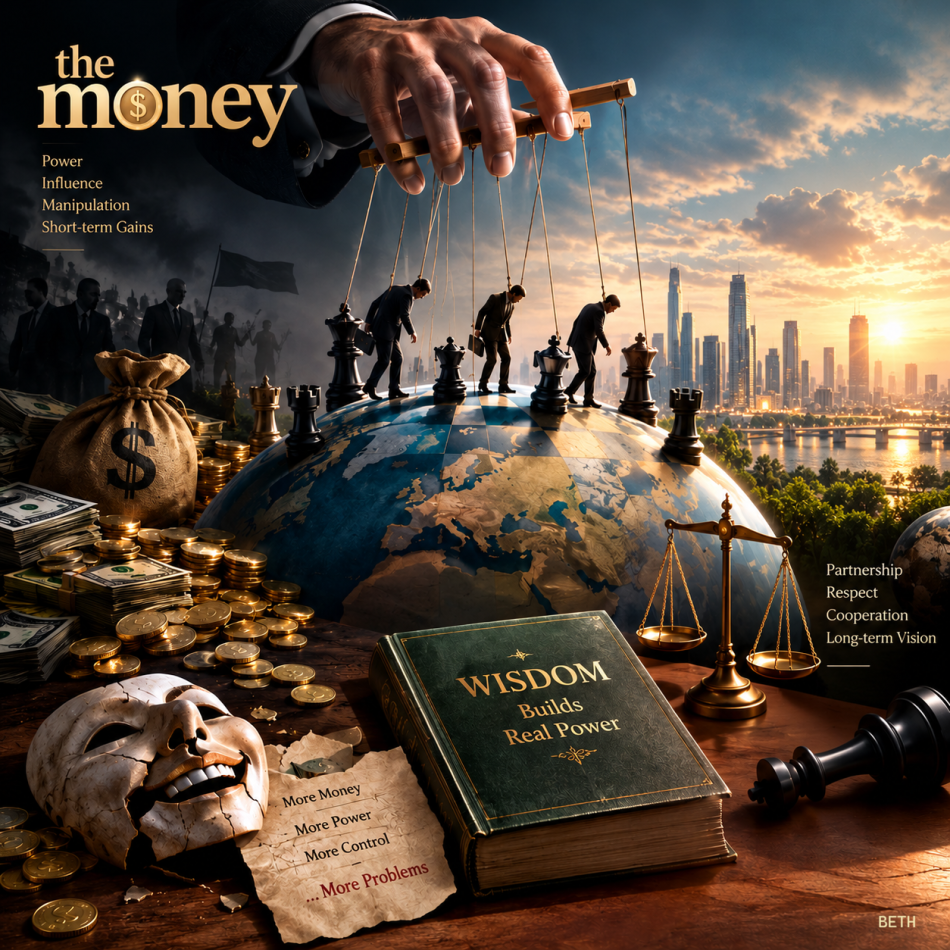
Pain Is Not Our Identity

How BETH approaches wars, achievements, and news—and why an abundance of words is not enough to make something worth publishing
By Abdullah Al-Omirah
The Essence of the Idea
BETH does not measure the value of its work by the number of stories it publishes, but by what it adds to the reader’s understanding. It does not make pain its identity when covering wars, nor does it reduce achievements to expressions of praise. Instead, it searches for information, numbers, and impact, moving from reporting an event to explaining its meaning and anticipating what comes next. It also distinguishes between a news agency and a newspaper, and between journalism and media, while recognizing creativity as the energy that makes institutions different. Supporting creative people is therefore not a courtesy, but an investment in an institution’s future and its capacity to innovate.
A professional news agency cannot distance itself from wars and crises, because covering them is part of its responsibility to the truth.
The difference, however, lies not merely in approaching the event, but in how we approach it.
Do we intensify people’s fear, or help them understand?
Do we report only the number of victims, or ask how further casualties can be prevented?
Do we leave the reader standing before the ruins, or search within them for a path toward a solution?
This is what distinguishes BETH: it does not make pain its identity, even when pain is its subject.
We cover war, but we stand on the side of peace.
We analyze danger, but we search for a path to safety.
We expose dark minds, but we do not allow them to extinguish the light of the text.
And we observe the world as it is, while believing that it can become better.
We Are Not Conveyors of Tragedy
Professional media practice does not mean placing the reader before a new pile of rubble every morning and then leaving them burdened by fear and helplessness.
Nor does it mean beautifying war, diminishing its horror, or searching within tragedy for manufactured scenes that give the audience a false sense of reassurance.
Our task is to convey the complete truth and then help the reader understand it.
People do not need only to know that a missile has fallen. They need to know why it fell, what preceded it, what may follow, and who can stop the next missile.
The number of victims, despite its human and documentary importance, is not enough if we do not ask about the decision that led to those deaths, the rhetoric that prepared the way, the interests that prolonged the war, and the door that could lead to peace.
This is why BETH does not treat the news story as the end of the work, but as its beginning.
The news tells us what happened.
True journalism asks: Why did it happen? What changed afterward? Who will be affected? And where might it lead?
Not Every Collection of Words Is News
Media organizations receive numerous submissions every day written in the form of news reports, yet carrying little beyond the external appearance of news.
Long sentences, repeated descriptions, mutual praise, and claims of excellence, leadership, and success—without a single number to prove the achievement, a new fact to explain its impact, or a measurable result.
Someone may send material of this kind and then say: “Please publish it in BETH newspaper.”
This reveals a problem deeper than the weakness of the submitted text: a lack of understanding of the difference between an agency and a newspaper, between news and advertising, and between an achievement and a description of an achievement.
Not every meeting is news.
Not every visit is an achievement.
Signing a memorandum is not sufficient unless we know what it will produce, when implementation will begin, who will benefit, and what value it will add.
Describing a project as “exceptional” does not make it exceptional, and calling an initiative “pioneering” does not prove that it leads.
News requires a new fact.
An achievement requires evidence.
Impact requires a number, a result, or a transformation whose meaning the reader can understand and examine.
A text that contains no information, figures, or impact remains a description rather than news, regardless of how many words it contains. It may even become institutional chatter that adds nothing to public knowledge.
What Is a News Agency?
The Arab world has long been accustomed to the model of official news agencies that report state news, decisions, statements, and activities, after which newspapers, television channels, and websites republish their output.
Over time, this created a mental image of a news agency as merely a source of official news and a newspaper as the place where that news appears.
A modern private news agency, however, is much more than that.
At its core, a newspaper is a platform that reaches its audience through its pages, website, or applications.
An agency, by contrast, is a factory of content and information. It monitors events and trends, measures their impact and influence, verifies the underlying facts, constructs news stories, and produces reports, analysis, research, and visual content. It then makes this output available to the public, institutions, platforms, and clients.
This is how BETH operates within an integrated media cycle that continues to expand day after day.
An agency may publish its material on its own website, but having a website does not turn it into a newspaper—just as a factory does not cease to be a factory because it owns an outlet where its products are displayed.
The difference lies not in where the material appears, but in the nature of the work that precedes its appearance.
A newspaper publishes.
An agency monitors, gathers, verifies, interprets, produces, and distributes—and it may publish as well.
It is natural for newspapers and television stations to rely on news agencies and correspondents and to attribute reports to their sources. Attribution is a matter of professional integrity, not a deficiency.
The deficiency begins when a media outlet limits its role to verbatim transmission and turns the phrase “according to the agency” into a substitute for research, verification, and contextualization.
Professionalism does not mean merely rebroadcasting a news item. It means completing it with background that explains it, connections that bring its elements together, analysis that examines its impact, and value that takes the audience beyond what appeared in the original source.
Because some media organizations have long grown accustomed to receiving ready-made news from agencies focused primarily on monitoring and rapid transmission, they have found it easier to pass stories along without connecting them to their broader context.
BETH, by contrast, builds news and analysis within an integrated process so that an event does not reach the reader separated from its meaning.
Journalism and Media
The terms “journalism” and “media” are often used as though they mean the same thing, but the distinction between them is important.
Media is the broader framework. It includes corporate communication, public relations, advertising, digital platforms, audiovisual content, campaigns, and influencing audiences.
Journalism, meanwhile, is the profession that searches for facts of public significance, verifies information, asks questions, compares evidence, places events in context, and presents them to the public with professional independence.
A media campaign may succeed because it improves an institution’s image.
A piece of journalism, however, does not succeed merely because it improves that image. It succeeds because it gives the reader reliable information and a deeper understanding.
Media sometimes asks: How do we reach the audience?
Journalism asks first: What deserves to be known by the audience? Is what we are saying accurate, complete, and valuable?
At BETH, we work within both fields, but we do not confuse them.
We provide strategic media services, monitoring, analysis, impact measurement, content production, and design. At the same time, we practice journalism grounded in information, verification, context, and value.
When we produce material for a client, we do not serve that client by turning descriptions into a news story. We help the client discover the genuine story within the achievement and present it in language that society can understand and trust.
What Deserves to Be Published?
When material reaches us, our first question is not about the name of the organization that sent it, but about the value it carries.
What is new?
What is the number?
What has actually been achieved?
Who benefits?
What is the difference between the situation before the project and after it?
Has implementation begun, or are we still dealing with an announcement of intentions?
What is the size of the investment?
How many jobs have been created?
What is the production capacity?
What is the geographic and time frame?
And what effect will the project have on the economy, society, or quality of life?
These questions do not complicate publication or diminish the achievement. They protect it from disappearing within generalized language that resembles hundreds of other statements.
Sometimes an institution has achieved something significant but presents it in a diminished form because it focuses on the names of those who attended, the order of their remarks, and the exchange of thanks—while forgetting to tell the public what actually changed.
This is where the journalist’s role begins: not to repeat the statement, but to extract its value.
From News to Impact
BETH does not select its stories according to conventional formulas, nor does it regard a high volume of publication as evidence of strength.
We look for material containing information, a number, a transformation, or an impact worth bringing to public attention.
We distinguish ourselves through analytical news, analytical reports, and analytical articles because, in an age of rapidly flowing information, an event no longer needs someone merely to repeat that it happened.
The public sees the news within seconds on a phone, but still needs someone to explain what it means.
We therefore examine a story from multiple angles:
What does it say?
What does it leave unsaid?
What appears in its opening?
What is concealed in its final line?
How will markets interpret it?
How will capitals understand it?
And what effect will it have on people?
We do not add analysis to make the text longer. We add it to reveal the invisible part of the event.
The Kingdom at the Center
Our coverage is anchored in the major achievements taking place across the Kingdom in politics, economics, development, science, technology, culture, and quality of life.
Celebrating a Saudi achievement, however, does not mean limiting ourselves to praising it.
An achievement serves itself when we explain it through figures, place it in its global context, compare what has been accomplished with what existed before, and show its effect on citizens, the economy, and the country’s international standing.
When the Kingdom builds a massive project, it is not enough to say that it is massive.
We must explain its scale, stage of development, timeline, expected contribution, connection to Saudi Vision 2030, and position compared with major international projects.
This is not the language of criticism directed at an achievement, but the language of respect for it. Major projects deserve journalism equal to their scale.
It is also our responsibility to help some clients move beyond a narrow understanding of media. Value does not lie in publishing a photograph of an official and reporting a meeting, but in building a credible narrative about work, results, and impact.
What People Do Not See
One of the most difficult challenges BETH faces is that a substantial part of what it creates is not directly visible to the public.
The reader sees the news story but not the hours of research, verification, and comparison that preceded it.
The reader sees the report but not the dozens of sources examined to eliminate repetition, weakness, and contradiction.
The reader sees the image but not the idea upon which it was built, nor the attempts rejected before arriving at a visual that does not merely repeat the text, but adds another perspective to it.
The reader sees a headline consisting of only a few words but does not know how many alternatives were tested before the meaning settled into its shortest form.
It is easy to ask artificial intelligence for an answer or an idea. The real difficulty lies in knowing what you want from it. A tool generates what it is asked to generate; value is created by a mind that knows the question, understands the objective, and guides the answer toward a complete subject.
When someone wishes to learn more about BETH, we therefore send them part of our strategy, our services profile, and the news we make freely available.
Documents alone, however, cannot always explain what we create. The true difference lies in the thinking that takes place before writing, the question that precedes the answer, and the selection of what we choose not to publish as much as what we do publish.
Free Does Not Mean Valueless
BETH makes part of its news output freely available to the public because public knowledge is part of journalism’s function and responsibility.
Free access to a news story, however, does not mean producing it required no time, knowledge, or expertise.
Professional work stands behind freely available material, while the agency offers institutions deeper services tailored to their needs. These include studies and research, strategic media, monitoring, trend analysis, measurement of impact and influence, content production, and media art and design.
We do not sell a number of words.
We provide understanding, build value, and help an institution see its achievement as society, the market, and the world will see it.
We Do Not Want a Longer Story
When we return material to its sender and request figures or details, we are not asking for a longer text.
We are asking for a stronger story.
When we ask about results, we are not questioning the achievement; we are searching for the evidence that gives it its proper value.
When we reject material lacking substance, we protect the agency and the reader. We also protect the organization itself from appearing through weak discourse unworthy of what it has achieved.
An institution with a genuine achievement does not need exaggeration.
It needs a journalist who knows where the story lies within it.
What Do We Create?
We do not create news alone.
We create knowledge that supports decision-making.
We create narratives connecting achievements to their impact.
We create images that do not repeat words but expand their meaning.
We create analysis that descends to the reader’s level—not to remain there, but to elevate the reader toward a deeper understanding.
We try to see an event before it becomes a trend, a trend before it becomes a crisis, and an achievement before it disappears inside a conventional statement.
This is the BETH we want people to know.
An agency that does not measure its value by the volume of what it publishes, but by the value of what it adds.
An agency that does not make pain its identity, even when covering war.
An agency that does not turn hope into a decorative closing sentence, but makes it a way of looking at the world.
We tell people what happened.
We explain why it happened.
And we explore with them what may happen next.
We tell the world what is happening—and remind it of what deserves to happen.
The Energy No One Sees
In the end, we must recognize that neither a human being nor a machine can function without energy.
Every form of energy has limits. If we want it to endure, we must nourish it with what renews it, preserves its brightness, and expands its capacity to give.
The energy of institutions is not money and technology alone. It is also passion, ideas, imagination, and the person who sees what others do not and then transforms that vision into an achievement.
Some people try to extinguish this energy for reasons that are well known. Others fail to notice whether it is still burning brightly or has begun to fade.
These are the prisoners of convention. They neither care about creativity and creative people, nor perhaps understand that what they regard as an unnecessary detail is precisely what separates an institution that repeats what others do from one that invents what others will repeat tomorrow.
Protecting a creative person is therefore not a courtesy, and nurturing their energy is not a luxury. It is an investment in the future of the institution itself.
Institutions do not lose their distinction when they publish fewer stories, but when the energy is extinguished in those who create their difference.