



World Science: The Latest Developments in Science and Knowledge
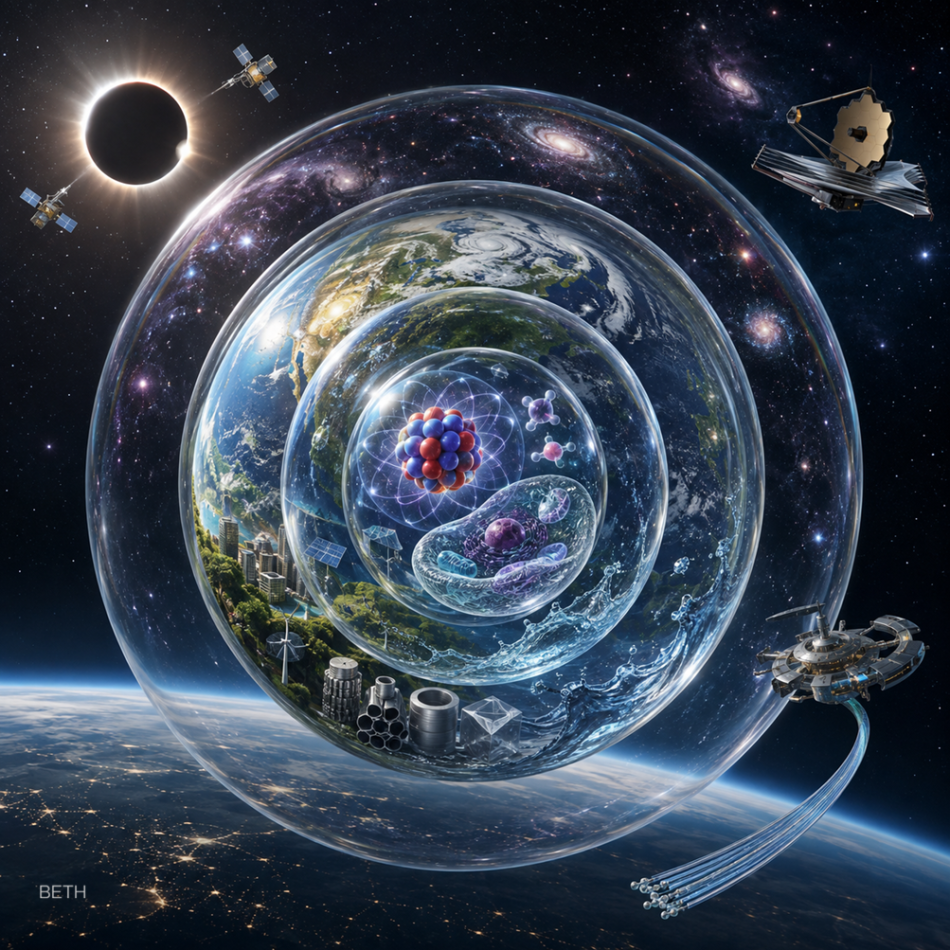
From medicine made by the atom to eclipses created by humans and factories moved into space, science is reaching into the smallest components of matter to redraw the largest features of the future
Monitoring and Analysis | Strategic Media Department at BETH Agency
Supervised by: Abdullah Al-Omirah
Science no longer advances along separate paths.
The atom that produces an isotope to treat cancer is the same atom involved in building a quantum computer. A membrane no thicker than a single atomic layer may separate the fuel of the future, while beams of light are transformed into fingerprints through which devices can recognize their own identities.
In space, humans no longer wait for an eclipse; they create one using two satellites. Orbital missions are no longer devoted solely to exploration, as scientists have begun asking: What materials could be manufactured beyond Earth at a level of quality impossible to achieve under the influence of gravity?
These developments may appear unrelated, but they share a single transformation: science is no longer satisfied with understanding nature; it has begun rearranging nature’s conditions to create new possibilities.
Medicine Is Born from the Atom
When nuclear activity is mentioned, people often think of energy, reactors, and weapons. Yet one of the most important fields of nuclear science today is found inside hospitals.
Radioactive isotopes have become an essential part of modern medicine. They are used to image organs, locate tumors, measure heart and brain function, and deliver radiation to cancer cells with greater precision.
Scientists are currently working to improve the efficiency of critical-isotope production by making use of secondary particles generated when protons collide with material targets inside particle accelerators.
Attention usually focuses on the primary interaction between the proton and the target atom. The collision, however, also releases neutrons and high-energy particles that can be used to trigger additional reactions and produce larger quantities of the required isotopes.
The secondary particle therefore ceases to be an excess byproduct of the experiment and becomes a new production opportunity.
This development is particularly important because many medical isotopes are short-lived. They begin to decay from the moment they are produced and cannot be stored for months or easily transported over long distances.
The future of nuclear medicine therefore depends not only on discovering the right isotope, but also on building a production and distribution network capable of delivering it to the patient before it loses its effectiveness.
Why Does This Matter to Saudi Arabia?
This development coincides with the Kingdom’s hosting of the International Nuclear Science Olympiad and its expansion in atomic energy and advanced medicine.
Connecting nuclear research with hospitals and universities could help establish a national capacity for producing medical isotopes, reduce dependence on external supplies, and enable the development of more precise treatments and diagnostic methods.
A research reactor or particle accelerator does not produce energy and knowledge alone. It may also produce a medicinal dose that enters a patient’s body and seeks out a tumor beyond the reach of surgery.
The next question is not whether we should use the atom, but how many lives the atom could save when directed toward medicine.
An Eye on the Unknown
The U.S. space agency is preparing to launch the Nancy Grace Roman Space Telescope on August 30, 2026, as part of a mission designed to survey vast areas of the sky in infrared light.
The telescope will investigate some of the universe’s most profound mysteries: What is dark matter? What is dark energy? And why is the expansion of the universe accelerating?
Roman’s strength lies in its wide field of view. While the Hubble and James Webb space telescopes can look deeply into limited regions, Roman was designed to survey vast areas rapidly and create a broader statistical picture of the universe.
It will be able to observe millions of galaxies, trace how matter has been distributed over time, and search for gravitational effects revealing the presence of matter that cannot be seen directly.
Roman will also search for planets beyond the Solar System using gravitational microlensing, a phenomenon that occurs when an object passes in front of a distant star, bending its light and temporarily increasing its brightness.
The telescope may detect distant planets orbiting far from their stars, and perhaps wandering objects moving through space without belonging to any identifiable star system.
The Great Paradox
Humans know that they can see stars and galaxies, yet they remain unable to explain most of what constitutes the universe.
Ordinary matter—the material from which bodies, planets, and stars are made—accounts for only a limited portion of the universe. Most of it consists of matter and energy whose effects we can observe but whose true nature remains unknown.
Humanity is therefore sending a machine into space to search for something it cannot yet fully describe.
Why Does This Matter to Saudi Arabia?
The mission offers an opportunity to connect Saudi space programs with astronomical data science, rather than limiting them to satellite launches and human spaceflight.
Future observatories will generate enormous volumes of data, making artificial intelligence, supercomputing, and image analysis some of the most important tools for discovering the universe.
A country that does not build a space telescope can still become a partner in the knowledge it produces—if it possesses the scientists, algorithms, and computing infrastructure required.
Roman may look toward the sky, but the true discoveries will occur in the minds capable of interpreting what it sees.
Humans Create an Eclipse
Humans have long waited for eclipses as rare phenomena determined by the movements of the Sun, Moon, and Earth.
Europe’s Proba‑3 mission, however, has changed the equation by using two satellites to create repeated artificial eclipses in space.
The two satellites fly in an extremely precise formation. One blocks sunlight from the observation instrument carried by the other, just as the Moon naturally blocks the Sun’s disc from Earth.
This makes it possible to image the solar corona—the extremely hot outer region surrounding the Sun—without its view being overwhelmed by the intense light from the solar surface.
Since July 2025, the mission has created 57 artificial eclipses and collected more than 250 hours of high-resolution imagery of the corona—equivalent to thousands of natural-eclipse observation campaigns conducted from Earth.
Initial findings indicate that some solar-wind structures in the inner corona may travel three to four times faster than scientists previously estimated.
Why Does Speed Matter?
The solar wind is not merely a distant phenomenon. It carries charged particles that can affect satellites, communications, navigation systems, power grids, and astronauts.
The better scientists understand where it forms, how fast it travels, and in which direction it moves, the more capable they become of forecasting space weather and preparing for solar storms.
This achievement comes ahead of the total solar eclipse expected on August 12, 2026, whose path will cross Greenland, Iceland, Spain, and a small part of Portugal.
The difference is that a natural eclipse lasts only minutes, while an artificial eclipse can be repeated, directed, and transformed into an orbital laboratory.
Why Does This Matter to Saudi Arabia?
As the Kingdom expands its activities in satellites, communications, navigation, and spaceflight, monitoring the Sun will become part of protecting its infrastructure.
Space is not a calm vacuum; its weather can affect technology on Earth.
The mission also offers an important engineering lesson: the achievement was not produced by one enormous satellite, but by two satellites cooperating with such precision that the distance between them became part of a single scientific instrument.
Humanity has moved from observing a phenomenon to recreating its conditions. It no longer waits for an eclipse, but creates one whenever knowledge requires it.
When Pollution Lights Up
PFAS compounds are known as “forever chemicals” because they are highly resistant to degradation and can remain in the environment, water, and living organisms for long periods.
They have been used in numerous industries, from water- and grease-resistant materials to certain coatings, foams, and packaging, before concerns grew over their accumulation and the effects of long-term exposure.
The problem is that detecting them often requires complex laboratory equipment and considerable time, particularly when they are present at low concentrations.
Researchers, however, have developed tiny water-soluble nanoclusters that interact with PFAS molecules and produce a fluorescent change detectable using light.
Instead of collecting a sample and subjecting it to a lengthy series of processing steps, the technology aims to enable rapid, one-step detection, with the possibility of remote monitoring.
What Has Changed?
Invisible pollution derives much of its power from the difficulty of detecting it.
If its presence can be converted into a rapid optical signal, monitoring water, soil, and industrial waste could become easier and less costly.
The technology, however, remains within the research-and-development stage. It does not mean the PFAS problem has been solved; rather, a new tool has emerged for detecting it earlier.
Why Does This Matter to Saudi Arabia?
The Kingdom depends on an extensive system for desalinating, treating, and transporting water. It is also working to expand water reuse and protect the marine environment.
Rapid-sensing technologies for microscopic pollutants could therefore support continuous monitoring of desalination plants, groundwater, industrial zones, and coastal areas.
Future water safety will depend not only on purifying water, but also on detecting what remains invisible within it.
When humans cannot see the poison, science makes the poison reveal itself through light.
An Atom Separates Atoms
Researchers have used extremely thin membranes made from two-dimensional materials to separate hydrogen isotopes.
Isotopes are atoms of the same element. They are chemically similar but differ in the number of neutrons and in their mass.
This similarity makes separating them difficult and expensive. They behave in almost the same chemical manner, while the difference between them lies inside the nucleus.
The new membranes function as extraordinarily precise filters, exploiting small differences in the movement of protons and deuterons through an atomic layer.
The paradox is that the thinner the membrane becomes, the shorter the distance a particle must travel—and the greater the possibility of exploiting subtle quantum differences between isotopes.
Applications Beyond the Laboratory
Isotope separation is used in numerous industries, including nuclear medicine, energy, scientific research, and certain quantum-computing technologies.
Separating hydrogen from deuterium is also particularly important for nuclear-fusion research and the production of advanced forms of fuel.
The path toward industrial application still requires testing the membranes’ ability to operate over extended periods, withstand pressure, and produce large quantities at a viable cost.
The principle, however, opens a new direction. Instead of constructing vast facilities dependent on repeated and costly processes, atomic layers may eventually perform part of the task.
Why Does This Matter to Saudi Arabia?
The technology could intersect with the Kingdom’s work in hydrogen, nuclear energy, advanced materials, and water desalination.
It also demonstrates that future economic value may not come solely from possessing natural resources, but from owning the membrane or material capable of separating, purifying, and transforming them.
Sometimes the world does not need a larger machine, but a barrier too small for the eye to see.
Disorder Within the Quantum World
Some of the most promising quantum computers rely on quantum units made from silicon, an element already familiar to the semiconductor industry.
Silicon gives this approach an important advantage: the expertise and technologies of semiconductor factories can potentially be used to produce large numbers of quantum bits, or qubits.
Scaling up a quantum computer, however, is not simply a matter of increasing the number of qubits. The units must perform consistently, remain controllable, and resist losing their quantum states.
Researchers have now measured industrial-grade qubit wafers and mapped variations in their materials down to the atomic level, revealing hidden disorder that may explain why some units fail or behave differently.
A chip may appear uniform in design, while its internal regions differ in ways that affect quantum behavior.
Why Does the Discovery Matter?
A conventional computer can tolerate a degree of variation and noise. A qubit, however, is extremely sensitive to its environment.
A tiny atomic change, or a defect at the interface between two materials, can disrupt a calculation or cause information to be lost.
Identifying the source of failure is therefore no less important than increasing computing power. Before building a quantum computer with millions of units, scientists must understand why one qubit succeeds while another—manufactured in the same way—fails.
Why Does This Matter to Saudi Arabia?
The Kingdom has begun entering the field of quantum computing, including the launch of the region’s first commercial quantum computer offered as a service.
Owning the hardware, however, is not the end of the journey. The ecosystem requires researchers in materials, algorithms, cooling, error correction, and applications.
Saudi Arabia’s opportunity may lie in moving from purchasing quantum capability to participating in solving its fundamental problems.
In quantum computing, the enemy may not be a lack of power, but a tiny atomic defect concealed inside the chip.
A Fingerprint for Every Machine
Digital identity typically depends on passwords, encryption keys, or electronic certificates.
All these methods, however, rely on information that can be stored and transferred—and may therefore be stolen, copied, or manipulated.
Researchers at King Abdullah University of Science and Technology have developed a system combining photonics and artificial intelligence that enables devices to prove their identities using unique optical fingerprints.
The fingerprint emerges from microscopic physical variations that occur naturally during manufacturing, even among devices built to an identical design.
When light passes through or reflects from a particular component, it produces a distinctive pattern that is extremely difficult to replicate precisely. Artificial intelligence then analyzes the pattern and verifies the device’s identity.
Why Does the World Need This?
As cloud computing, data centers, and the Internet of Things expand, verifying the identity of the user alone will no longer be sufficient. Devices themselves will need to prove that they are genuine and authorized to enter a network.
Physical fingerprints could become an additional line of defense against counterfeit chips, compromised equipment, and the insertion of untrusted devices into digital infrastructure.
The technology, however, must demonstrate that it can maintain its accuracy despite changes in temperature, use, and age, while resisting attempts to imitate its fingerprint.
The Saudi Dimension
This is not simply a global technology with relevance to Saudi Arabia; it is a Saudi-origin innovation capable of serving cybersecurity, cloud computing, and artificial-intelligence centers.
In an economy where data is becoming a strategic asset, the optical fingerprint could evolve into a national identity for machines themselves.
In the future, the network may no longer ask, “What is your password?” Instead, it may look at the machine and say, “Prove that you are you.”
Factories Beyond Earth
Gravity does not affect only the movement of large objects. It also influences how materials freeze, mix, and crystallize.
Scientists are therefore studying the manufacture of ZBLAN optical fibers in the microgravity environment aboard the International Space Station.
These fibers can transmit infrared light and may achieve lower signal loss than some conventional fibers if they can be manufactured at a sufficiently high level of purity.
Producing them on Earth, however, is complicated by unwanted crystallization. Tiny structures can form within the material and reduce the quality of light transmission.
In space, microgravity can alter fluid movement, heat distribution, and the settling of components, potentially helping to produce more uniform fibers.
Will Space Become an Industrial Zone?
The success of an experiment does not yet mean that manufacturing fibers in orbit has become economically viable.
Launching materials into space and returning them to Earth remains expensive, and scientists must demonstrate that the improvement in quality outweighs transportation and operating costs.
Falling launch costs and advances in reusable vehicles and commercial space stations, however, could change the equation.
Space manufacturing may begin with small, high-value products—medicines, crystals, semiconductors, and advanced fibers—before expanding to larger goods.
Why Does This Matter to Saudi Arabia?
If the space economy is part of economic diversification, it should not be confined to satellites, communications services, and tourism.
The deeper opportunity may lie in orbital research, development, and manufacturing, as well as in designing materials that cannot be produced on Earth with the same efficiency.
The Kingdom can build on its strengths in materials, energy, photonics, and university research to develop partnerships exploring what is truly worth manufacturing in orbit.
When a factory leaves Earth, it is not escaping the planet—it is escaping gravity to create a new material.
Medicine Returns to Africa
The registration of a new treatment for African sleeping sickness marked a transformation extending beyond the addition of another medicine to the pharmaceutical list.
Sleeping sickness is a neglected tropical disease affecting poor communities and does not usually receive the level of investment devoted to diseases prevalent in wealthier markets.
African scientists and institutions, however, participated in developing and testing the medicine, determining how it should be used, and delivering it to patients.
This changes the traditional relationship in which the continent served as a location for disease, sample collection, and clinical trials, while knowledge and decisions were produced elsewhere.
Who Chooses the World’s Diseases?
The pharmaceutical industry is not guided by health needs alone. It is also influenced by market size, purchasing power, and expected returns.
A disease affecting millions of poor people can therefore remain outside investment priorities, while companies compete to treat conditions offering larger markets.
The African model delivers an important message: when scientists from the affected region participate in every stage of drug development, priorities become more closely aligned with patients’ actual needs.
This participation also increases trust in the treatment, improves trial design, and helps build independent scientific and healthcare systems.
Why Does This Matter to Saudi Arabia?
The Kingdom has the capacity to become a partner in funding research into neglected diseases, manufacturing medicines and vaccines, and building healthcare partnerships with Africa.
This is not linked solely to Saudi Arabia’s humanitarian role, but also to health security. Diseases do not recognize borders, while air travel, trade, and climate change increase the likelihood of their spread.
Saudi Arabia can also combine financing, laboratories, manufacturing capabilities, and its geographical position linking Asia and Africa.
A country’s independence is incomplete when it merely imports treatments for its diseases; true independence comes when it participates in defining the question, conducting the research and trials, and producing the medicine.
Another Perspective
The Smallest Creates the Largest
These developments reveal a paradox at the heart of modern science: the greater the change humans seek to create, the smaller the things toward which they turn.
They enter the nucleus to create medicine.
They design a membrane one atom thick to separate two isotopes.
They search for a microscopic defect inside a chip to build a supercomputer.
They read a change in light to give a machine an identity.
They then travel millions of kilometers—not to escape Earth, but to observe and understand it, and to manufacture beyond its gravity what cannot be made on its surface.
Knowledge may not be advancing solely because human tools have become more powerful, but because the human perspective has become more humble. We have realized that the things invisible to the eye may exert the greatest influence on our lives.
From the atom to the universe, science does not measure importance by size.
The next transformation may therefore begin with a secondary particle once regarded as excess, a faint flash of light, a membrane that barely exists, or a disease the world has long neglected.
Progress does not always come from discovering something new. Sometimes it comes from recognizing the value of something that has always been before us, but that we never knew how to see.