



Day 148 🇺🇸⚔️🇮🇷: The Truce Collapses
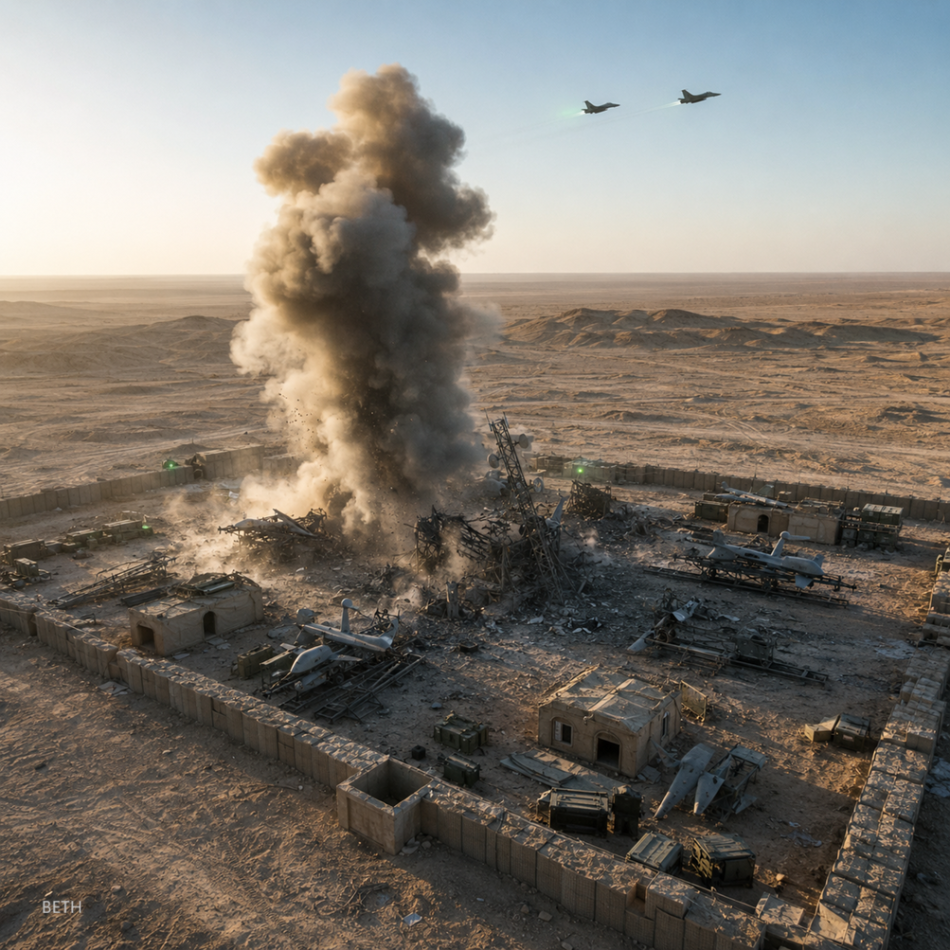
Saudi-American strikes target militias in Iraq, Iran attacks American sites and tankers in Hormuz, while seeking to rebuild its defenses with Chinese missiles
BETH | B
The pause in fire that lasted for several days did not hold.
The Saudi Armed Forces, in coordination with the U.S. Central Command, carried out precise, targeted strikes against positions belonging to Iran-affiliated militias inside Iraq that were proven to be linked to drone attacks on Saudi petroleum facilities. — Report.
The Kingdom confirmed that the strikes were conducted in exercise of its right to self-defense and targeted the sources of aggression following repeated attacks launched from Iraqi territory.
In response, the Islamic Revolutionary Guard Corps announced the launch of ballistic missiles at U.S. military sites in Jordan, while Jordanian forces announced the interception of five missiles.
Thus, within hours, the conflict shifted from a conditional pause to a renewed exchange of strikes, but this time across the fronts of Iran, Iraq, Jordan, and Saudi Arabia.
Hormuz Ignites Again
Tehran rejected the Omani proposal for joint regional management of the Strait of Hormuz and insisted on retaining control over the route used by ships entering the strait and part of the route used by those leaving it.
The Revolutionary Guard also announced that it had attacked three oil tankers and forced them to stop, claiming that they had used a route it described as illegal, while warning against U.S. military intervention in the strait.
The renewed attacks pushed oil prices up by more than three dollars per barrel, after markets had begun pricing in the possibility that the de-escalation would continue.
These moves reveal that the dispute is no longer solely about freedom of passage.
Iran wants any agreement to preserve its direct authority over the strait, while Oman and the Gulf states want a regional mechanism that prevents any single country from controlling the international waterway.
What Came Out of the Netanyahu Meeting?
Trump and Netanyahu described their meeting at the White House as positive and productive, but they did not announce a final agreement or a new joint plan for the war.
Netanyahu entered the meeting demanding that Iran be prevented from using the pause in airstrikes to rebuild its capabilities, while Trump kept the path of negotiations open, confirming that good talks were underway and renewing his threat to target Iranian facilities if an agreement was not reached.
Netanyahu did not publicly obtain a U.S. announcement that the large-scale campaign would resume.
But he left Washington after limited military operations against Iran’s network in Iraq had resumed and the brief period of calm had effectively collapsed.
The most likely conclusion is that Trump did not give Netanyahu an open war, but he also stopped granting Iran an unconditional pause.
Iran Buys Chinese Air Defenses
A Western report revealed that Iran is preparing to receive between 300 and 400 Chinese man-portable air-defense systems of the QW-12 and FN-16 models, in a deal valued at between $60 million and $70 million.
The two systems use infrared guidance and are designed to intercept low-flying aircraft, helicopters, and drones.
The first batch is expected to be transported within weeks along a route beginning in Urumqi in western China and passing through Pakistani territory, while more discreet overland routes are also being considered.
However, the Chinese Foreign Ministry denied the report and described it as baseless, while Pakistan also denied any involvement in transporting the weapons.
Even if the systems arrive, they will not fully rebuild Iran’s air-defense network.
They would provide mobile protection against low-altitude targets, but they cannot, on their own, stop stealth aircraft, long-range missiles, and precision-guided munitions operating from greater altitudes and distances.
They address the lower layer of the gap, not the entirety of U.S.-Israeli air superiority.
Why Did the United States Stop?
Washington does not appear to have been lenient with Iran. Rather, it gave diplomacy a limited trial period while keeping military force ready.
The objective was to determine whether the bombing had pushed Tehran toward accepting a settlement concerning Hormuz, the nuclear program, and the proxies, while easing pressure on forces, munitions, and energy prices.
But Iran used the pause to mobilize militias against Saudi Arabia, reject the Omani proposal, attack ships, and then target U.S. sites.
The test therefore ended quickly.
The U.S. pause was not an acknowledgment of Iran’s strength, but a conditional opportunity that Tehran’s conduct proved it was unable to use.
Is China Testing Its Weapons?
If the deal is implemented, China will gain an important opportunity to assess the performance of its systems against Western drones, aircraft, and weapons in an actual war.
But weapons testing is not necessarily the primary objective.
Beijing’s broader interest is to prevent the collapse of Iran as an energy partner and an influential location between the Gulf and Asia, while forcing the United States to pay a higher price to maintain its air superiority.
China can also achieve this through relatively low-cost defensive systems and through companies and indirect transportation routes, while retaining the ability to deny political responsibility.
It would thereby secure three potential gains:
Protecting a partner from collapse.
Testing its technologies in a combat environment.
And tying down the United States without entering the war directly.
Forecasts
The next phase faces three possible paths:
Continued Limited Strikes
Saudi Arabia and the United States continue targeting militia positions and drone launch sites, while temporarily keeping airstrikes inside Iran suspended.
This is the most likely path if direct attacks decrease and negotiations resume.
Resumption of Strikes Inside Iran
The Revolutionary Guard continues targeting ships, bases, and countries in the region, prompting Washington to resume strikes against air defenses, missiles, and command centers inside Iranian territory.
Expansion of the War in Hormuz and Iraq
Omani mediation fails, Iran insists on controlling the strait, and the Iraqi militias continue their attacks, turning the maritime and Iraqi fronts into a single theater of war.
What Comes Next?
On Day 148, the question is no longer whether the truce will continue.
It has effectively ended.
The question now is whether the strikes will remain confined to militias and specific sites, or whether Iran will continue escalating until it brings U.S. aircraft back into its airspace.
The Chinese deal, if implemented, reveals that Tehran is not preparing only for an imminent agreement.
It is also preparing for the next round.
But purchasing hundreds of man-portable missiles does not change the truth exposed by the war:
Iran can add a new weapon to its defenses, but it has not yet found a solution to the superiority that reaches its targets, nor to the policy that revives the war whenever diplomacy comes close to stopping it.