



Localizing Desalination Technologies in the Kingdom
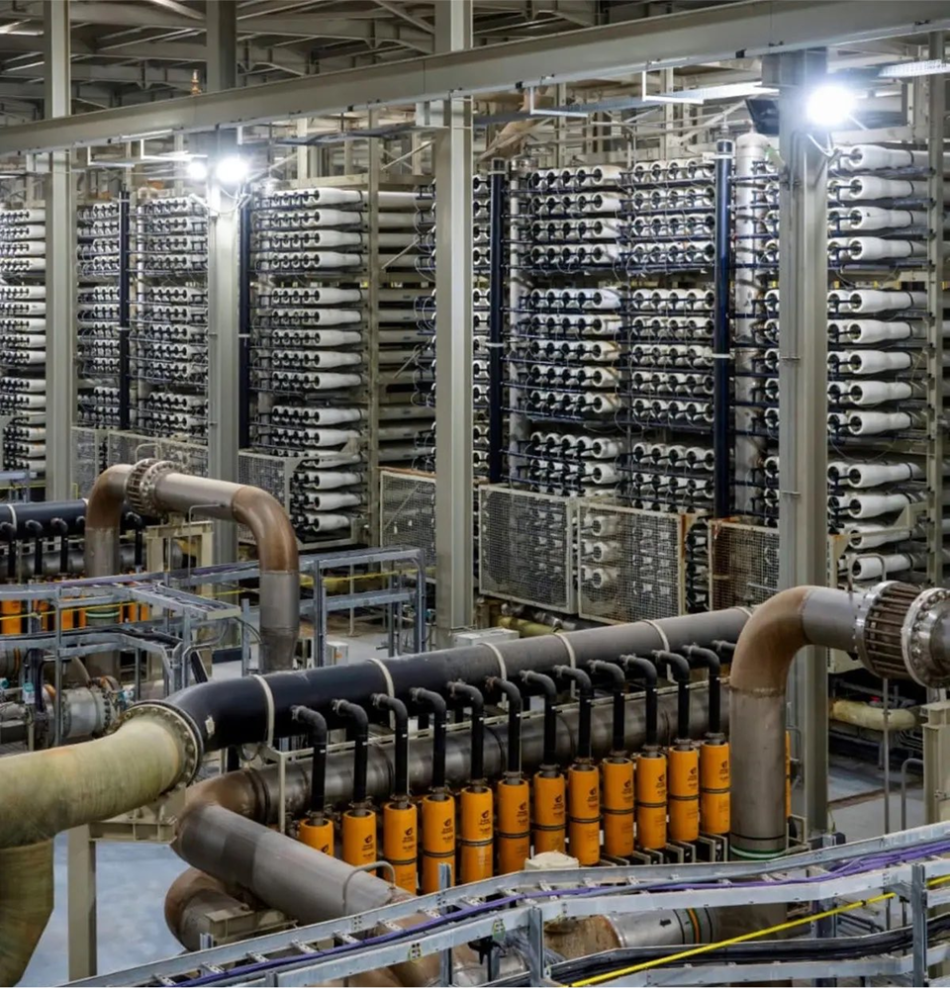
Saudi Arabia is establishing the first factory for energy recovery devices outside the United States, with an annual capacity of 2,000 units and production beginning in 2027
Riyadh | BETH
The Saudi Water Authority announced the localization of energy recovery device manufacturing for use in seawater reverse-osmosis desalination plants, through the establishment by Energy Recovery of its first factory for these devices outside the United States.
The factory is scheduled to begin production during the first quarter of 2027, with an annual capacity of 2,000 devices, compared with estimated local demand of approximately 1,200 devices, allowing part of its production to be allocated for export to regional and global markets.
These devices represent a strategic component in reverse-osmosis plants. They recover the remaining pressure in the brine discharged from the membranes and transfer it to the incoming seawater, instead of allowing it to be lost and requiring the pumps to bear the full pressure-raising process.
Less Energy for Water
Energy is one of the largest components in the cost of producing desalinated water. Improving energy recovery efficiency therefore directly affects water prices, electricity consumption, and emissions.
Energy Recovery says its pressure exchanger devices can reduce energy consumption in seawater reverse-osmosis desalination plants by up to 60%, with pressure-transfer efficiency reaching 98%. Energy Recovery
The company’s installed and contracted devices in the Kingdom support the production of more than 11 million cubic meters of desalinated water per day, making the Saudi market one of the world’s largest markets for this technology.
From Importing to Exporting
The importance of the factory is not limited to meeting local demand, but extends to transferring a chain of industrial knowledge that includes precision manufacturing, testing, maintenance, spare parts, and the training of Saudi professionals.
Its production capacity, which exceeds the needs of the domestic market, also gives the factory an opportunity to serve desalination projects in the Gulf, the Middle East, Africa, and Asia, where demand for water is increasing alongside population growth, drought, and industrial expansion.
BETH Commentary | Owning the Technology
The factory represents a transition from purchasing an energy-saving device to possessing the ability to manufacture and export it.
This is the most important value. The Kingdom is not localizing a marginal product, but one of the components that controls the efficiency of plants upon which its water security depends.
The project’s success will be measured by the proportion of locally manufactured components, the technical jobs it creates, and its ability to develop the device within the Kingdom, not merely by the number of units assembled.
A country that leads the desalination industry should not merely be the largest user of its technologies, but one of their most important producers and developers in the world.