



Thwarting Drones from Iraq Targeting Saudi Oil
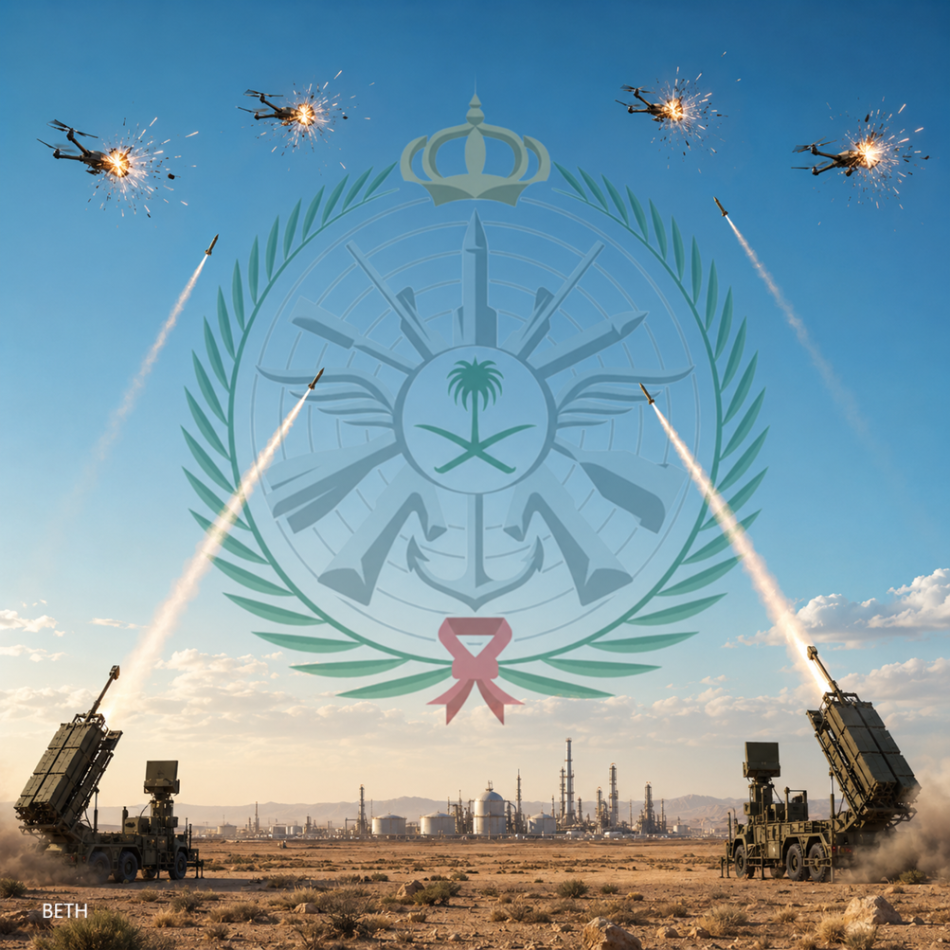
Saudi defenses destroy the aircraft before they reach facilities in Riyadh and the Eastern Province, while the Foreign Ministry affirms the Kingdom’s right to deter aggressors and respond to the sources of aggression
Riyadh | BETH
The Saudi Ministry of Defense announced the interception and destruction of a number of drones that attempted to target oil facilities in the Riyadh and Eastern regions during the past hours.
The ministry’s official spokesperson, Major General Turki Al-Maliki, said the drones were launched from Iraqi territory and that the attack was carried out by terrorist militias affiliated with Iran.
Al-Maliki affirmed the Kingdom’s inherent right to defend itself and its resources, and that it reserves the right to respond at the appropriate time and place.
The statement did not specify the number of drones or the facilities targeted, nor did it report any damage or injuries, which means that the air defenses succeeded, according to the available official information, in preventing the aircraft from reaching their targets.
Foreign Ministry: Responding to the Sources of Aggression
In a subsequent statement, the Ministry of Foreign Affairs expressed Saudi Arabia’s strongest condemnation of the reprehensible drone attacks launched by militias affiliated with Iran in Iraq.
The Kingdom affirmed its determination to preserve its security and sovereignty, deter the aggressors, and exercise its right to respond to the sources of aggression.
It also stressed the necessity for the Iraqi government to take all necessary measures to ensure that its territory is not used as a launching point for aggression against the Kingdom.
The Saudi position thus identified three levels of responsibility:
The militias that carried out the attack.
Iran, to which those militias are affiliated.
And the Iraqi government, which bears responsibility for preventing its territory from being used as a platform to attack a neighboring state.
The Attack Goes Beyond the Drones
The danger of the attack lies in three main facts.
The first is that its targets were oil facilities, making it an attack on Saudi and global energy security, rather than a limited military attempt.
The second is that the drones targeted two geographically distant regions: the Eastern Province, where production, processing, and export facilities are concentrated, and the Riyadh Region, which contains vital facilities and administrative and control centers.
The third is that the attack was launched from Iraqi territory.
After Saudi facilities and ports were threatened from Yemen and the Red Sea, the use of Iraqi territory opens a new northern route and places the Kingdom before attempts at pressure extending across more than one front.
The threat moves through a network of groups linked to Iran and uses the geography of different states in an attempt to confuse defenses and distribute the sources of danger, while keeping Iran seemingly distant from direct execution.
Why Oil Facilities?
The choice of oil facilities is not random.
Oil is the resource most capable of transmitting the effect of an attack from Saudi Arabia to the world within minutes.
The effect of targeting a military facility may remain within security calculations, but targeting an oil facility is immediately reflected in crude prices, insurance and shipping costs, and the decisions of markets and central banks.
This choice does not arise from the planning of a primitive militia whose mission is limited to launching drones and missiles. Rather, it reveals the planning of a war state that builds its strategy on spreading danger and expanding its impact, even when it uses limited means that do not achieve significant military or economic objectives.
An initial reading of this terrorist attempt shows that the attacker seeks to achieve several objectives:
Demonstrating its ability to reach deep inside Saudi Arabia from more than one direction.
Raising the cost of protecting a broad network of facilities, pipelines, and ports.
Causing anxiety in the markets, even when the attack fails militarily.
Pressuring the Kingdom because of its role in stabilizing energy supplies.
And expanding the war without entering into a direct and declared Iranian confrontation with Saudi Arabia.
The drone thus becomes a military, media, and economic instrument at the same time.
It may fail to strike the facility, but it attempts to strike confidence in the continuity of supplies.
What Do Iran and Its Proxies Want?
The Saudi statement attributes the operation to militias affiliated with Iran.
This means that the attack falls within an Iranian pattern based on using armed groups to achieve regional objectives, while maintaining a distance that allows Tehran to deny involvement or avoid direct responsibility.
A reading of the timing, direction, and targets of the attack points to four possible objectives.
Why Saudi Arabia?
Targeting Saudi Arabia does not mean that the militias view it as incapable of responding or as an easy target. Rather, it reveals that they recognize the Kingdom’s position as a center of energy, stability, and political influence in the region.
An attempt to strike a Saudi facility seeks to cause anxiety in oil markets, raise insurance and shipping costs, and pressure a state that plays a role in preventing the expansion of the war and opening a political path to end it.
But why are these militias not tasked with attacking Israel or US warships?
Because attacking warships—mobile and heavily fortified targets—requires more advanced reconnaissance and guidance capabilities. It may also provoke an immediate and direct US response against launch and command sites.
Attacking Israel, meanwhile, involves long distances, complex air routes, and sophisticated defense systems. It may also expose Iran’s connection to the operation more clearly and give the United States and Israel a justification to expand the war against Tehran itself.
In contrast, Iran attempts to distribute roles according to the geography of its proxies:
Iraqi militias apply pressure from the north.
The Houthis threaten from the south and the Red Sea.
Meanwhile, Tehran retains its direct forces and weapons to manage the level of confrontation and avoid paying the price of all operations itself.
This does not make Saudi Arabia a target less capable of responding, but rather a target of greater value in Iranian calculations, because an attack on it affects energy, maritime routes, and regional stability simultaneously.
But these calculations may turn into a strategic mistake.
The Kingdom, which is working to stop the war, will not accept its diplomatic efforts being turned into cover for attacks against it. Restraint in responding does not mean the absence of a response; it means that Riyadh determines its target, timing, and limits.
The actions of the proxies therefore do not reveal Saudi weakness, but rather an Iranian attempt to compensate for the difficulty of confronting its direct adversaries by using proxies and multiple fronts. It is an attempt that may push the Kingdom from the position of seeking de-escalation to that of creating deterrence.
Attempting to Encircle the Kingdom
Following the Houthi escalation from the south and the Red Sea, launching drones from Iraq represents an attempt to portray Saudi Arabia as being exposed to pressure from the north, south, and east.
The aim is not to occupy territory or disable all facilities, but to force the Kingdom to distribute its defenses and raise its state of readiness across a broad geographical area.
However, the multiplicity of the executing parties does not conceal the unity of the objective:
Attempting to test defenses, threaten energy, and raise the cost of the stability that the Kingdom provides to the region, markets, and the world.
Disrupting the Calm
The attack came at a time when US strikes on Iran had stopped and Washington had given the talks another opportunity.
Some groups linked to Tehran may seek to exploit the pause to demonstrate their presence, improve Iran’s negotiating position, or prevent de-escalation from reducing the role and influence of the militias.
But this behavior may produce the opposite result.
It provides evidence that stopping strikes on Iran does not mean stopping the threat represented by its regional network, and that any agreement that does not address proxy activity may close one front while opening others.
The use of proxies should not be treated as though it were a curtain behind which Iran has successfully hidden. The ties between these militias and the Islamic Revolutionary Guard Corps, as well as their armament, financing, training, and direction, are no longer unknown to the United States, its allies, or the states of the region.
Tehran is not counting on convincing the world that these groups are not affiliated with it, but on distributing the cost of war. It strikes through its arms and from the territories of other states, then leaves those arms and states to bear part of the response and consequences.
A militia may choose the timing of an operation or some of its details, but this does not erase the responsibility of the party that built its capabilities, identified its adversaries, and supplied it with weapons. Limited operational independence does not mean the independence of the project or its objective.
Iranian disavowal therefore does not change the reality of responsibility. Nor does the use of proxies reveal a hidden capability as much as it exposes the narrowing options of the Islamic Revolutionary Guard Corps in confronting its adversaries directly. It is trying to prove that it remains capable of inflicting harm, but through instruments whose connection to it has become exposed.
Any agreement that stops fire with Iran while leaving its arms capable of continuing their mission is insufficient, because the war would not end. It would merely move from the state that created it to the militias created by that state.
Testing the Defenses
Drone attacks are sometimes used to test the speed of detection and response, identify interception routes, and search for gaps that could be exploited in later attacks.
The distribution of drones between Riyadh and the Eastern Province may reveal an attempt to measure the defense system’s ability to deal with simultaneous and geographically distant targets.
The operation should not be measured solely by what it hit or failed to hit, but also by what the enemy attempted to learn about Saudi defenses and what it may be planning to carry out later.
Embarrassing Baghdad
Launching the attack from Iraq places the Iraqi government before a direct sovereign responsibility.
It must either demonstrate its ability to prevent its territory from being used to attack a neighboring state, or the militias will appear more powerful than the authority of the state in controlling decisions of war and peace.
Creating tension between Riyadh and Baghdad may be one of the operation’s objectives, particularly as political and economic relations between the two countries have expanded in recent years.
The militias are not targeting Saudi facilities alone. They are also attempting to place Iraq before a confrontation it did not choose and to damage its relations with its Arab surroundings.
Iraq Is Not the Militias
It is important to distinguish between the Iraqi state and the groups operating within its territory.
The Saudi position stated that the attack was launched from Iraqi territory and carried out by militias affiliated with Iran. It did not attribute it to the Iraqi government or armed forces.
This distinction is necessary because it prevents the perpetrators from achieving a dual objective:
However, respecting Iraq’s sovereignty does not absolve its government of responsibility for investigating the launch sites, dismantling the structure that carried out the attack, holding those involved accountable, and ensuring that it is not repeated.
State sovereignty does not merely mean rejecting accusations against it, but also having the ability to prevent its territory from becoming a platform for cross-border attacks.
This is why the Saudi Foreign Ministry’s wording was precise and firm.
It did not accuse Baghdad of carrying out the attack, but demanded that it take all necessary measures to prevent Iraqi territory from being used as a launching point for aggression.
This wording goes beyond requesting condemnation or the opening of an investigation. It demands practical action to stop the danger.
From Interception to Deterrence
The Foreign Ministry’s statement complements what the Ministry of Defense began.
The Ministry of Defense announced that the attack had been thwarted, identified the source from which the drones were launched and the party that carried it out, and affirmed that the Kingdom reserves the right to respond at the appropriate time and place.
The Foreign Ministry, meanwhile, went one step further when it spoke of responding to the sources of aggression, not only to the drones after they had been launched.
This expression broadens the scope of the Saudi message.
The source of aggression may include launch sites, command-and-control networks, supply lines, and the parties providing weapons, financing, and information, once their responsibility is established and identified by the Saudi assessment.
The use of the phrase “deter the aggressors” also means that the objective is not only to punish those who carried out the previous attack, but to prevent the next one.
Interception protects a facility from a drone that has been launched.
Deterrence, however, makes the hostile party reconsider before launching another drone.
How Does Saudi Arabia Respond?
The Kingdom is dealing with the incident through parallel tracks, rather than through a single hasty response.
Defense First
Successful interception is the first element of the response because it deprives the attacker of achieving its direct objective and protects facilities, production, and the population.
However, the multiple directions of attack require the continued development of the early-warning system, the enhancement of capabilities to counter small and low-flying drones, and the integration of radars and defensive systems around facilities, airports, pipelines, and control centers.
The lower the cost of interception and the greater the ability to detect a drone early, the more this weapon loses part of its value to the militias.
Establishing the Evidence
Before taking any action, the Kingdom needs to identify the launch sites, flight paths, types of drones, their components, and the party that operated and directed them.
This information does not only determine responsibility. It also reveals whether the attack was an independent operation carried out by a militia or part of a coordinated campaign involving other fronts.
It also gives Riyadh a legal and political basis for any action it may take later and assists the Iraqi government if it decides to act against the perpetrators.
Holding Baghdad to Its Responsibility
The political track begins with direct communication with the Iraqi government, demanding that it control the launch sites and armed groups, disclose the results of the investigation, and provide practical guarantees preventing a recurrence.
Iraq’s own interest requires action.
The ability of militias to launch external attacks from the country’s territory means depriving the state of its sovereign decision and exposing Iraq to responses and tensions not chosen by its people or government.
A failure to deal seriously with the attack may also transform Iraqi territory into an open arena for settling regional scores and impose on Baghdad the cost of actions by groups that do not answer to its decisions.
A Calculated Response
The phrase “responding at the appropriate time and place” means that the Kingdom does not allow the perpetrator to impose the timing or form of its response.
The response may range from diplomatic, intelligence, and financial measures to disrupting supply and command networks, and ultimately dealing with the sources of the threat if the aggression continues and the evidence and military necessity are established.
The strength of the response is not measured solely by its speed, but by its ability to prevent the next attack without expanding the war in a manner that serves the attacker’s plans.
The militia may want to draw the Kingdom into an open confrontation that grants it domestic legitimacy or presents it once again as part of a wider regional battle.
The most effective Saudi response is one that punishes the perpetrator, protects the relationship with Iraq, and prevents Tehran from hiding behind its proxies.
Protecting the Continuity of Energy Supplies
The security response should be accompanied by a clear economic message:
The facilities are operating, supplies are continuing, and alternative routes are ready.
One of the objectives of targeting oil is to push markets into exaggerating the level of danger and raise prices and insurance costs, even when the drones do not reach their targets.
The more accurate information the Kingdom provides about the safety of its facilities and the continuation of production, the more it deprives the attacker of achieving an economic and media gain it failed to achieve militarily.
Protecting energy is also no longer limited to facilities inside the Kingdom. It extends to ports, tankers, pipelines, and navigation and communications systems, from the Arabian Gulf to the Red Sea and the Mediterranean.
Who Bears Responsibility?
The militias bear responsibility for the execution.
The party that armed, trained, financed, and directed them bears responsibility for supporting the aggression.
The state from whose territory the attack was launched bears responsibility for preventing its recurrence, investigating it, and holding its perpetrators accountable.
These levels should not be confused, but neither should they be used to allow responsibility to become lost between one party and another.
The use of proxies does not erase their sponsor’s connection, and the presence of a militia within a state does not transform it into an entity without an address. Likewise, the Iraqi government’s lack of participation in the attack does not absolve it of its duty to prevent a recurrence.
BETH Reading | A Front from the North
Saudi facilities had been facing the Iranian threat from the east, before the Houthis moved to threaten the western coast and the Red Sea.
Today, the attack comes from Iraqi territory to the north.
In this sense, these drones do not represent an isolated operation, but an attempt to build a ring of pressure around the Kingdom and target the element that provides Saudi Arabia and the world with a great measure of stability: energy.
At the same time, however, the attack exposed the limits of this strategy.
The drones were destroyed, no damage to the facilities was announced, and the attempt to hide behind proxies was met with a clear Saudi declaration identifying the source of launch, the executing party, and the sponsor to which it is affiliated.
The Foreign Ministry’s statement also elevated the message from intercepting aircraft to deterring the aggressors and responding to the sources of aggression.
The most important decision now remains in Baghdad:
Will the Iraqi state act to prevent militias from using its territory in a war that Iraq did not choose?
Saudi Arabia succeeded in preventing the aggression, but it now faces a stage requiring more than interception:
Turning every new attempt into a cost for its perpetrator and building a deterrent that makes launching a drone more difficult than shooting it down.
The danger no longer comes from one direction.
The Kingdom will therefore not be satisfied with protecting the skies above its facilities. It will work to prevent the region’s geography from being transformed into open platforms for attacking it.
Targeting Saudi Arabia in such a coordinated manner confirms that its adversaries view it as an anchor and a regional power that is difficult to confront directly. They therefore resort to scattered militias and terrorist operations that achieve no strategic objective, but instead make the Kingdom stronger, more steadfast, and more determined to deter anyone who attempts to undermine its security and resources.