



Because the Reader Is Human
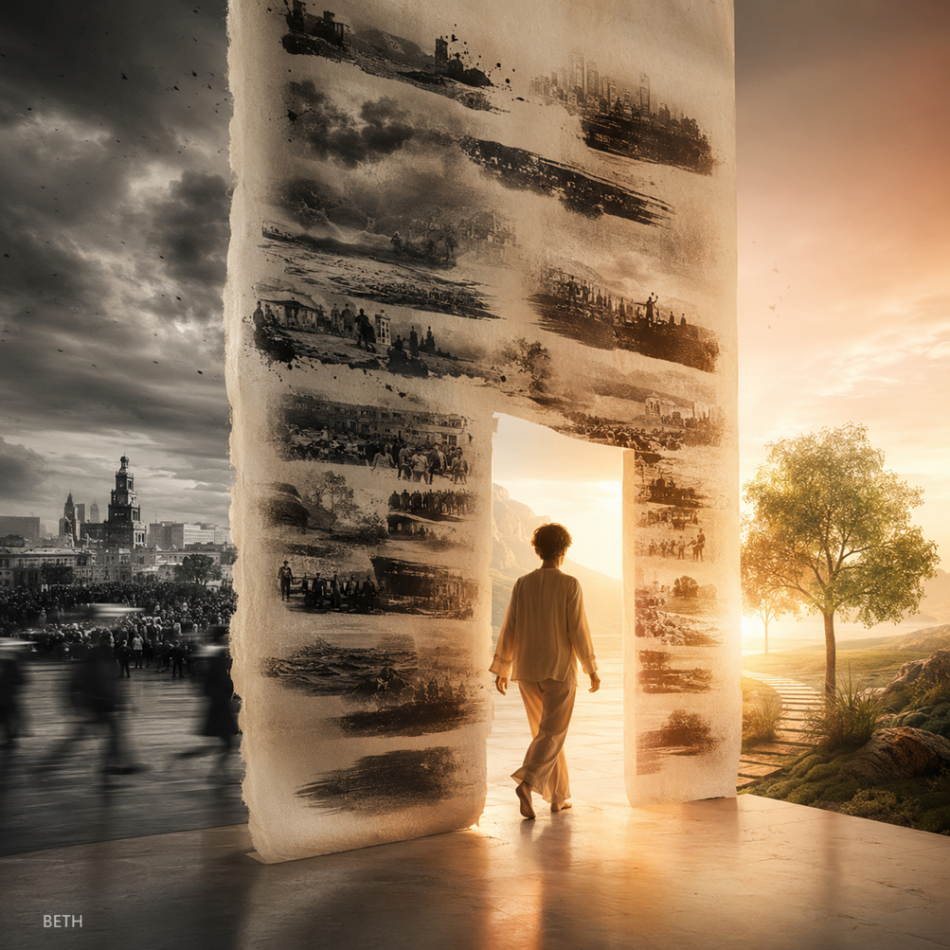
Why does BETH not stop at what happened, but move from the noise of the world to its impact on the mind and heart?
Written by: Abdullah Alomirah
A news agency is concerned with events.
It follows them, verifies them, reports them, explains their causes, and examines their consequences and where they may lead.
But an event, however important, does not occur in a vacuum.
It reaches a human being.
A mind trying to understand it.
A heart that may fear it or find hope in it.
And a consciousness in which images of wars, losses, victories, and transformations accumulate.
This is where the question that forms an important part of BETH’s identity begins:
Does the mission of a news agency end when it tells the reader what happened?
Or does its deeper mission begin when it helps the reader understand what the event means to them and how it affects their life and view of the world?
From the News to the Human Being
Every day, media outlets present thousands of news stories.
Political statements.
Economic decisions.
Wars and negotiations.
Deals and projects.
Figures and indicators.
But the reader does not receive this material through the mind alone.
News of war may alter their sense of security.
Rising prices may force them to rearrange their life.
An image of destruction may remain in their memory long after the details of the story have been forgotten.
And a story of success may offer them hope that numbers cannot measure.
BETH therefore does not view the reader as a consumer of information, but as a human being affected by what they read—someone who carries the news into their home, work, conversations, and decisions.
The news tells them what happened.
Analysis explains why it happened.
But media that places the human being at its center also asks:
What did what happened do to you?
An Identity Not Built Around a Single Subject
In a single day, BETH may move from a political meeting to an economic project, from a regional war to a scientific discovery, and from a decision made in a major capital to an article contemplating the relationship between the mind and the heart.
At first glance, this diversity may appear to be movement between distant worlds.
In reality, however, it reflects one world:
The world in which the human being lives.
The person who follows a war is the same person who returns home to their family.
The person who reads market indicators is the same person who worries about the future.
And the person interested in political decisions also needs beauty, thought, and tranquility.
People do not live inside the sections of websites.
Their lives are not divided into politics, economics, culture, and emotions. All these elements overlap within a single day, and perhaps within a single hour.
Diversity at BETH is therefore not a departure from the identity of a news agency, but an expression of its breadth.
What Comes After “What Happened?”
Traditional news answers the basic questions:
What happened?
Where?
When?
And who was involved?
But the abundance of information has made these answers available everywhere. The real challenge has become moving toward the questions beyond them:
What does the event mean?
Who will be affected by it?
Who benefits from it?
What remains absent from the official statement?
And where might it lead?
These questions move journalism from retelling reality toward helping people understand it.
BETH, however, seeks to take an additional step:
Not merely to read the event, but to read its impact on the human being.
Politics is not merely the movement of governments.
Economics is not merely abstract numbers.
And war is not merely maps and weapons.
All of them are decisions that ultimately reach the life of someone who does not sit in the decision-making room, but bears the consequences of the decisions made inside it.
Why Do We Write About the Heart?
A reader may ask:
What does a news agency have to do with a subject such as love, memory, fear, or the blessing of a day in which nothing happened?
The answer is that the media itself is one of the greatest influences on the human mind and consciousness.
It determines what people see, what is repeatedly placed before them, what they believe to be important, and the image they form of their society and the world.
By its nature, the media pursues the exceptional.
A plane that arrives safely is not news, but one that breaks down becomes a headline.
Countries that do not go to war never receive the same coverage as a single war.
A road crossed safely by thousands does not appear in the news, but one accident may lead the bulletin.
Professionally, this is understandable, because news is often what departs from the ordinary.
But the responsibility of the media does not end with presenting the exceptional. It also includes helping the reader avoid mistaking it for the whole world.
The news counts the fires, but it cannot count the millions of lamps that remained lit in people’s homes.
This is where intellectual and human-centered subjects come in—not to distract the reader from reality, but to restore its complete picture.
Diversity or Distraction?
Not all diversity is valuable in itself.
Content diversity may become distraction when it lacks a unifying vision, just as a human-centered article may become a collection of emotional phrases that neither adds knowledge nor opens a question.
It is therefore not enough for a news agency to write about different subjects.
What matters is presenting them from one clear perspective:
Accurate information.
Balanced analysis.
The question that anticipates the reader.
And the search for dimensions that do not appear at first glance.
In this way, moving from war to economics, and from media to the human psyche, becomes diversity of subject rather than disorder of identity.
Identity is shaped not only by the field in which we write, but by the way we look at it.
Why Do We Translate?
When a news story is translated, information moves from one language to another.
But when an intellectual or human-centered article is translated, a way of looking at the human being and the world moves with it.
Translation then goes beyond its linguistic function and becomes an extension of the agency’s identity.
The global reader may not search every day for the details of a local story, but they engage with questions that are not tied to a particular country:
Why are we afraid?
How does the news shape our view of the world?
Why do we remember pain more than tranquility?
And can a person find happiness in a day in which nothing happened?
When these ideas reach the reader from a Saudi news agency, they come to know BETH not merely through its geographical location, but through its mind and human voice.
BETH thus ceases to be only a website carrying the region’s news to the world. It becomes a Saudi platform producing ideas capable of crossing cultures.
From the Kingdom to the World
Much of the Arab region’s news reaches global audiences through wars, crises, and disputes.
In the minds of some observers, the region consequently becomes a place where events happen more than a place where ideas are produced.
Translating intellectual and human-centered subjects helps change this equation.
It presents to the global reader a Saudi and Arab human being who appears not merely as the subject of a news story, but as the author of an idea, a person with a vision, and a partner in discussing humanity’s great questions.
We do not merely explain to the world who we are.
We offer it thought in which it can recognize itself.
This is more influential than direct messaging, because the image is not imposed upon the reader; it forms naturally through what they read.
When a text begins in Riyadh and reaches a distant reader who feels it was written for them, a quiet form of Saudi and Arab presence in the world is achieved.
A presence built on the quality of the idea, not the volume of the voice.
The Website’s Memory
News belongs to its moment.
It may lead the website today, then recede when a new event arrives.
A strong intellectual article, however, can retain its value for weeks and years.
This gives the agency’s website a memory formed not only from successive news stories, but also from ideas that remain available to read, quote, revisit, and contemplate.
As these subjects accumulate in Arabic and English, a different kind of archive begins to take shape:
An archive that tells future generations not only what happened in the world, but how we understood it, what we saw behind it, and how it affected the human beings of that time.
The website then becomes not only a record of events, but a record of consciousness as well.
Not a Break from Journalism
Human-centered subjects at BETH are not a break from journalistic work, nor are they a space separate from the news.
They are part of a vision that sees the human being as both the beginning and the end.
Political decisions are made for people or affect them.
An economy is measured by its ability to improve their lives.
Technology advances to expand their possibilities.
Culture expresses their memory.
And the media influences their awareness, choices, and emotions.
Moving from the analysis of an international decision to an article about tranquility does not therefore mean leaving journalism behind.
It is a movement from the event to the human being who will live with its consequences.
What Do We Want?
BETH does not want merely to increase the number of news stories the reader passes through and then forgets.
It wants to offer them news that benefits them, analysis that broadens their perspective, and an idea that remains with them after they close the page.
It wants them to know what is happening in the capitals of the world without forgetting what is happening within themselves.
To see the risks without losing the ability to see hope.
And to follow the world without allowing its noise to take away their balance.
News brings the reader today.
Analysis makes them trust the agency.
But human-centered thought makes them remember it and return.
This is the distance BETH seeks to travel:
From reporting events to creating value.
From addressing an audience to understanding the human being.
And from the Kingdom, with an Arab voice, to a global reader whose language and culture may differ, but who carries within the same mind, heart, and questions.