



Saudi Tanker Targeted
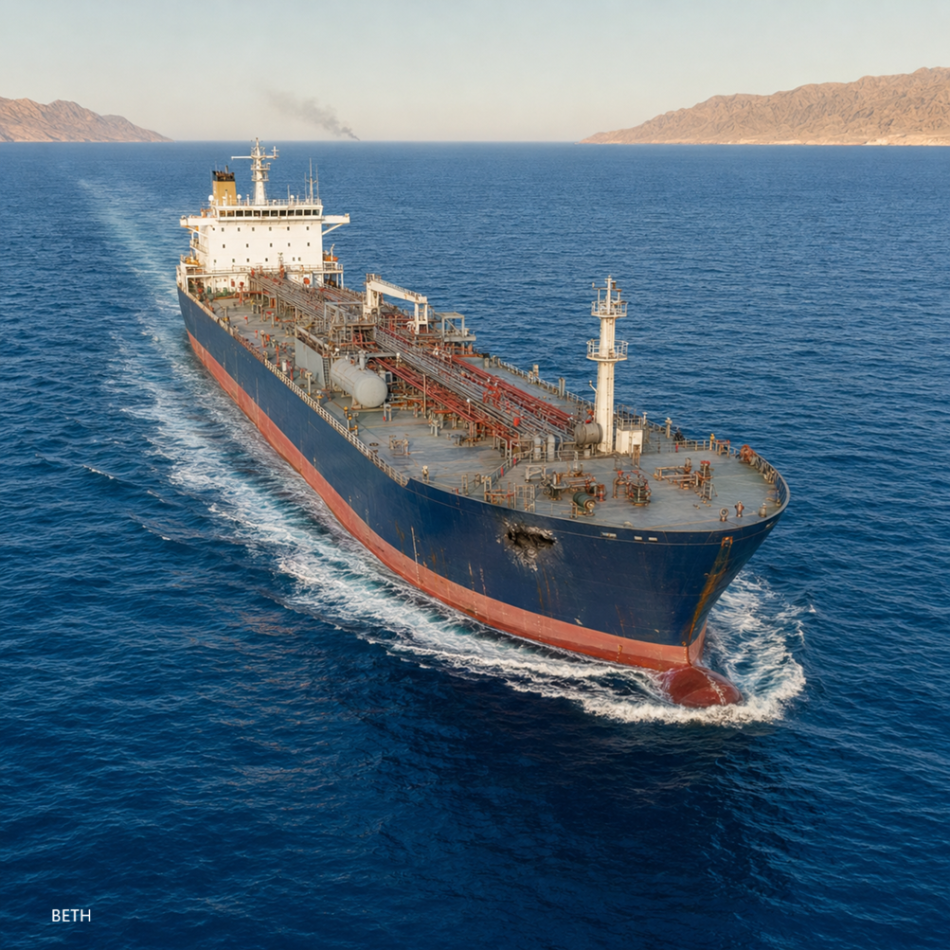
NCC MASA Continues Its Voyage After Sustaining Minor Damage as the War Shifts From Threatening Maritime Passages to Striking Commercial Vessels
Riyadh | BETH
The Transport General Authority announced that NCC MASA, operated by a Saudi company, was targeted while sailing in the Red Sea on Friday, July 24, 2026, sustaining minor damage to its hull.
The authority confirmed that the vessel and all crew members were safe, explaining that it continued towards its destination after its ability to complete the voyage safely had been verified.
It described the continued targeting of commercial vessels as a violation of international laws and conventions safeguarding maritime navigation, ships, and their crews.
NCC MASA is a Saudi chemical and oil-products tanker built in 2014. It is approximately 183 metres long, has a deadweight capacity of nearly 50,000 tonnes, and forms part of Bahri’s chemical tanker fleet.
The Incident Goes Beyond the Vessel
The significance of the incident lies in the fact that it does not represent an isolated attack on a commercial vessel, but comes as the war shifts from the Strait of Hormuz to the Red Sea and Bab al-Mandab.
After the US-Iran confrontation had centred on the Strait of Hormuz, the Houthis announced the expansion of their maritime operations and imposed what they described as a blockade on Saudi shipping, while targeting tankers and energy-related facilities.
The targeting of NCC MASA came two days after an earlier attack on another Saudi vessel in the Red Sea caused a fire, indicating a shift from declared threats to a recurring pattern aimed at testing the ability of Saudi shipping to continue operating.
No party had claimed responsibility for targeting NCC MASA when the official statement was issued. The incident therefore remains linked to the context of Houthi escalation without being directly attributed to a party that has not announced carrying out the attack.
The Vessel Continued on Its Course
The most important message in the statement is not the damage, but the continuation of the voyage.
The vessel’s continued sailing after its safety and that of its crew had been confirmed demonstrates the limited extent of the damage and the attack’s failure to disable the ship or force it to change its destination.
The vessel’s safety, however, does not diminish the seriousness of what occurred.
Repeated attacks could lead to higher insurance and shipping costs, changes to the routes of some tankers, and increased risks to energy exports and trade heading towards Asia and Europe.
When a commercial vessel is targeted, the impact does not stop with its owner or the country whose flag it flies. It extends to ports, markets, consumers, and global supply chains.
A Second Front in the War
The incident confirms the conclusion reached by the BETH report, “Day 144: The War Opens a Second Front”: the war is no longer confined to the United States and Iran, nor to the Strait of Hormuz alone.
The Red Sea and Bab al-Mandab have entered the sphere of confrontation, and Saudi vessels have become part of an attempt to expand the cost of the war and transfer pressure to another maritime passage. BETH Report
The region therefore faces a simultaneous threat to two strategic passages:
The Strait of Hormuz, through which a significant proportion of Gulf energy exports passes.
And Bab al-Mandab, which connects the Red Sea to the Gulf of Aden and the Indian Ocean.
Threatening both passages simultaneously does not merely signify the geographical expansion of the war. It represents an attempt to place global energy trade between two turbulent gateways.
After the Attack
The incident places navigation in the Red Sea before a different phase.
The question is no longer whether the Houthis are capable of threatening vessels, but whether the attacks will develop into a sustained campaign to disrupt Saudi exports and raise the cost of maritime transport.
In response, the continuation of vessel movements, the protection of maritime passages, and action against the sources of the threat will determine whether the Red Sea remains an artery of trade or becomes a permanent front in the war.
The vessel was hit, but it did not stop.
Yet the continuation of its voyage does not diminish the danger of the route. It reveals that the battle for the Red Sea has become a direct part of the war.