



Fix the Air Conditioner First
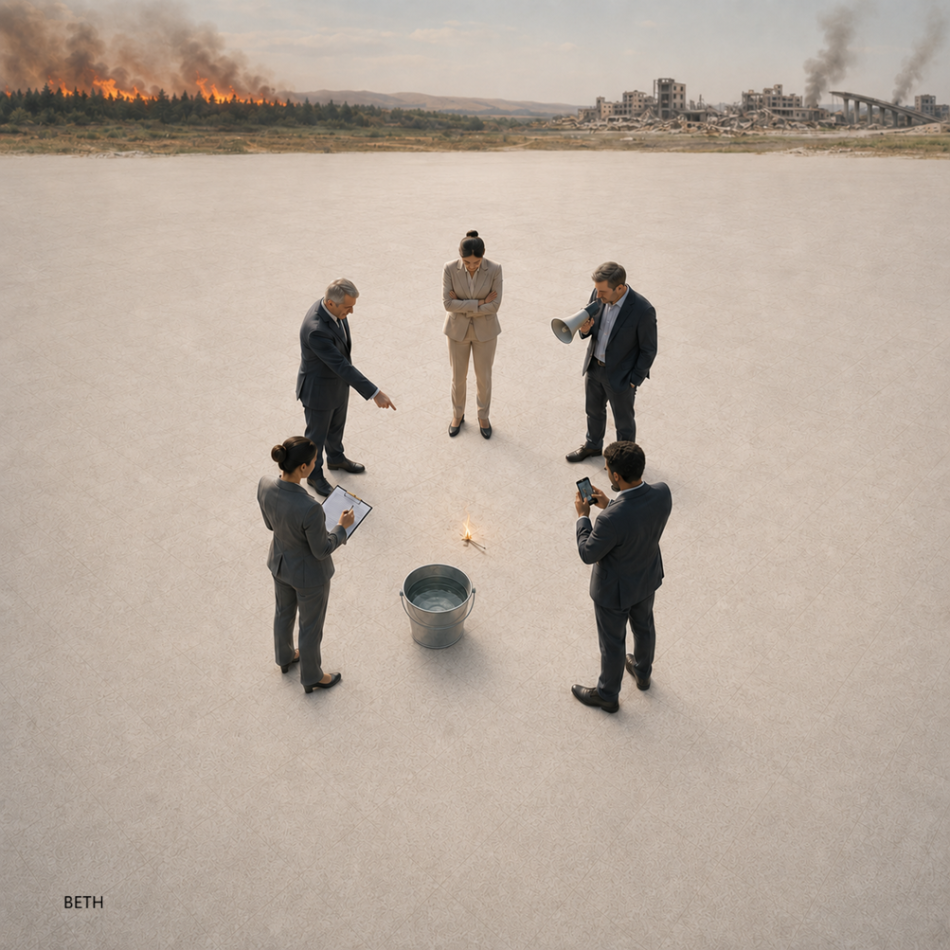
Why Are Some Leaders and Preachers Skilled at Manufacturing Fear, but Not at Creating Solutions?
Written by Abdullah Al-Omairah
Every few days, a statement comes out of Moscow or Kyiv announcing the success of another strike.
A factory destroyed.
A warehouse burned.
A refinery shut down.
A port disrupted.
And a production facility no longer capable of producing.
Images are displayed, losses are counted, and the operation is presented as a military achievement demonstrating one side’s ability to reach deep into the territory of the other.
In June, Ukraine announced that it had targeted a Russian factory producing electronic components used in missiles. In July, Russia’s largest oil refinery was attacked, forcing it to suspend operations.
Russia, meanwhile, announced operations targeting dozens of facilities inside Ukraine, including military-industrial enterprises, while strikes extended to ports, energy installations, and essential infrastructure.
Beyond the need to verify every military account, the scene itself remains worthy of reflection:
Human beings have begun boasting about their ability to destroy what took years to build.
A factory that could have produced machinery, medicine, energy, or materials benefiting human life can become a target in an instant.
A port that could have carried grain to a country in need becomes a battlefield.
Billions that could have built cities, roads, and hospitals are spent on war. Then billions more are requested to rebuild what was destroyed, if anyone remains to rebuild it.
Afterward, leaders stand before their people and speak of victory.
But what kind of victory is measured by the number of factories brought to a halt, cities plunged into darkness, and opportunities burned away?
When Destruction Becomes Heroism
The purpose here is not to equate those who start wars with those upon whom wars are imposed.
There is an aggressor and a defender. There is occupation and resistance. There is a moral and legal distinction that must not be erased beneath general appeals for peace.
Defending one’s homeland is a right, and it may become a necessity that no nation has the luxury of abandoning.
Yet even a war imposed upon a country should not become a culture that glorifies destruction, or a condition in which a leader finds his identity, glory, and continuity.
The question is not whether a nation has the right to defend itself.
The question is: Does defence remain a path toward peace, or does the continuation of war become an objective in itself?
Some leaders do not create solutions. They manufacture complications, then present themselves as the only people capable of managing them.
They do not open a road out of the crisis. They build their seats inside it.
The more complicated the crisis becomes, the greater their need for it.
They resemble gang leaders and highway robbers. They do not know how to create wealth, so they search for someone to rob. They cannot master trade, so they prefer domination. They possess no project for life, so they turn death into a project.
Theft is faster than investment.
Destruction is faster than construction.
Launching a missile is easier than signing an agreement that requires compromise, courage, and responsibility.
Not All Wars Are the Same
What is happening between Russia and Ukraine cannot be weighed on the same scale as the confrontation between the United States and Iran.
The U.S.-Iran conflict emerged from a different context, following years of intervention and threats by the Iranian regime, its use of the Islamic Revolutionary Guard Corps and armed proxies to destabilize the region, and its subsequent endangerment of navigation, energy flows, and neighboring states.
Iran does not appear here as a country searching for peace but unable to find it. It appears as a regime that maneuvers, negotiates when it needs time, and retreats when the moment of commitment approaches.
The Revolutionary Guard also appears willing to expose Iran and its people to overwhelming military force in order to protect its influence and survival.
The U.S. strikes can therefore be understood as an attempt to deter this behavior and compel Tehran to respect rules it has been unwilling to observe voluntarily.
Yet even military discipline must have a clear objective and a possible political conclusion. If deterrence becomes open-ended destruction without limits, it may itself become part of the problem.
There is a major difference between a war fought for conquest and expansion, and force used to restrain a reckless actor.
But the standard remains the same in both cases:
Does force lead to a solution, or does it produce another fire?
Why Are People Drawn to Darkness?
This tendency does not appear only in wars.
We find it in politics, media, education, administration, and even in certain religious and social discourses.
I once had a discussion with a man who practiced religion through ignorance rather than knowledge, during a period when this kind of religious thinking nearly closed in on society.
I said to him:
You put up signs that you call guidance, saying:
“If you do not pray, you will enter Hell.”
Why do you not write:
“If you pray, you will enter Paradise”?
Why is it always the fire?
Where is Paradise?
The question may appear simple, but it reveals an entire way of looking at human beings.
Some people believe that fear is the only force capable of moving others.
They frighten a child to make him obey.
They frighten an employee to make him work.
They frighten society to make it silent.
They frighten the believer to make him comply.
They frighten the voter to secure his vote.
They frighten a country to force it to concede.
Fear is a fast instrument because it speaks to the oldest human instinct: survival.
Hope requires trust.
Persuasion requires knowledge.
Construction requires time.
And a solution requires a mind willing to accept responsibility.
Some people therefore prefer the fire, not because it is better, but because it is easier to use.
Fear Grants Authority
The person who describes danger appears to know what others do not.
The person who threatens punishment appears powerful.
The person who manufactures an enemy can rally people around him.
But anyone who offers a solution must explain how it will be implemented, when its results will appear, who will bear its cost, and what will happen if it fails.
Fear requires none of that.
It is enough to tell people:
The enemy is coming.
Hell awaits you.
The conspiracy surrounds you.
If I leave, the nation will fall.
If you do not obey me, you will perish.
Leadership is thus transformed from creating the future into managing fear of it.
The preacher becomes the guardian of the fire.
The politician becomes the guardian of the enemy.
The official becomes the guardian of the crisis.
If the fear ended, they would lose a large part of their authority.
Fix the Air Conditioner
A story comes to mind that captures this entire article.
People were praying in a mosque and listening to a preacher delivering a lengthy sermon.
In the height of the summer heat, the electricity went out. The air conditioner stopped, the lights went dark, and the worshippers began to feel suffocated.
The preacher paused for a moment, then saw in the situation another opportunity to deliver a warning.
He said:
Can you feel this heat?
The fire of Hell is far more severe.
An elderly man then stood up and said:
“Go and fix the air conditioner, remind us of the blessings of Paradise, and spare us the chatter.”
The remark may sound amusing, but it contains an entire philosophy of leadership, administration, and guidance.
The preacher was skilled at describing the fire.
The elderly man was searching for a solution.
The preacher used people’s suffering to increase their fear.
The elderly man asked what had caused their suffering and how it could be ended.
The preacher took them from the heat of the mosque to the fire of Hell.
The elderly man wanted the electricity restored and the air conditioner repaired, and then to hear words that gave him hope of Paradise.
This is precisely what some leaders around the world do.
They describe the crisis.
They explain its dangers.
They warn of its consequences.
They blame others for it.
Then they ask people for more patience, fear, and sacrifice.
But they do not fix the air conditioner.
The Spark That Is Left Behind
Not every fire results from neglect, and not every war can be prevented.
But many disasters did not begin as major events.
They began as a small spark that someone saw but did not extinguish.
A limited violation that no one stopped.
A handful of criminals who tested the authority of the state and discovered that no one was watching or holding them accountable.
Gangs do not grow through strength alone. They grow through confidence in the absence of scrutiny and punishment.
They begin with a small step that meets no response, then take a larger one. Each time they escape consequences, their numbers and weapons do not merely increase. Their certainty that the road is open grows as well.
A small group becomes a gang.
The gang becomes a force.
The force becomes a threat that costs society many times more than stopping it at the beginning would have cost.
Fires do not become disasters because of flames alone.
They become disasters because of the minute that passed without anyone acting, the warning that was not taken seriously, the fault whose repair was postponed, and the spark everyone considered too small to deserve attention.
The same is true of wars.
Wars do not expand through weapons alone. They grow through accumulated and delayed mistakes, inflammatory rhetoric, neglected grievances, and agreements that no one approaches until the cost of a solution has risen.
Many crises do not become dangerous because they were powerful from the beginning, but because those who could have stopped them early decided they were too small to justify intervention.
When a fault is ignored, the wire burns.
When the wire is left unattended, the building catches fire.
Then the official arrives late, surrounded by cameras, speaking of the heroism of extinguishing a fire that might never have occurred.
True leadership is not measured by the number of fires extinguished in public, but by the number of sparks prevented from becoming fires without anyone ever noticing.
It is therefore not enough to repair the air conditioner after it stops.
The wiring must be inspected before it burns.
Who Builds Peace?
After the Second World War, Europe could have remained a prisoner of vengeance.
Millions had been killed.
Cities had been destroyed.
Hatred had accumulated across generations.
Yet France and Germany chose to link their interests through coal and steel, the two materials upon which the machinery of war depended.
They did not erase history or forget the bloodshed.
But they made another war more difficult by turning factories, markets, and investment into shared interests.
Peace was not merely a moral speech.
It was an engineering of interests.
In South Africa, Nelson Mandela could have turned his release from prison into a prolonged campaign of vengeance.
Instead, he understood that leading a state was more difficult than leading anger.
A true leader is not someone capable of starting a fire. Many people can do that.
A true leader is someone who can stand before an angry public and guide it toward a solution that may not satisfy its desire for revenge, but protects its children from another war.
Power That Does Not Build
Not every capability is power.
You may possess a missile capable of reaching a factory, yet lack an idea capable of preventing its launch.
You may be able to bring down a bridge, yet be incapable of building one between two peoples.
You may defeat an opponent in battle, then fail to create a peace in which everyone can live.
You may frighten people for years, yet remain unable to make them love what you preach.
Power that produces no life is incomplete.
Leadership that creates no solutions is not leadership, regardless of the flags, guards, and speeches surrounding it.
A leader does not deserve respect merely because he can issue an order to attack.
Any military commander can provide him with a list of targets.
True respect belongs to the leader who finds a road when every road appears closed, creates a shared interest when interests collide, and prevents war when starting it is the easier decision.
Those Who Cannot Build Paradise
Perhaps this is why some people speak so often of the fire.
Describing Hell is easier than building a road toward Paradise, even though no human being controls another person’s destiny in Paradise or Hell. That belongs to God’s judgment, mercy, and will, glory be to Him.
Those who cannot offer hope offer fear.
Those who cannot create the future create an enemy.
Those who do not know how to build a factory may boast about destroying one.
Those who cannot solve a problem turn it into a sermon.
And those who neglect a spark while it is small may later stand before the fire pretending to be heroes.
The world does not need more leaders who describe the blaze eloquently.
It does not need more preachers who speak to people about the intensity of heat while standing beside the electricity switch.
Nor does it need officials who explain a crisis until people memorize every detail, then leave it exactly as it was.
The world needs those who see the spark before it becomes a fire.
Those who know where the fault lies.
Those who have the courage to acknowledge it.
And those who know how to repair it.
Before you tell us about the power of your missiles, tell us how the war will end.
Before you boast about the factories you have destroyed, tell us about the factories you intend to build.
Before you ask people to endure more fire, open a window for them toward life.
And before you describe Hell to us once again:
Fix the air conditioner first.