



China and the Open Mind
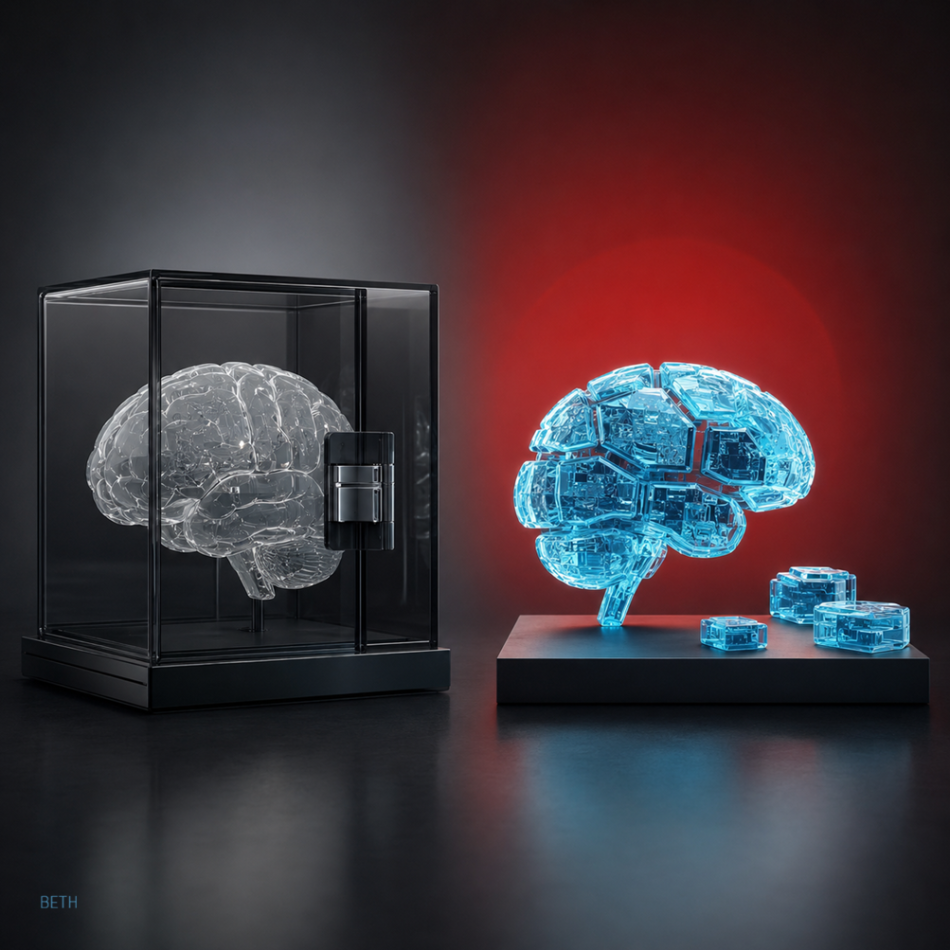
How Kimi K3 Is Attempting to Change the Rules of Global Competition and Transform AI From a Corporate-Owned Service Into a Power Others Can Build Upon
Prepared and analyzed by the Strategic Media Department – BETH Agency
Supervised by Abdullah Alomairah
In the artificial intelligence race, American companies built the world’s most advanced digital minds, then closed their doors and sold the world the right to access them.
China is now experimenting with a different path:
Approaching the capabilities of those minds, then opening their weights to the world.
This is what makes the launch of Kimi K3 by the Chinese company Moonshot AI more than a technical announcement.
With 2.8 trillion parameters and a context window of up to one million tokens, the model is not merely attempting to compete with ChatGPT and Claude in answering questions. It is designed to execute long-term tasks, write software, create websites, games, and presentations, process images and video, and manage multiple assignments through digital agents.
But the largest number in this story is not the number of parameters.
It is the number of doors that an advanced open-weight model could open for companies, countries, and developers unable to build a comparable model from scratch.
This raises the global question:
Is China using technological openness to break American dominance over artificial intelligence?
What Has China Launched?
On July 17, 2026, Moonshot AI launched Kimi K3, presenting it as the world’s largest open-weight artificial intelligence model.
The model contains 2.8 trillion parameters, making it the first open-weight model to approach the three-trillion threshold. It also features a one-million-token context window and native capabilities for understanding text, images, and video, using tools, and executing complex tasks.
Kimi K3 was designed specifically to perform three categories of work:
- Advanced reasoning.
- Long-horizon coding.
- Multi-stage knowledge work.
Official Kimi Code documentation shows that the model supports continuous reasoning, image and video input, tool use, and a context window of up to 1,048,576 tokens.
In theory, this means it can handle large software repositories, lengthy documents and studies, or a substantial number of interconnected files and information within a single task, without requiring users to divide them manually across dozens of separate conversations.
Moonshot AI says Kimi K3 can build websites, applications, and games, prepare professional presentations, perform complex knowledge work, and run parallel tasks through groups of digital agents.
Do 2.8 Trillion Parameters Mean a Smarter Mind?
In artificial intelligence, parameters are the internal variables a model learns during training. They are commonly used as an approximate indicator of a model’s scale and its ability to absorb patterns and relationships.
But size does not automatically equal intelligence.
A model may be larger while also being slower, more expensive, or less efficient in using its resources.
A model’s quality also depends on:
- The quality of its training data.
- The organization of its components.
- Training and inference efficiency.
- Its ability to distinguish accurate from inaccurate information.
- The quality of its tool use.
- Its ability to continue executing long tasks without losing sight of the objective.
- The computing power and energy required to produce results.
The figure of 2.8 trillion parameters should therefore not be read as an automatic declaration that the world’s smartest model has arrived.
It demonstrates China’s ability to build an extraordinarily large model while attempting to make that scale useful in coding, reasoning, and autonomous work.
Kimi K3 may be the largest open-weight mind by scale, but the real test is how much work it can accomplish—not how many parameters it contains.
From Assistant to Worker
The most significant transformation represented by Kimi K3 does not concern the volume of knowledge it can retrieve. It concerns the kind of relationship it seeks to establish with the user.
The first generations of artificial intelligence answered questions.
They then began producing text, images, and software.
The new generation is attempting to move from producing one part of the work to managing the entire process.
Instead of asking the model:
Write code for a website.
The user may say:
Build the website, design its interfaces, write its software, test it, identify its errors, fix them, and prepare it for operation.
Rather than merely requesting information about an economic sector, the user may ask the model to collect references, divide the research into tracks, distribute those tracks among sub-agents, analyze the results, and produce an integrated study and presentation.
Artificial intelligence then becomes closer to a digital working environment that includes a researcher, programmer, designer, analyst, and project manager.
The true transformation is not merely from a less intelligent model to a more intelligent one.
It is from a machine that talks about work to a machine that begins performing it.
What Do the Tests Show?
Moonshot AI says its new model has approached the strongest American models in some capabilities and surpassed several of them in specific tasks, particularly long-horizon coding, web-interface development, and processor optimization.
The significance of Kimi K3, however, does not depend solely on the company’s claims.
According to independent testing results reported by Reuters, the model ranked first in a benchmark evaluating web-interface development capabilities. Vals AI placed it second in an overall assessment, behind an advanced American model and ahead of several other leading systems.
Other evaluations also showed performance comparable to American models in complex, multi-step tasks.
But outperforming rivals in one benchmark does not constitute overall superiority.
A benchmark may measure coding without assessing factual accuracy, or evaluate reasoning without testing the capacity for sustained work. Results may also change when a model moves from a controlled testing environment to real-world use by institutions and companies.
Kimi K3 can therefore be said to have entered the highest tier of competition.
Claiming that it has become the world’s best model, however, would require broader independent testing and extended real-world use.
Open or Open-Weight?
There is an important distinction between an open-source model and an open-weight model.
Making the weights available means permitting access to the mathematical values that constitute the model and allowing it to be operated or modified under the terms of its license.
It does not necessarily mean fully disclosing:
- The training data.
- How the data was collected and filtered.
- Every stage of training.
- Internal engineering decisions.
- Safety and review systems.
- The model’s actual development cost.
Describing Kimi K3 simply as “open” therefore requires precision.
It is open-weight, but not necessarily open across every component of its development.
Nevertheless, access to the weights gives developers, companies, and governments greater room to operate than closed models provide. They may customize the model, run it within their own technical infrastructure, develop applications on top of it, and reduce dependence on an external service whose owner controls its terms, prices, and updates.
This is where the strategic value of openness begins.
Why Might Openness Be More Powerful Than Superiority?
An American company may retain the most intelligent model.
But an open-weight Chinese model may spread across more universities, companies, research centers, and applications.
Throughout the history of technology, the best product has not always won.
Sometimes, the winning system was the one that allowed more people to build upon it.
Every developer who uses a particular model gains expertise in its tools.
Every company that builds a product upon it becomes connected to its technology.
Every university that teaches its architecture produces a generation of engineers capable of developing it.
Every institution that integrates it into its operations expands the economic ecosystem surrounding it.
Open weights could therefore evolve from a technical option into a means of global expansion.
China may become capable of competing with the United States not by possessing the top-ranked model in every benchmark, but by making its model a foundation upon which others build.
China Is Not Opening the Mind for Free
Making a powerful model available to the world is not a technical act detached from interests.
When China offers an advanced model that companies and countries can customize, it expands the presence of its engineering, tools, and standards within global digital infrastructure.
Every application built upon the model could become part of a wider technological ecosystem connected to Chinese companies, research centers, platforms, and computing services.
This raises a question no less important than openness itself:
Does an open model liberate its users from dependence, or does it move them from reliance on a closed American platform to an open Chinese infrastructure?
There is no single answer.
A country or company capable of operating the model within its own infrastructure may achieve a greater degree of independence.
Those relying on cloud services, tools, and platforms connected to an external provider may remain within a new circle of dependence, even if the model’s weights are available.
Openness should therefore not be viewed as the absence of influence.
Openness itself may be one of the most intelligent forms of influence.
What Is the Value of an Open Mind if Operating It Requires a Fortune?
Kimi K3 faces a major paradox.
It is open-weight, but its enormous scale places the complete version beyond the reach of most individuals and small companies.
A model containing 2.8 trillion parameters requires advanced computing infrastructure, vast memory capacity, substantial energy consumption, and specialized expertise to operate and optimize.
Estimates reported by Reuters suggest that operating it locally may require computing equipment costing hundreds of thousands of dollars.
The door is therefore technically open, but the cost of entry may keep the model largely within the reach of major companies, governments, computing centers, and advanced universities.
This raises another question:
What is the value of an open mind if operating it requires a fortune?
The answer may lie in producing smaller models derived from Kimi K3, offering it through less expensive cloud services, or using technologies that allow only selected parts of it to operate at a given time.
Its global success will ultimately depend on its ability to move from a model that can theoretically be downloaded to one that can be used economically.
Why Does It Matter to American Companies?
The threat represented by Kimi K3 does not come from proving absolute superiority over American models.
It comes from the pressure it creates on three sensitive points:
Price
If Chinese models offer most of the capabilities of American systems at a lower cost, Western companies may be forced to reconsider their pricing and business models.
Distribution
Making weights available allows developers and companies to build independent products rather than remaining within a closed platform.
Narrowing the Gap
The closer an open-weight Chinese model comes to a closed American system, the more urgent the commercial question becomes:
Why should a company pay more and accept greater restrictions if an open alternative can perform most of the work?
This does not mean the end of closed models.
They may remain safer, easier to use, more stable, and better supported for institutional customers.
But they will face a competitor that does not merely sell intelligence as a service. It gives users the ability to operate and shape a version of that intelligence according to their needs.
American Restrictions and the Chinese Paradox
Kimi K3 is emerging while China faces American restrictions on access to the most advanced chips.
The assumption was that such restrictions would slow the ability of Chinese companies to train and compete with extremely large models.
Chinese developers, however, turned toward improving efficiency, developing new architectures, and searching for ways to use available computing resources more effectively.
This does not mean that the restrictions have had no effect. Computing capacity remains one of the principal weaknesses limiting the expansion of Chinese models.
But the emergence of a model of this scale shows that restrictions may not stop development. They may instead encourage the creation of different routes toward the objective.
The competition is thus shifting from a race to possess chips alone to a race over how efficiently every unit of computing power can be used.
What Do We Not Know?
Despite the considerable attention surrounding Kimi K3, several questions cannot yet be answered conclusively:
- Will real-world use reproduce the results achieved in benchmarks?
- Can the model execute long tasks without drifting away from its objective?
- What is its actual operating cost at scale?
- What are the limits of its license and openness?
- What was the nature of its training data?
- Can small companies benefit from it?
- Will smaller versions emerge while retaining most of its capabilities?
- How does it handle sensitive information, bias, and errors?
- Will it maintain its position after the next generation of American updates?
Some Chinese artificial intelligence companies have also faced previous American allegations that they used outputs from Western models to train their own systems through distillation techniques.
These allegations should be presented as disputed claims, not as conclusive evidence regarding the development of Kimi K3.
Separating technological competition from political conflict will be difficult. Artificial intelligence has become part of national security, economic power, and international influence. It is no longer an ordinary commercial product.
Where Could the Open Mind Lead?
Four potential paths are emerging:
A Global Chinese Ecosystem
Kimi K3 succeeds in attracting developers and companies, while derivative models, tools, and applications emerge around it, transforming it from a product into a technological ecosystem with a global presence.
Efficiency Defeats Scale
Operating a model of this size proves more expensive than useful, prompting the market to move toward smaller models capable of performing most tasks with greater efficiency and speed.
An American Open-Weight Response
The spread of Chinese models pushes American companies and institutions to make more advanced models available under increasingly open terms, preventing China from building the open ecosystem alone.
A Global Digital Divide
Some countries and companies choose closed American models, while others turn toward open-weight Chinese alternatives. Two global artificial intelligence ecosystems emerge, each with its own tools, standards, and interests.
The division may not be absolute. Companies and countries could use models from both sides.
Competition, however, will intensify around the most important question:
Who will establish the underlying infrastructure upon which global artificial intelligence operates?
Who Owns the Future?
Kimi K3 does not represent a declaration of Chinese victory in the artificial intelligence race.
Nor is it conclusive evidence that open-weight models will outperform closed systems.
It does, however, show that the rules of the race are changing.
The question is no longer:
Who owns the most intelligent model?
It is:
Who can distribute its intelligence across the world and persuade companies, countries, and developers to build their futures upon it?
The United States may retain the most powerful digital minds.
China, however, is attempting to make its own mind accessible to a larger number of users.
Throughout the history of technology, the winner has not always been the one who created the best tool.
Sometimes, the winner was the one who persuaded the world to use it.
Conclusion
The strength of Kimi K3 does not lie solely in its scale, a benchmark result, or the fact that it is a Chinese model approaching its American competitors.
Its true strength lies in the idea it represents:
Artificial intelligence may not remain a centralized service owned by a handful of companies. It could become an infrastructure that institutions, countries, and developers can modify and build their own systems upon.
Openness, however, does not eliminate questions of cost, control, trust, and influence.
The mind may be open-weight, but it still needs computing centers capable of operating it, data to feed it, companies to develop it, and governments to determine the terms under which it enters their economies and institutions.
China is therefore not merely opening a model.
It is opening a new struggle over who owns the mind, who can operate it, and who will set the rules through which it thinks and works.
The strength of Kimi K3 may not be that it is the largest open-weight mind in the world, but that it is attempting to open the world to the Chinese mind.
What Does This Mean in Practice?
For Individuals
It means the emergence of more capable tools for research, coding, website design, and presentations, at prices that may decline as competition intensifies.
Ordinary users will not need to operate the full model on their own devices. They will most likely access it through Kimi’s platform or services that integrate it into their applications.
For Companies
It means the availability of an alternative that can be customized and connected to corporate data and systems instead of relying entirely on a closed American model.
Operating the complete version, however, requires expensive computing infrastructure and specialized expertise.
For Developers
It means greater room to build applications and derivative models, with more control and customization than closed services generally permit.
For Governments and Institutions
It creates an opportunity to build more independent artificial intelligence systems.
But it also raises questions about data security, the origin of the technology, operating costs, and the possibility of moving from dependence on American companies to dependence on Chinese infrastructure.
In Brief
Kimi K3 will not transform an individual’s phone tomorrow, but it may change the tools operating behind applications, companies, and institutions, pushing artificial intelligence to become more powerful, less expensive, and more customizable.
The potential benefit is a wider range of choices. The challenge is determining who owns the technology, the data, and the infrastructure that operates it.
In one sentence:
The closed American model gives you the right to use intelligence; the Chinese open-weight model gives you the opportunity to operate it, modify it, and build upon it.