



Crown Prince Discusses Latest Developments in Lebanon
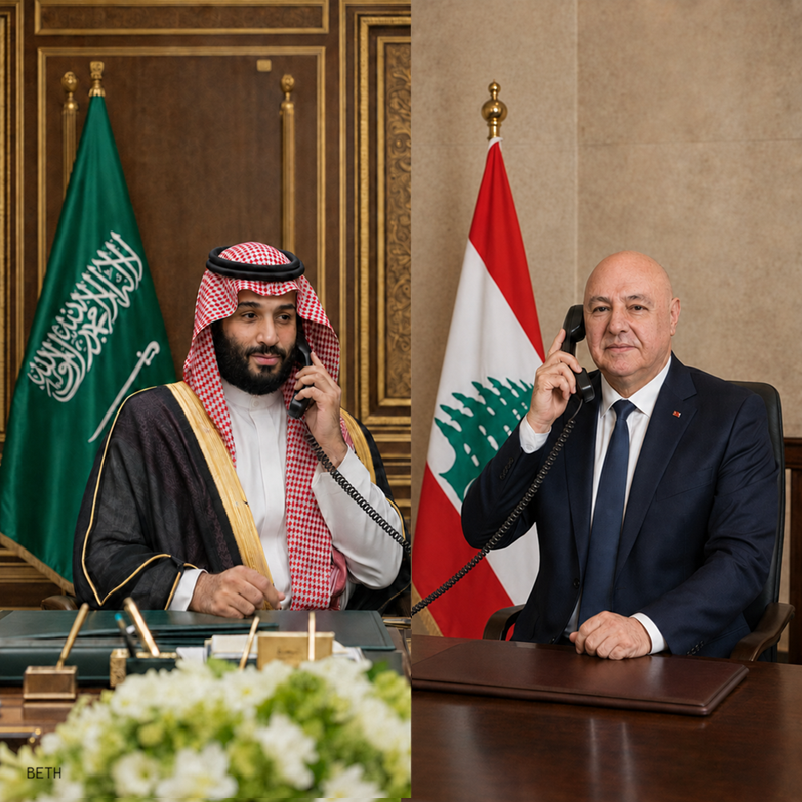
A phone call with President Joseph Aoun reviews regional developments and efforts to enhance security and stability
Bth | B
Jeddah, 6 Safar 1448 AH, corresponding to July 20, 2026
His Royal Highness Prince Mohammed bin Salman bin Abdulaziz Al Saud, Crown Prince and Prime Minister, received a telephone call from His Excellency President Joseph Aoun, President of the Lebanese Republic.
During the call, they reviewed the latest developments in Lebanon and the region, as well as the efforts being made to enhance security and stability.
The Lebanese president expressed his profound appreciation for Saudi Arabia’s supportive positions toward Lebanon and for its efforts to achieve stability and peace in the region.
Analysis
A Call from Washington
The phone call acquires political significance from its timing. President Joseph Aoun is currently in Washington, where he met U.S. Secretary of State Marco Rubio and is expected to meet President Donald Trump, in the first visit by a Lebanese president to the White House in nearly two decades.
The visit focuses on consolidating the ceasefire, implementing the framework agreement, pressing for the withdrawal of Israeli forces, deploying the Lebanese army, extending the state’s authority, and addressing the issue of Hezbollah’s weapons.
Although the statement did not officially link the call to the Washington visit, its timing allows it to be read as consultation with the Crown Prince and an effort to keep the Kingdom informed about the Lebanese initiative and Aoun’s discussions with the U.S. administration.
The Need for Arab Support
The Lebanese president recognizes that any understanding formulated in Washington requires domestic acceptance, Arab backing, and political and economic support to help the state implement it.
Saudi Arabia is at the forefront of the countries capable of providing this depth, given its Arab and international weight and its position that support for Lebanon should be tied to the establishment of a state capable of protecting its sovereignty and extending its authority across all its territory.
From this perspective, Aoun’s praise for the Saudi positions can be read as confirmation of Beirut’s desire for the Kingdom to be present during the coming phase of stabilization and recovery, rather than remaining distant from postwar arrangements.
Between Riyadh and Washington
Washington can exert pressure on Israel and sponsor the implementation of the agreement, but Lebanon’s stability also requires Arab support, assistance for the army and state institutions, and political confidence that could later open the doors to recovery, investment, and reconstruction.
The call may therefore carry two parallel messages:
The first is directed to Riyadh: Lebanon appreciates the Kingdom’s role and looks forward to its continued support during the next phase.
The second is directed to Washington: Lebanon’s initiative is inseparable from its Arab depth, and any sustainable settlement requires the Kingdom’s support.
Conclusion
On the surface, the call concerned the latest developments and appreciation for Saudi Arabia’s positions, but its timing opens the door to a broader political reading.
The Lebanese president is negotiating in Washington over security, withdrawal, and the extension of state authority, while appearing equally keen to consult the Kingdom and keep it informed about his initiative.
An agreement may begin in Washington, but consolidating its results in Lebanon will require Arab support, of which Saudi Arabia remains the most important source.